


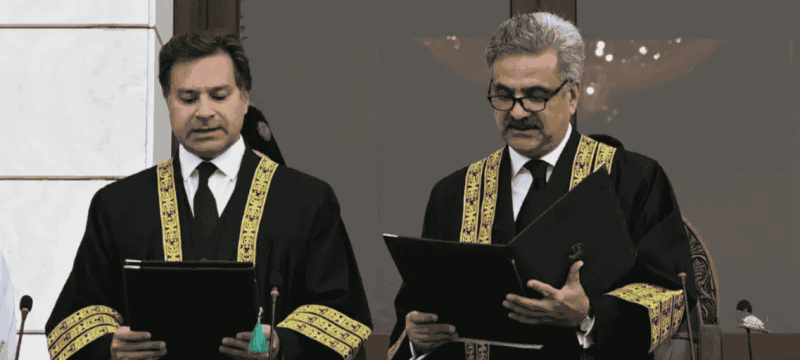
Justice Miangul Hassan has officially been appointed as a permanent judge of the Supreme Court after months of serving in an ad hoc capacity. The decision came during a meeting of the Judicial Commission of Pakistan (JCP) held on Tuesday. The session was chaired by Chief Justice of Pakistan Yahya Afridi and marked the commission’s first gathering since the approval of the 27th Constitutional Amendment and the formation of the Federal Constitutional Court (FCC).
Justice Miangul Hassan was earlier elevated from the Islamabad High Court before being temporarily posted to the apex court in February. His permanent appointment is seen as a key development amid several major judicial changes in recent months.
During the same session, the JCP also approved the elevation of Justice Zafara Ahmed Rajput as chief justice of the Sindh High Court and Justice Kamran Mullahkhail as chief justice of the Balochistan High Court. Both posts were filled after reviewing candidates from among the most senior judges of the respective courts.
The meeting also highlighted the impact of the recent constitutional changes. With four Supreme Court judges joining the newly established FCC and two others resigning, the total strength of the Supreme Court has now dropped from 24 to 18 judges.
The session was attended by senior judges, government officials, and parliamentary members, including FCC Chief Justice Aminuddin Khan, Justice Munib Akhtar, Justice Syed Hasan Azhar Rizvi, Justice Aamer Farooq, Attorney General Mansoor Usman Awan, Law Minister Azam Nazeer Tarar, and Pakistan Bar Council nominee Ahsan Bhoon. Lawmakers Farooq Hamid Naek, Syed Ali Zafar, Sheikh Aftab Ahmad, and Gohar Ali Khan were also present.
In addition to Justice Miangul Hassan’s confirmation, the meeting reflected broader changes in judicial bodies. Justice Jamal Khan Mandokhail was added to both the Supreme Judicial Council (SJC) and the Practice and Procedure Committee, while FCC’s Justice Aamer Farooq became a new member of the JCP.
These reforms continue to shape the structure of judicial oversight. The SJC remains the top body for judicial accountability, the Practice and Procedure Committee manages bench formation and scheduling, and the JCP oversees appointments across the higher judiciary.
In other news read more about: Supreme Judicial Commission Schedules Key Meetings On Judicial Appointments