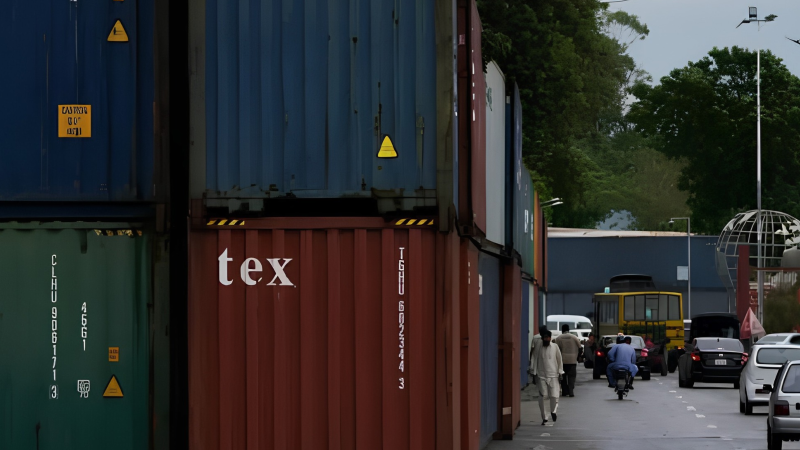
Most capitals get a skyline. Islamabad gets a skyline and, every few months, a wall of steel boxesShipping containers lined up along streets or placed across key routes have become a familiar sight in Islamabad whenever a protest is expected. The latest round came ahead of the PTI march demanding the release of jailed former Prime Minister Imran Khan. Transport associations and officials put the number of containers barricading the roads at between 1,500 and 2,000. Locals have a name for the result: “Containerabad.”
The containers raise a bigger question: when the state wants something badly enough, it can assemble trucks, cranes, cash and manpower on a very large scale. Why is that kind of mobilisation so rare for the things citizens ask of it?
A City Sealed for Weeks
The latest barricades have been up for a long time. Al Jazeera reports they had been in place for nearly four weeks as the government tried to block the opposition march on the capital. Reports also suggest that PTI says its October 4 march is still on, even as the government opens talks.
This is not new. In August 2024, while hearing a PTI petition at the Islamabad High Court, then-Chief Justice Aamer Farooq remarked that authorities had turned the capital into a “container city,” . The same tactic appears in 2017 reporting on the Tehreek-e-Labaik sit-in, which describes roads blocked with shipping containers and hours-long traffic jams. It also appears in coverage of the March 2009 protests over the restoration of sacked judges. Those episodes span different governments and different protesting groups, and the playbook barely changes.
What the Containers Cost
Nobody agrees on the bill. Islamabad police reportedly sought about 820 million rupees ($2.9m) for a week of security arrangements around the march. With the march delayed, officials now expect the total to top 1 billion rupees ($3.6m). One estimate puts the daily rental for more than 1,500 containers at 46.5 million rupees ($167,000).
For comparison, in a March 2025 written reply to the National Assembly, Interior Minister Mohsin Naqvi disclosed 1.35 billion rupees ($4.9m) spent on law-and-order deployments in Islamabad over five years. That reply excluded the period covering the 2024 PTI protest, and the word “container” never appeared in it. State Minister for Interior Talal Chaudhry told Al Jazeera that container rentals are not necessarily recorded as a separate protest-spending category and are traceable through official accounts. The figures are not like-for-like, but the lack of an itemised public breakdown makes the true cost hard to see.
The Government’s Side
The state rejects the idea that this is overreach. State Minister for Interior Talal Chaudhry says the preparations rest on intelligence assessments, and that Islamabad, as the federal capital, often puts precautionary security arrangements in place well in advance. He also says rentals are documented and paid through official accounts. He argues that renting containers avoids the permanent cost of buying, storing and maintaining a fleet.
Other officials point to PTI’s past conduct. Information Minister Attaullah Tarar said last week that PTI has a track record of disruption and vandalism during protests, and that its supporters would not be allowed into the capital, per AP. Arab News notes that federal authorities cite past unrest, including a November 2024 march on Islamabad that ended in deadly clashes. PTI says its march will be peaceful. AP reports that police have positioned containers along key routes leading to the Red Zone, home to parliament, government offices and foreign embassies. Protecting that zone is a legitimate concern, and it is the case the state makes.
Who Actually Pays
The people who dispute the “properly paid” account are the truck owners and drivers.
Owais Chaudhry of the All Pakistan Goods Transport Owners Association says a truck-and-container combination idles at a loss of 30,000 to 40,000 rupees ($108 to $144) a day. He says no compensation has been paid, and that no transporter has ever been compensated for past protests. The government disputes this and says any legitimate outstanding claim will be settled. AP also reports that authorities say they pay rent to container-truck owners, while some drivers say police stopped them, seized their vehicles and took their keys. Separately, transporters told Reuters (via Arab News) that police took over more than 2,000 vehicles in September, many held for days with little or no compensation.
The foreign-exchange angle is easy to miss. A Karachi-based customs agent reports that most of the roughly 2,000 stuck containers belong to foreign shipping lines, each accruing $150 to $300 a day in penalties. In his words, Pakistan has only shipping agents and no shipping line of its own, so those dollars go out of the economy. That is one expert’s estimate, not an official figure.
Ordinary residents also bear the cost. Even where roads stayed open, the preparations narrowed lanes and created long lines of vehicles. One commuter said roadblocks force him to travel farther at a time when fuel prices have almost doubled, a rise he attributed to US-Iran tensions rather than the containers. In earlier episodes, ambulances were reported stuck on Murree Road in Rawalpindi in October 2021 because containers sealed it, and schoolchildren had to walk to school.
The Hidden Economics of a Closed Capital
The direct costs are only part of it. Sajid Amin Javed of the Sustainable Development Policy Institute says the full cost goes well beyond rental, because the signal sent to investors, businesses and tourists carries a cost too. Researcher Danyal Adam Khan notes that Islamabad and Rawalpindi together form the country’s third-largest metropolitan area, so a shutdown cuts off people from distant provinces as well.
The Bottom Line
Containers are not the problem on their own. Every state has security costs, and the government has a real duty to protect the capital. The sharper question is one of priorities and accountability. When the state wants to secure the capital, it can assemble well over a thousand heavy steel containers, cranes, police and a budget expected to top a billion rupees, and keep them in place for weeks. Meanwhile, the transporters whose vehicles were taken say they have received no payment or written terms, a claim the government disputes. Until protest-season spending is itemised and transparent, “Containerabad” will keep being both a joke and an accusation.
Sources
Al Jazeera, Oct. 2, 2026, “‘Containerabad’: Pakistan’s capital and truckers bleed money amid lockdown” — https://www.aljazeera.com/features/2026/10/2/containerabad-pakistans-capital-and-truckers-bleed-money-amid-lockdown
AP, Sept. 29, 2026, “In Islamabad, shipping containers on the streets signal a protest is imminent” — https://baynews9.com/fl/tampa/ap-top-news/2026/09/29/in-islamabad-shipping-containers-on-the-streets-signal-a-protest-is-imminent
Arab News (with Reuters), “Pakistan’s PTI party says Oct. 4 march to go on as restrictions disrupt freight” — https://www.arabnews.pk/pakistan/pakistans-pti-party-says-oct-4-march-to-go-on-as-restrictions-disrupt-freight-3002961
Gulf News, “Pakistani police fire tear gas at protesters blockading capital” — https://gulfnews.com/amp/story/world%2Fasia%2Fpakistan%2Fpakistani-police-fire-tear-gas-at-protesters-blockading-capital-1.2130144
VOA via GlobalSecurity, 2009 — https://www.globalsecurity.org/wmd/library/news/pakistan/2009/pakistan-090315-voa01.htm
The Pak Banker, “Lahore, twin cities partially shut down” — https://www.pressreader.com/pakistan/the-pak-banker/20211023/281865826675220