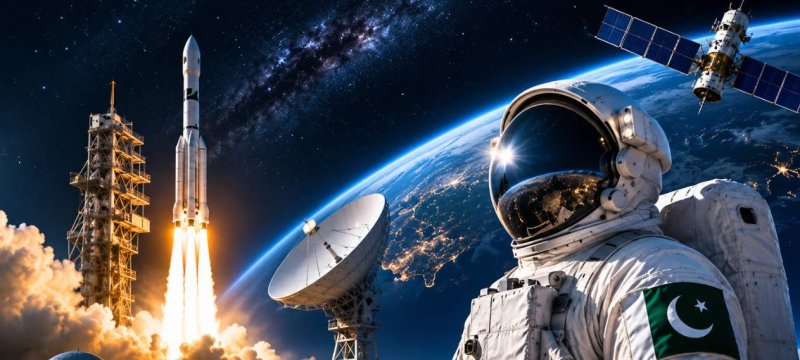
ISLAMABAD — Pakistan will observe November 25 as National Space Mission Day every year, Information Minister Attaullah Tarar announced Wednesday, cementing a permanent tribute to the country’s entry into human spaceflight as its first astronaut, Muhammad Zeeshan Ali, arrived at China’s Tiangong space station.
The declaration came during the inauguration of the Kehkashan Mission Control Centre in the federal capital, a temporary facility established to track and celebrate Ali’s mission and to bring space science closer to the Pakistani public.
A Historic First for Pakistan and the Region
Ali, a 40-year-old wing commander in the Pakistan Air Force, lifted off aboard China’s Shenzhou-24 spacecraft from the Jiuquan Satellite Launch Centre on Wednesday morning, becoming the first Pakistani to reach orbit and the first foreign national to board Tiangong . The spacecraft docked with the station roughly three and a half hours after launch, where Ali joined Chinese commander Tang Hongbo and flight engineer Wu Yi .
His week-long stay will involve conducting Pakistani-designed scientific experiments in microgravity, including research on microalgae as a potential oxygen and nutrient source for long-duration missions, and the durability of composite materials under extreme space conditions . The mission has been framed by officials in both countries as a milestone in a space partnership dating back to the early 1990s .
Kehkashan Centre Opens to the Public
The Kehkashan Mission Control Centre, situated at the Pakistan-China Friendship Centre, will remain operational for four days, offering visitors documentaries on space science, a SUPARCO exhibition stall, and displays featuring photographs of Ali . Tarar said the facility was established within a short timeframe through coordinated efforts across government departments.
Speaking at the inauguration, the information minister described the centre as a symbol of Pakistan’s resolve to advance its space programme and praised the contributions of SUPARCO, scientists, and supporting institutions. He also acknowledged the role of Pakistan-China cooperation in enabling the mission, calling Ali’s participation a reflection of the “strong partnership” between the two nations .
Public Engagement and Scientific Outreach
SUPARCO, the national space agency, has launched a complementary online portal allowing the public to track the space station’s passes over Pakistani cities including Islamabad, Lahore, Karachi, Quetta, Peshawar, Gilgit, and Muzaffarabad . The Mission Hub also provides mission timelines, educational materials, and a channel for citizens to send goodwill messages to the astronaut.
The decision to mark November 25 annually is expected to institutionalise public interest in space science, particularly among students. Analysts cited by state media described Ali’s flight as a defining moment for a nation of more than 240 million people, with space technology experts calling it an inspiration for young Pakistanis considering careers in astronomy and aerospace .
A New Chapter in Pakistan-China Space Ties
Ali’s mission traces its origins to a bilateral astronaut cooperation agreement signed in February 2025. He was selected from an initial pool of candidates and underwent seven months of intensive training in Beijing, including Chinese language instruction, spacecraft systems, and emergency procedures . Prime Minister Shehbaz Sharif, in a social media post, called the flight “living proof of the ironclad friendship between Pakistan and China” .
In other news read more about: ‘Beyond the Stars’: Pakistan Releases Patriotic Anthem to Celebrate Space Milestone
For Pakistan, the achievement represents more than a single mission. It positions the country among a small group of nations whose citizens have reached space and opens avenues for deeper collaboration with China on future lunar and scientific projects. Tarar indicated that the annual observance would serve as a recurring reminder of that ambition — and of the scientists and institutions whose work made it possible.