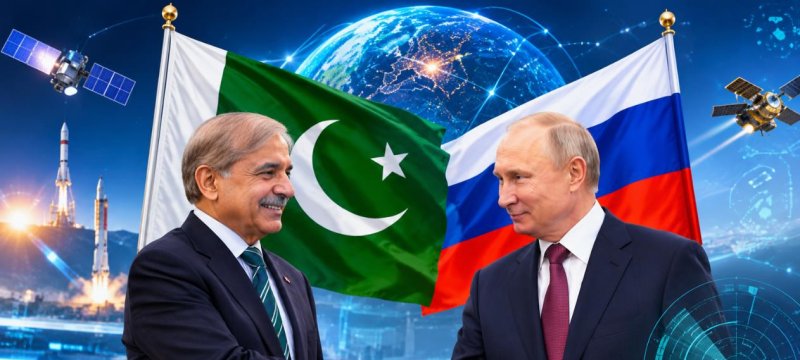
ISLAMABAD — Russia has offered to share some of its most closely held space expertise with Pakistan, a move that could give Islamabad a rare opening into satellite navigation, communications, and even human spaceflight technology.
Russian Energy Minister Sergei Tsivilev made the offer in Moscow on Tuesday, telling reporters that both countries had prepared a set of documents on space cooperation ready for signing when their leaders meet . The proposal covers satellite navigation, global communications, Earth observation, and crewed spacecraft operations .
The timing is notable. The announcement came on the sidelines of the 11th Pakistan-Russia Intergovernmental Commission, where the two countries signed a sweeping economic cooperation programme running through 2030 . Space was not the headline item at that meeting, but it may be the one with the longest reach.
What Russia Is Actually Putting on the Table
Tsivilev was specific about the areas where Moscow is willing to share. Satellite navigation and communications sit at the top of the list, alongside remote sensing of the Earth and human spaceflight . He described Russia as “a leading space power” with “unique experience, a robust scientific and technical foundation, and expertise in the exploration of outer space” .
For Pakistan, the most immediately useful element is likely Earth observation. Remote sensing data has practical applications in agriculture, disaster management, and urban planning—areas where Pakistan has pressing needs and limited indigenous capability . Satellite navigation cooperation could also support transport and logistics infrastructure, though the documents do not specify whether this involves Russia’s GLONASS system.
Human spaceflight cooperation is the most ambitious item on the list. Pakistan has sent one astronaut to space, but that was aboard a US shuttle in 1985. A Russian pathway would be a different route entirely, and one that comes with significant technical and financial hurdles.
The specific terms, timelines, and financial arrangements remain undisclosed. Tsivilev said only that the documents would be signed “during the meeting of our heads of state,” without offering a date .
The Economic Framework Behind the Offer
The space proposal sits within a much larger package. At the same Moscow meeting, Pakistan’s Energy Minister Awais Ahmad Khan Leghari and Tsivilev signed the IGC Protocol and a Programme for Economic Cooperation covering 2026 to 2030 .
That programme sets a target of $5 billion in bilateral trade by 2030 and identifies energy, agriculture, transport, education, and science and technology as priority areas . It also includes provisions for a joint feasibility study on a free trade agreement with the Eurasian Economic Union, cooperation on LNG supplies, and a pilot cargo train route to Russia .
The space documents are separate from this economic programme but fit the same pattern: Moscow is broadening its engagement with Islamabad beyond the traditional energy and defence sectors.
What Pakistan Gets—and What It Doesn’t
The offer comes with obvious limits. Russia is sharing expertise, not hardware. There is no mention of satellite launches, joint manufacturing, or technology transfer in the documents described so far. Pakistan’s space agency, SUPARCO, has its own satellite development programmes, but cooperation with Russia would be a supplement rather than a substitute for indigenous capacity.
There is also the question of delivery. Pakistan and Russia have announced ambitious cooperation before, only to see momentum stall. The space documents are prepared but unsigned, and the leaders’ meeting where they would be formalised has no confirmed date.
What is clear is that Russia sees Pakistan as a willing partner at a moment when Moscow’s traditional space relationships have narrowed. For Pakistan, the offer is a chance to diversify its technological partnerships at a time when its space ambitions—including a planned lunar mission and expanded satellite coverage—require exactly the kind of expertise Russia is offering to share.
In other news read more about: Pakistan Declares November 25 as National Space Mission Day to Celebrate Historic Milestone
Whether that translates into anything beyond a signed document depends on what happens when the two leaders finally meet.