


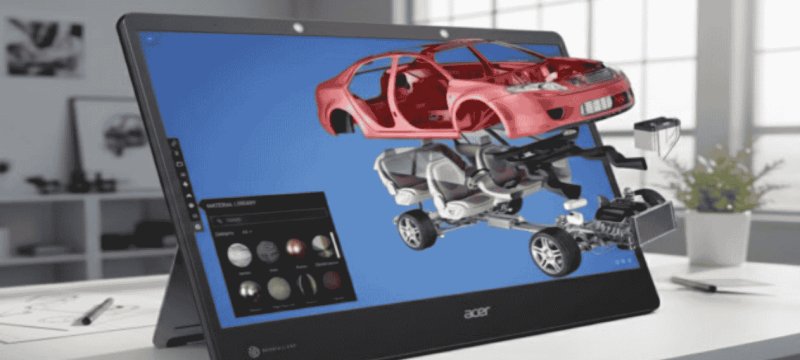
Chinese researchers develop a breakthrough display technology that delivers highly immersive 3D experiences without the need for glasses or headsets.
The new system, called EyeReal, allows viewers to enjoy 3D visuals on desktop-sized screens. Users can see objects, like cars in a race, seemingly leap out of the screen while maintaining the 3D effect from different angles.
This innovative technology uses artificial intelligence to dynamically optimize visuals based on eye movements. The AI ensures smooth and natural 3D effects across a 100-degree field of view, overcoming limitations of earlier systems. Traditional glasses-free 3D displays offered only small viewing angles or required complex hardware.
Chinese researchers develop EyeReal using a simple stack of three standard LCD panels. This approach makes the technology more feasible for consumer applications, offering full HD resolution at 1,920 x 1,080 pixels and a refresh rate above 50 frames per second.
The project was led by experts at Shanghai AI Laboratory and Fudan University. According to their study published in Nature, the system could transform 3D experiences in gaming, virtual reality, educational tools, and 3D design. Users can move naturally in front of the screen without losing the 3D effect, a key advancement over prior technologies.
Analysts believe this AI-powered display could eventually find its way into classrooms, offices, and home setups, providing interactive and realistic visual experiences. The simplicity of the setup also suggests potential for broader adoption in consumer electronics.
With this innovation, Chinese researchers develop a new pathway for immersive visual technologies. Their work demonstrates how AI can enhance display systems, creating glasses-free 3D environments that were previously impossible on larger screens.
The breakthrough marks a significant step forward for 3D visualization and highlights the potential for AI-driven displays in both professional and personal settings.
In other news read more about: Chinese Scientists Develop Infrared-Detecting Contact Lenses