

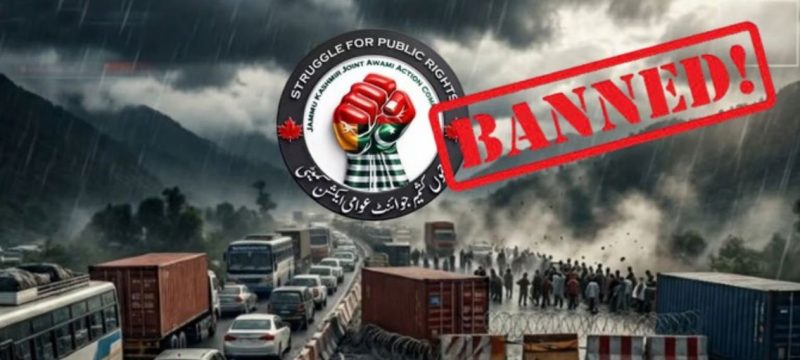
Authorities in Azad Jammu and Kashmir (AJK) have declared the Jammu Kashmir Joint Awami Action Committee (JKJAAC) a banned organization under anti-terrorism laws. The decision marks a significant development in the region’s ongoing political and social landscape.
According to an official notification, the Jammu Kashmir Joint Awami Action Committee, along with associated names including “Jammu Kashmir Action Committee” and “Joint Awami Action Committee,” has been added to the First Schedule of the Anti-Terrorism Act 2014. The move was approved by the President of AJK.
The ban criminalizes support, association, or activities linked to the organization. Authorities stated that the action followed intelligence reports suggesting the group’s involvement in activities that could threaten public peace and security. Officials also alleged that the group had contributed to unrest and actions that disturbed law and order.
The development has sparked debate across Jammu Kashmir, where JKJAAC had emerged as a major grassroots movement in recent years. Supporters describe the organization as a platform advocating for economic relief and governance reforms. Critics, however, support the government’s concerns regarding public safety and stability.
The movement gained momentum in 2023 amid rising public frustration overinflation, expensive electricity bills, and increasing food costs. Traders, students, lawyers, transporters, and civil society members joined forces under a shared demand for economic reforms.
Unlike traditional political parties, JKJAAC operated as a coalition representing different social groups. It focused on issues affecting ordinary citizens across Jammu Kashmir, particularly concerns related to electricity tariffs, subsidized wheat prices, and the rising cost of living.
The group later expanded its agenda to include governance reforms. Its demands included reducing government expenditures, strengthening anti-corruption measures, and increasing local control over resources. It also called for a review of political representation systems within the region.
By 2024, JKJAAC had transformed into a powerful protest movement. Demonstrations, strikes, and shutdowns affected daily life in several areas. Government negotiations reportedly resulted in subsidy packages and temporary agreements.
However, tensions resurfaced in 2026 when JKJAAC accused authorities of failing to implement previous commitments. Fresh protests were announced, leading to renewed concerns over stability in Jammu Kashmir.
In other news readmore about:AJK Government Imposes Ban On JKJAAC Amid Security Concerns
Officials maintain that the ban was necessary to preserve public order. Meanwhile, critics argue that it represents a major escalation in the state’s relationship with one of the region’s most influential civil society movements. Regardless of differing opinions, JKJAAC has had a significant impact on public discourse and political engagement in Azad Jammu and Kashmir.