Gilgit-Baltistan government has introduced a new healthcare initiative that aims to provide free outpatient medical services to around 67,000 deserving residents.
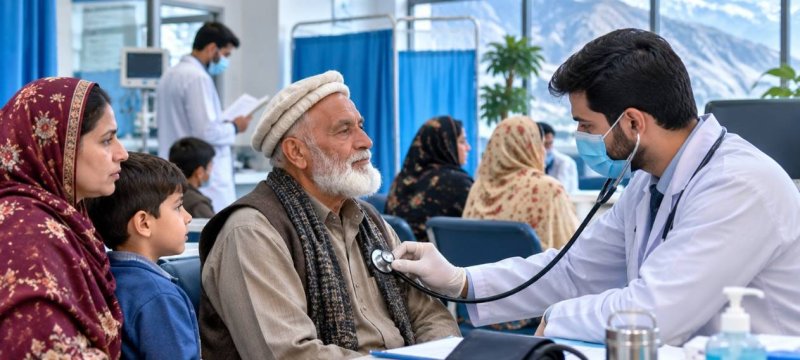
The programme, called the Sehat Hifazat Card scheme, will help low-income families access medical consultations, diagnostic tests and prescribed medicines without facing the full financial burden.
The initiative is being launched with financial support from Germany through its state-owned development bank, KfW. Gilgit will be the first area covered under the pilot project, while authorities plan to extend the scheme to other districts in later phases.
Gilgit-Baltistan Chief Minister Amjad Hussain distributed Sehat Hifazat Cards among deserving residents during a launch ceremony at Gilgit on November 1, 2026.
The project is expected to improve access to basic healthcare and provide financial assistance to families struggling with medical expenses.
The new Sehat Hifazat Card initiative is an outpatient health insurance programme developed through cooperation between the Gilgit-Baltistan government and Germany.
Its main purpose is to cover essential OPD services, including doctor consultations, medical examinations and medicines for eligible individuals.
The project has an estimated budget exceeding Rs407 million. Under the announced funding arrangement, KfW will contribute 90 percent of the total cost, while the Gilgit-Baltistan government will provide the remaining 10 percent.
Around 67,000 residents are expected to benefit from the initial phase in Gilgit.
The programme primarily targets financially disadvantaged families who cannot easily afford routine medical treatment.
Although the government has identified the expected number of beneficiaries, detailed information about registration, eligibility conditions and individual coverage limits has not yet been made publicly available.
Residents should contact the Gilgit-Baltistan Health Department for verified information about card distribution and access to medical services.
Speaking at the launch ceremony, Chief Minister Amjad Hussain appreciated Germany’s support for improving healthcare facilities in the region.
He said the government wanted to develop a universal healthcare system that could provide affordable medical services to people across Gilgit-Baltistan.
The chief minister also highlighted the importance of improving hospitals, strengthening medical facilities and addressing the shortage of qualified doctors.
In another healthcare-related development, the Gilgit-Baltistan government is planning cooperation with the Sindh government to facilitate free medical treatment for deserving patients.
The proposed arrangement could allow eligible residents to receive specialised treatment at major hospitals in Sindh.
This initiative aims to help patients who require advanced medical facilities that may not be available in their local areas. However, details about participating hospitals and the treatment process have not yet been announced.
The chief minister also discussed plans to improve medical education in Gilgit-Baltistan.
He announced that classes at the proposed medical college are expected to begin next year. The institution is expected to create opportunities for local students and help address the shortage of medical professionals in the region.
Meanwhile, the Sehat Hifazat Card programme will initially operate as a pilot project in Gilgit. Authorities intend to assess its performance before extending coverage to additional districts.
The initiative, backed by German financial assistance, could provide significant relief to thousands of families by making essential outpatient healthcare services more accessible.
In other news read more about: Sindh Bans CNG and LPG Cylinders in School Vans Under New Safety Rules
Residents can follow updates about the scheme, eligibility requirements and card distribution through the official Gilgit-Baltistan government website and the Health Department.