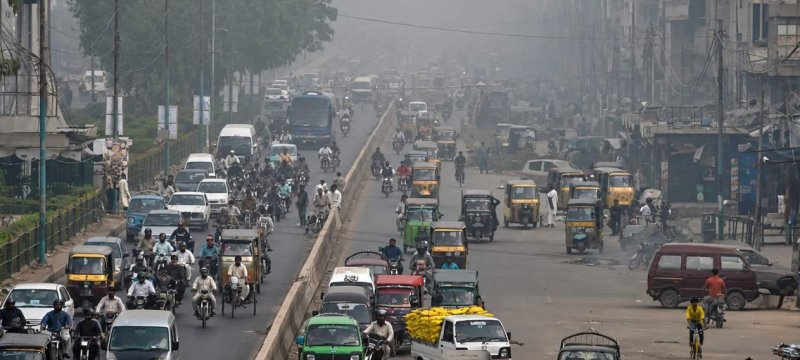
Air pollution continued to worsen across Punjab on Friday, November 20, as several major cities recorded hazardous air quality levels. Gujranwala and Multan reported higher pollution readings than Lahore, highlighting the growing smog crisis across the province.
According to real-time air quality data, Gujranwala recorded an Air Quality Index (AQI) of 661, while Multan reached 641. Lahore also experienced extremely polluted conditions, with its hourly AQI climbing to 465 between 7am and 8am.
A separate ranking placed Lahore’s AQI at 426, following Gujranwala and Multan. The figures indicate that dangerous air quality is no longer limited to Lahore and is affecting several urban centres across Punjab.
Other cities also reported concerning pollution levels. Sargodha recorded an AQI of 289, followed by Sialkot at 232 and Rahim Yar Khan at 228. Bahawalpur registered an AQI of 198.
The worsening air quality has raised concerns about the health of millions of residents. Children, elderly people and individuals with respiratory or cardiovascular conditions face greater risks from prolonged exposure to polluted air.
Fine particulate matter, particularly PM2.5, is among the major health concerns associated with smog. These tiny particles can penetrate deep into the lungs and contribute to respiratory and cardiovascular problems.
Residents have been advised to reduce unnecessary outdoor activities during periods of heavy pollution. Wearing protective masks, keeping windows closed and using indoor air purifiers can help reduce exposure to harmful particles.
Meanwhile, the Punjab government has intensified its enforcement campaign against pollution sources, particularly brick kilns operating in violation of environmental regulations.
According to the Environment Protection and Climate Change Department, authorities conducted 84,370 brick kiln inspections between January 1 and November 18.
The enforcement campaign resulted in the demolition of 1,429 kilns and the sealing of another 968 units. Officials also registered 1,248 FIRs and imposed financial penalties totalling Rs178 million.
During the period from September 1 to November 18, enforcement teams carried out 29,999 inspections. These operations led to 519 demolitions, 494 closures and fines worth Rs101.45 million.
Authorities have also introduced follow-up inspections to identify kilns that resume environmentally harmful activities after initial enforcement action.
In Lahore, the district administration has separately stepped up operations against vehicles releasing excessive smoke.
Deputy Commissioner Muhammad Ali Ijaz directed relevant departments to take action against vehicles violating environmental standards.
According to the district administration, enforcement teams impounded 21 smoke-emitting vehicles. Another 54 vehicles received fines amounting to Rs216,000.
Transport operators have been directed to maintain their vehicles properly and obtain valid fitness certificates before operating on public roads.
Pakistan’s wider air quality situation also remains concerning. According to the 2025 World Air Quality Report, the country’s average PM2.5 concentration reached 67.3 micrograms per cubic metre.
This level was nearly 14 times higher than the World Health Organization’s recommended annual guideline, highlighting the scale of the country’s air pollution challenge.
Despite ongoing government operations, controlling emissions from transport, industrial activities and other pollution sources remains a major challenge.
Residents can report environmental violations through the Green Punjab App or by calling the Punjab Environment Protection Department’s helpline at 1373. Complaints about smoke-emitting vehicles can also be registered through 1071.
In other news read more about: Smog Could Disrupt Daily Life in Punjab! NDMA Warns of Health and Travel Risks
The latest pollution readings underline the need for sustained environmental enforcement and public cooperation to improve air quality across Punjab.