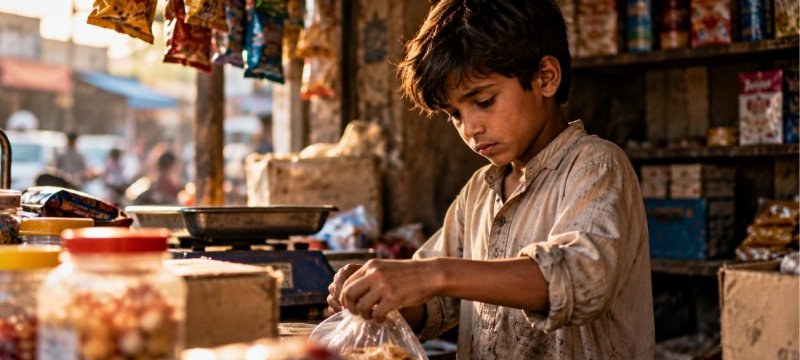
Go to almost any busy bazaar in Rawalpindi, Lahore or Karachi and you will see them.
A young boy carrying a tray of tea between tables. A girl cleaning someone’s house. A child working in a small workshop, doing a job that seems too difficult even for an adult.
We see these children almost every day. Perhaps that is part of the problem. We have become so used to seeing children work that we sometimes stop noticing them.
Child labour is not something distant or unusual in Pakistan. It is happening around us—in farms, brick kilns, workshops, shops and, in many cases, inside private homes. Millions of children are believed to be working, while around 25 million children are out of school. These are often treated as separate problems, but they are closely connected. When a child is forced to work, that child is usually losing an opportunity to study at the same time.
The Law Is There. The Problem Is Enforcement.
Pakistan’s laws are not completely silent on this issue. Article 11 of the Constitution prohibits hazardous employment for children, while Article 25A provides for free and compulsory education. Different federal and provincial laws also deal with child employment, domestic work and bonded labour.
So why does child labour remain so common?
The answer is simple: having a law and enforcing it are two different things.
Labour inspectors are limited, resources are often inadequate, and private homes are especially difficult to monitor. When a child domestic worker is abused or dies, the public reacts with anger. The story makes headlines and people demand justice. But after a few days, public attention moves somewhere else.
For many employers, the chances of facing serious consequences still seem too small. For poor families, there may also be no realistic alternative.
Poverty Is a Reason, But It Cannot Become an Excuse
There is no point pretending poverty has nothing to do with child labour.
A father may not earn enough to feed his family. A mother may be unable to work. A family may be trapped in debt. In such situations, sending a child to work can look like the only option.
But there is a painful side to this decision that we often ignore.
A child who spends his early years working instead of studying is likely to have fewer opportunities later in life. Lower education often means lower-paying work. And then, years later, that same person may struggle to provide for his own children.
That is how the cycle continues.
In other words, child labour is not only a result of poverty. It can also help keep families poor.
What Can Actually Be Done?
Simply announcing another ban will not solve the problem. If families have no income and children have nowhere useful to go, the work may simply move somewhere harder to see.
There are some practical steps that could make a difference.
Make education genuinely affordable. Saying that school is free does not mean there are no costs. Uniforms, books, transport and other expenses can still be difficult for poor families. Financial support for families whose children attend school could help, especially if the system is properly monitored.
Improve inspections. Pakistan needs more trained labour inspectors and better ways for people to report child labour. Domestic workers also need protection because abuse inside private homes can remain hidden for years.
Make businesses responsible for their supply chains. Large companies and exporters should have to show that their products are not being made through child labour. At the same time, smaller industries should be given practical support to change their practices rather than simply being punished and pushed further underground.
What About Us?
The government has a major responsibility, but ordinary people cannot completely wash their hands of this issue either.
If we hire a child to clean our homes, calling it “help” or “charity” does not change the reality. If we buy products from businesses that rely on child labour because they are cheaper, we are also part of the system.
Most of us do not wake up in the morning intending to contribute to child labour. But sometimes we choose not to ask where a cheap product came from or why a child is working instead of going to school.
That is why the first step may simply be to stop looking away.
Pakistan does not lack laws on paper. What it lacks is consistent enforcement, better support for poor families and, perhaps most importantly, the willingness to treat child labour as a serious national problem rather than something we have simply learned to live with.
Children should not have to earn their right to an education.
They should be in classrooms, not workplaces.