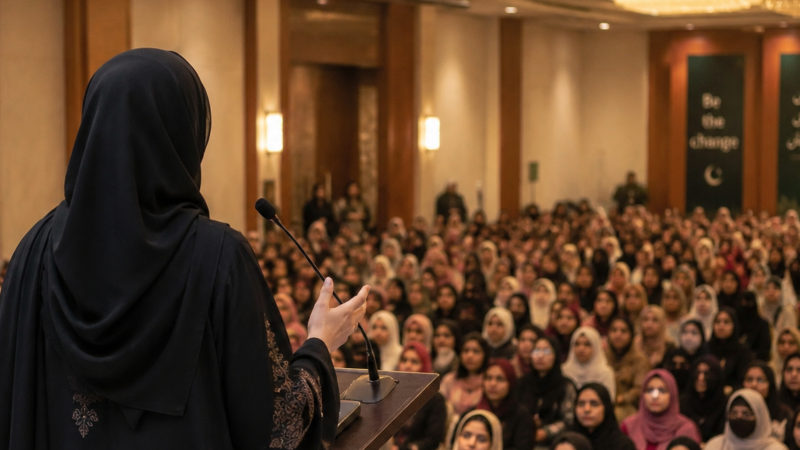
When a Woman Speaking in Public Is Called “Their” Wife
I saw a Facebook post of a woman on stage speaking at a conference, with a lot of comments in the comment section about how she’s now “their” wife, a public commodity, circling about how they would not allow their wife to speak publicly. Mind you, it was some sort of corporate conference and the woman was fully covered in an abaya and hijab.
A random woman on stage speaking, being condemned by hundreds of men saying that she is “their” wife, calling a woman speaking on stage “accessible”, “easy” and a public property.
What Is the Cuckold Narrative?
Cuckolding is a sexual situation in which a man willingly “shares” his female significant other. It is a deviation rooted in the feeling of possession that men feel in regards to their significant other.
Why Pakistani Men Claim Ownership of Women They Don’t Know
Why are Pakistani men cucked by a modest woman speaking on stage, a woman who has no relation to them whatsoever? Why are they debating on the ownership of a woman they do not even know? Why are they inclined to call her their wife, simply because they see her actions as accessible or easy?
Is a woman existing publicly a heresy? Is a woman an inherently commodity to be owned and shared when she exists publicly?
Centuries of Storytelling: From King Arthur to Adam and Eve
The Tale of King Arthur, the King of Camelot has existed since the 6th Century, however the version of it that we know of, where King Arthur’s wife was having an affair with Knight Lancelot was written in the 12th Century by the French, who rewrote the legend around the topic of Arthur getting cucked. The “immoral” woman is usually purely added to enrich the story of “the good guy”.
Centuries of stories and legends written by men with male heroes and bland women betraying them for the plot. centuries of storytelling to view women as supporting characters in the male arc. And none of these storytellers are creative enough to imagine a better plot device.
Men like to imagine stories of themselves being cucked. Where they love a woman, protect her and she just cheats on them and their only sin is “loving” too much.
This also relates to the Biblical Retelling of Prophet Adam AS and his wife Eve, where only SHE succumbs to the temptation of eating the apple.
This literary structure is exactly why modern online mobs get so furious when they see real women making independent choices. They have been conditioned by centuries of storytelling to view women as supporting characters in the male arc.
How Desi Patriarchy Treats Women as Public Property
Desi patriarchy takes this a step further. When men look at a woman speaking at a conference and can only see “our wife.”
How dare she not be hidden at home? How dare her voice reach millions?
Subject vs. Object: Who Gets a Public Voice?
In philosophy, the “subject” is the person who acts, thinks, and experiences life. The “object” is the thing that is acted upon. Under this mindset, men are the only true subjects of society.
A full human subject has desires, intellectual ambitions, and a public voice that exist entirely separate from caretaking. Arguing that her biology or spirituality limits her to “nourishment” is a way to deny her the right to act as an independent agent in the public sphere (like speaking at a conference).
The Traditionalist Argument: Complementarity and Qiwamah
Traditionalist arguments lean heavily on the concept of complementarity rather than absolute equality in roles. They argue that God created men and women with different intrinsic natures (fitrah). In this view, men are assigned the role of financial providers and protectors (qiwamah), while women are assigned the role of primary nurturers and keepers of the home. They argue this is a divine, balanced system.
Why Online Mobs Dehumanize Women Who Speak in Public
It is much easier for online mobs to harass, police, and insult a woman if they never view her as a flesh-and-blood human being with feelings. Treating her as a digital commodity or a character in a “cuckold narrative” protects the male ego.