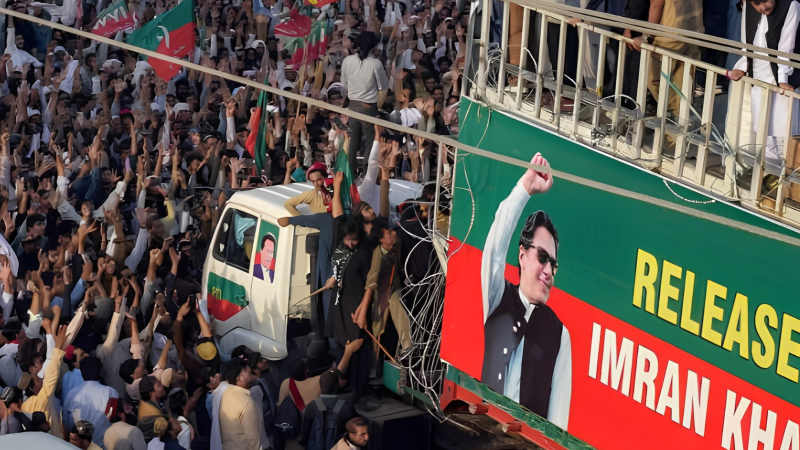
What Does the KPK State of Emergency Reveal About Public Power?
With the KPK now under a state of emergency, Pakistanis have tuned out the reasons spewed forth for the removal of the provincial government. They do not need to know them, as the PTI’s long march was already under way.
Why Do Pakistanis Distrust Their Elections?
My mother told me that my grandfather never cast a vote in elections, believing his vote to be of no importance. She told me that she herself did not vote until 2013, when there was something to vote for other than legacy political figures.
A 2024 Gallup survey found that “Seven in 10 Pakistanis lack confidence in the honesty of their elections.” Gallup also found that 88% of Pakistanis believe corruption within the government is widespread, close to the record 86% recorded in 2022, and that only one in four (25%) approved of Pakistan’s leadership in 2023.
With these dreadfully high numbers showing public distrust, has voting become obsolete? Has it become nothing more than an indigo-blue mark on a countryman’s thumb?
An Ipsos Pakistan survey conducted after the 2024 elections found opinion divided: 54% of Pakistanis thought the elections were overall transparent, while 39% thought they were rigged. Perceptions of rigging were highest in Khyber Pakhtunkhwa (73%), followed by Islamabad (49%), and lowest in Sindh (28%).
How Has Voting Behaviour Changed in Pakistan?
On the contrary, voting in Pakistan works differently now than it did in my grandfather’s time, and differently from other democracies. Historically, rural voting blocs relied heavily on collective decisions made by clan elders, but legacy and biradari politics appear to be weakening. Gallup Pakistan’s election-day surveys found that in 2018, 59% of voters said the candidate they voted for did not belong to their biradari (clan, tribe or caste network), and 52% said their biradari had made a collective decision on how to vote. In 2024, 48% said their biradari decided their vote, while 52% said they ignored the biradari factor. Gallup cautions that the 2024 survey method differs from 2018’s, so the comparison should be treated carefully.
Is Voting in Pakistan Now an Act of Defiance?
In Pakistan, voting has long since had a different definition of political empowerment. If Pakistanis were as apolitical and hopeless as the surveys suggest, the government would not spend such an enormous amount of effort on controlling elections. Data from the Free and Fair Election Network (FAFEN) showed that 60.6 million people cast their votes in the 2024 elections, nearly 5.8 million more than in 2018.
For millions of voters, especially the youth, casting a ballot is no longer about believing the system is fair. It is an act of defiance. By turning out in higher absolute numbers than in 2018 (over 60 million people), voters create an undeniable paper trail of public will. Even if the final mandate is distorted, the vote strips the resulting government of moral legitimacy, making it incredibly difficult for it to govern smoothly.
Political analysts call this defiance voting. When a vote has lost its traditional structural utility, meaning that it no longer reliably translates into forming a government, it transforms into an act of civilian resistance. The ballot paper is no longer a tool for selection; it is weaponized as a legal, undeniable receipt of dissent against the ruling establishment.
Why Does the Establishment Fear the Pakistani Vote?
If voting were entirely obsolete, the political and security establishment would not need to expend massive energy trying to control it. The heavy-handed tactics used before and during elections, like shutting down mobile networks, arresting campaigners or, as opposition parties allege, altering results late at night, suggest that the establishment is deeply aware of the power of the vote and treats it as a genuinely unpredictable threat.
Local essayists and academics often describe this as a psychological victory. In a country with a history of direct and indirect military interventions, voting becomes a way for citizens to conquer their own fear. Even if the physical vote is manipulated or altered later that night, the psychological act of standing in line and choosing defiance breaks the illusion of absolute control held by the ruling elite.
What Does Emergency Rule Say About the State’s Control?
The fact that the state had to resort to a full-scale constitutional override and emergency rule is the ultimate proof that the resistance is loud enough to shake the system. When a government can no longer govern through standard laws, police cordons or political narratives, it signals that ordinary administrative control has failed. Drastic measures like governor’s rule are rarely a sign of absolute strength; they are usually a reactive, high-stakes attempt to contain a public will that has grown too large and too loud to ignore.
By forcing the establishment to take such an extreme step, the public achieves a critical objective in expressive politics: it strips away the illusion of normalcy. It makes the political fracture visible to the entire world, forcing the international community and domestic observers to see that the ruling setup is functioning through executive decrees rather than public consent.
References
KPK state of emergency and governor’s rule (October 2026)
- Pakistan imposes emergency rule in province governed by Imran Khan’s party, Al Jazeera, 11 Oct 2026: emergency invoked under two constitutional articles, with the governor in charge alongside an advisory council for an initial six months.
- Pakistan imposes emergency, Governor’s rule in PTI-led Khyber Pakhtunkhwa, ANI, 11 Oct 2026: presidential approval of the federal cabinet’s recommendation; the PTI long march began on 4 October.
- KP Governor’s Rule: An emergency in the street and state, Dawn
- Pak imposes emergency in Khyber Pakhtunkhwa, suspends Imran Khan’s PTI govt, Business Standard
Trust in elections and corruption (Gallup, 2024)
- Pakistanis’ Discontent Reaches Record High Before Election, Gallup, Feb 2024: seven in 10 lack confidence in election honesty; 88% see government corruption as widespread (86% in 2022); one in four approved of the country’s leadership in 2023.
Perceptions of rigging and the mobile shutdown (Ipsos, 2024)
- Pakistan General Elections 2024: Perception on Transparency and Rigging, Ipsos Pakistan: 54% transparent, 39% rigged; rigging perception highest in KP (73%), Islamabad (49%), lowest in Sindh (28%); also covers views on the mobile service suspension.
Biradari and voting behaviour (Gallup Pakistan)
- Gallup Pakistan Exit Poll (Election Day Survey) 2018 report: 59% said their candidate did not belong to their biradari; 52% said their biradari decided together.
- 87% of Pakistani voters trust electoral process as ‘free and fair’: Gallup, The Business Standard, Feb 2024: 2024 exit poll, 48% said biradari decided their vote and 52% ignored it.
- Gallup Pakistan Exit Poll 2024, Report 3: notes that comparisons with 2018 and earlier surveys should be made with caution.
Turnout (FAFEN, 2024)
- FAFEN Analysis: Voter Turnout, General Elections 2024: 60.6 million voters in 2024, about 5.8 million more than the 54.8 million in 2018; turnout rate fell from 52.1% to 47.6% as registered voters rose from 106 million to 128.6 million.
- Overall voter turnout falls, more women vote in 2024 over 2018 Pakistan polls, Arab News