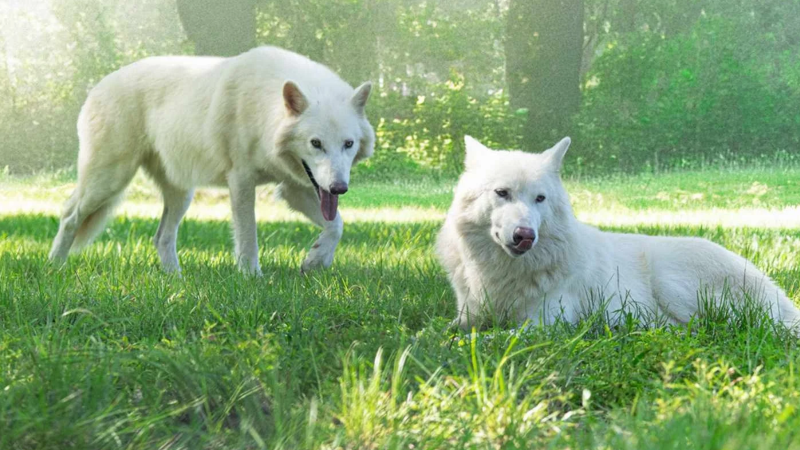
In a news straight out of an Episode of The X Files, an extinct animal, the dire wolf has been brought back. Or at least, that’s what Colossal wants you to believe.
In 2025, a Texas biotechnology company made an announcement that sounded like something from science fiction: an extinct animal had supposedly been brought back to life. Colossal Biosciences introduced three white, wolf-like animals named Romulus, Remus and Khaleesi and described them as the world’s first “de-extinct” animals.
The company is led by entrepreneur Ben Lamm, who co-founded Colossal with geneticist George Church. Its ambitions go far beyond the dire wolf. Colossal is working on projects involving the woolly mammoth, the dodo, the thylacine and the moa, with the broader goal of using genetic engineering to recreate traits from species that have disappeared.
At first glance, it sounds like an extraordinary conservation project. But the science behind the dire wolves is considerably more complicated than the company’s headline suggests.
Did Colossal Really Bring Back the Dire Wolf?
The animals were not created by simply reconstructing an extinct dire-wolf genome and turning it into a living animal. Scientists at Colossal started with cells from modern gray wolves and used ancient DNA recovered from dire-wolf remains as a reference. They then made genetic edits intended to reproduce some of the extinct animal’s characteristics before cloning the modified cells and implanting the embryos into surrogate dogs.
Colossal made 20 edits across 14 locations in the gray-wolf genome. The changes were associated with traits such as size, coat colour and other characteristics that the company believes were associated with dire wolves. The resulting animals certainly look unusual, but several scientists have argued that calling them actual dire wolves is misleading.
Colossal’s own chief scientist, Beth Shapiro, later described the animals as gray wolves with 20 genetic edits. The company argues that “de-extinction” does not necessarily mean producing a genetically identical copy of an extinct species. Instead, it defines the goal more broadly as recreating important traits and potentially restoring ecological functions.
That distinction is at the centre of the controversy. The extinct dire wolf genome differed from that of the gray wolf at millions of individual DNA positions. Critics therefore argue that changing a relatively small number of genes does not turn a gray wolf into an extinct species. In their view, Colossal has created a genetically modified modern wolf designed to resemble the animal that disappeared thousands of years ago.
Why Is Colossal Doing This?
Colossal presents its work as a response to the biodiversity crisis. The company’s argument is that the same genetic technologies being developed for de-extinction could eventually help endangered species reproduce, increase genetic diversity and potentially restore animals to ecosystems where they have disappeared.
But there is also a very obvious commercial dimension.
Colossal is a private biotechnology company backed by investors, and its work has attracted enormous amounts of public attention. The company has turned a technically complicated field of genetic engineering into something that millions of people can understand immediately: bringing extinct animals back from the dead.
That makes the dire wolf more than a scientific experiment. It is also a powerful demonstration of what the company wants people to believe is possible.
The company has already used the attention surrounding its projects to expand its ambitions. Alongside the dire wolves, Colossal has announced work involving genetically engineered mice with mammoth-like traits and plans involving other extinct species. It has also said that it hopes to produce a mammoth-like animal in the coming years.
And Then There Is Ben Lamm
Lamm’s background is important to understanding Colossal’s approach. He is a technology entrepreneur rather than a traditional conservation scientist, and before Colossal he founded several technology companies, including Hypergiant, an artificial-intelligence company involved in critical infrastructure, space and defense. Colossal’s own biography describes him as an entrepreneur focused on emerging technology, science, space and climate change.
His vision for Colossal is therefore much bigger than recreating a few extinct animals. The company describes itself as developing technologies that could advance genomics more broadly, meaning the discoveries made through de-extinction could potentially have applications far beyond extinct species.
That is where the story becomes more interesting. A company that learns how to reconstruct ancient DNA, edit living genomes and produce animals with deliberately selected characteristics is not merely studying the past. It is developing increasingly sophisticated tools for manipulating biology in the present.
The Israel Connection
There is also a documented connection between Lamm and Israel-focused business circles that has attracted attention online.
In October 2026, Lamm appeared as a featured keynote speaker at Unicorn Rodeo, a Dallas technology conference produced by the Texas-Israel Alliance. The event was explicitly designed to connect Israeli entrepreneurs with Texas investors, business leaders and policymakers, with sessions covering areas including technology, defense, health and biotechnology. Other featured figures included former Mossad director Yossi Cohen and Israel’s consul general to the Southwest United States.
That establishes an Israel-related professional connection, but it does not establish that Lamm personally identifies as a Zionist. There is no reliable public evidence that would justify making that claim.
What is more interesting from a broader perspective is the overlap between the worlds represented at the conference: biotechnology, artificial intelligence, defense, investment and emerging technologies. Those are also areas in which Lamm’s companies and professional network have operated.
The Bigger Question
The controversy surrounding Colossal is ultimately not just about whether Romulus, Remus and Khaleesi deserve to be called dire wolves. It is about how quickly biotechnology is moving into territory that once belonged entirely to science fiction.
If scientists can use ancient DNA to identify characteristics of extinct animals and then reproduce some of those characteristics through gene editing, the possibilities are enormous. But so are the questions about who controls these technologies, how they are regulated and what happens when the same techniques become easier and cheaper to use.
There are also ethical questions surrounding the animals themselves. Colossal’s dire-wolf project required cloning and surrogate dogs, and critics have questioned the welfare implications of using animals in experiments designed partly to demonstrate what the technology can accomplish.
Colossal insists that its work could ultimately benefit conservation and help humanity respond to biodiversity loss. Its critics worry that the company’s publicity sometimes runs ahead of the science.
Perhaps the most unsettling part is that both things can be true at once. Colossal may genuinely be developing useful technologies for conservation while also benefiting enormously from the spectacle of promising to resurrect animals that disappeared thousands of years ago.
The dire wolves may not actually be the return of an extinct species. They may instead be the first highly public demonstration of something potentially much bigger: humanity becoming increasingly capable of redesigning living organisms to resemble what nature has already lost.
And if that is what Colossal is really building, the dire wolf may only be the beginning.