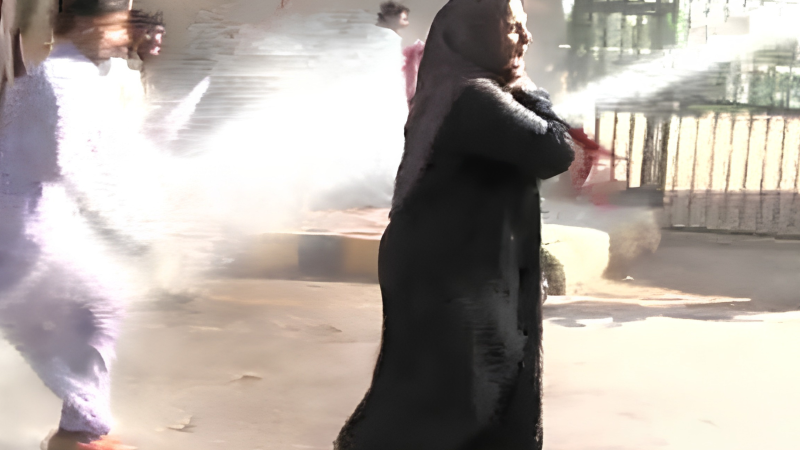
On Wednesday, roads around the Karachi Press Club were closed after a protest by a primary teachers’ association, reportedly heading towards the Chief Minister’s House. According to Dawn’s report, police tear-gasssed to disperse the demonstrators.
The people who spend their working lives teaching Pakistan’s children their first letters and numbers were running from tear-gas shells in the streets of Karachi. Teachers were not demanding privileges. They were protesting over their working conditions, salaries and professional rights.
There is something deeply disturbing about a country in which educators have to take to the streets to demand basic employment security, only to be met with force. Teachers are responsible for shaping the next generation, yet their own livelihoods remain uncertain. A teacher should not have to fear losing their job, waiting for their salary or being injured while demanding what they are owed.
What Quaid-e-Azam Said About Sindh’s Education Crisis
On January 12, 1947, Muhammad Ali Jinnah spoke about education and the state of literacy in Sindh. As reported by The News, he said:
“It was a matter of regret that Sindh was the most backward province in the whole country in education.”
Jinnah acknowledged that there was some awakening in the province, but called for an earnest drive towards literacy across Sindh, extending to all communities. He also described education as the foundation of every nation.
His assessment reflected the educational conditions of the time, when access to schools, literacy and educational infrastructure remained severely limited. But nearly eight decades later, the province is still struggling with many of the same problems.
According to the Pakistan Bureau of Statistics’ Household Integrated Economic Survey 2024–25, Sindh’s literacy rate among people aged 10 and above is approximately 56 percent. Punjab stands at 65 percent, Khyber Pakhtunkhwa at 54 percent and Balochistan at 45 percent. Rural Sindh is particularly concerning, with adult literacy at just 36 percent.
Sindh is no longer the least literate province; Balochistan now has the lowest rate. But that distinction offers little comfort when large parts of Sindh continue to struggle with access to education.
The same survey found that 39 percent of Sindh’s children aged 5 to 16 are out of school. In rural Sindh, the figure rises to 51 percent. Punjab’s overall out-of-school rate is 21 percent, while Balochistan’s is 45 percent.
These figures show that Jinnah’s concerns about education in Sindh have not disappeared. They have evolved into a much larger crisis involving poverty, inadequate infrastructure, poor access to schools and an education system that continues to leave millions of children behind.
The All Pakistan Educational Conference: A Promise Made in Karachi
There is another historical detail that makes the recent scenes outside the Karachi Press Club particularly painful.
After independence, Pakistan held the All Pakistan Educational Conference in Karachi from November 27 to December 1, 1947. The conference was organised to discuss the educational direction of the newly established country. Jinnah was too ill to attend in person, but sent a message outlining his vision for education.
In his address, he emphasised that education should extend beyond academic instruction. He called for character-building, scientific and technical training, and greater attention to vocational education. He believed the country needed people equipped to contribute to its economic and social development.
The official proceedings of the Pakistan Educational Conference were published by the Government of Pakistan’s Education Division.
The conference took place in the same city where teachers are now being tear-gassed for demanding better working conditions. Karachi was once the setting for discussions about building an educated nation. Today, its streets have become the setting for teachers being forced to fight for their own rights.
It is difficult to reconcile those two images. The people entrusted with educating the country’s children should not have to plead for decent wages and job security, let alone face police action for doing so.
This Is Not the First Time Teachers Have Been Tear-Gassed
The recent protest is part of a longer history of confrontations between teachers and the authorities in Karachi.
In December 2017, police used tear gas, water cannons and baton charges against protesting teachers outside the Karachi Press Club. Dawn reported that a woman teacher lost consciousness after exposure to tear gas, while another teacher suffered a head injury.
In June 2024, contractual teachers associated with the National Commission for Human Development (NCHD) and Basic Education Community Schools (BECS) also faced baton charges and water cannons. They were demanding permanent employment and a Grade 14 pay scale. According to The Express Tribune, these teachers had originally been hired by the federal government and transferred to the Sindh government in 2021, but their employment had still not been regularised.
In June 2025, another protest by government employees outside the Karachi Press Club ended in clashes, with police using water cannons and tear gas. Teachers and other employees were demanding improvements to salaries and pensions.
These are not isolated demonstrations. Teachers have repeatedly taken to the streets over regularisation, delayed payments, promotions, salary increases and pension-related demands. The recurring nature of these protests points to a system in which educators are forced to repeatedly fight for employment conditions that should be addressed through ordinary administrative processes.
What Are Teachers Actually Paid?
The financial conditions of teachers in Sindh vary considerably depending on whether they work in government schools, private schools or non-formal education programmes. But across these categories, low wages and insecurity remain serious concerns.
Regular government teachers
Sindh’s government primary school teachers have seen changes to their pay structure over the years. In November 2022, the provincial government upgraded primary school teachers from BPS-9 to BPS-14 for eligible teachers, including those recruited with bachelor’s degrees. The revised structure also established promotion pathways to Senior Primary Teacher positions in BPS-16 and Chief Primary Teacher positions in BPS-17.
The upgrade was an important change, but a government pay scale does not automatically mean that every teacher receives the same salary. Basic pay, allowances, years of service and deductions all affect take-home earnings. Regular government employment offers a more secure position, with a defined pay structure and retirement benefits, but teachers still face disputes over promotions, increments and outstanding payments.
ProPakistani reported the 2022 pay-scale upgrade.
Contract teachers: Working without permanent security
Teachers associated with NCHD and BECS have faced a particularly difficult situation. These programmes provide education through non-formal and community-based schools, often serving areas where access to conventional government schools is limited.
Their teachers were originally hired on contractual arrangements by the federal government before being transferred to Sindh in 2021. Despite the transfer, many continued to demand permanent status, a Grade 14 pay scale, a retirement age of 60 and improved salaries.
The difference between a permanent and contractual teaching position is significant. Permanent government teachers generally have a defined salary structure, promotion opportunities and retirement benefits. Contractual teachers, meanwhile, may have no comparable guarantee of continued employment, a predictable promotion pathway or pension security.
In June 2024, NCHD and BECS teachers protested for regularisation, arguing that years of service and repeated assurances had not translated into secure employment.
The uncertainty has not been limited to job status. In September 2025, the Sindh School Education and Literacy Department issued an official letter requesting the release of salaries and honoraria for NCHD and BECS teachers. The document stated that payments had not been released through the usual process because of changes to the department’s online payment system. It requested that payments for the current quarter be released through manual cheques until the new system was implemented.
The official Sindh Education Department letter is particularly revealing. It shows that even the payment of teachers’ wages can become entangled in administrative delays.
Private school teachers: Low wages and limited protection
The situation is often worse for teachers employed by private schools, particularly smaller institutions.
In January 2023, Sindh’s education minister acknowledged that complaints had been received about private school teachers being paid as little as Rs8,000 to Rs10,000 per month. He said the provincial government had set a minimum salary of Rs25,000 at the time and that schools would be required to comply.
The issue has not disappeared. In February 2026, Dawn reported that the education minister had told the Sindh Assembly that teachers in private schools across the country were earning around Rs10,000 to Rs12,000 a month.
These wages are far below what educators need to support themselves, particularly in a city with rising living costs. Low pay also makes it difficult for teachers to invest in professional development, afford transport and manage household expenses.
Private school teachers may also face limited job security, particularly where employment contracts are informal or poorly enforced. Without reliable contracts, clear promotion structures or adequate employment protections, teachers can be vulnerable to sudden dismissal and arbitrary salary decisions.
The problem is not simply the salary. It is the lack of security.
A teacher’s ability to plan a life depends on knowing when they will be paid, whether their job will continue and whether years of experience will lead to career progression. When these basic conditions are missing, the profession becomes increasingly difficult to sustain.
The Reality of Pakistan’s Education System
The treatment of teachers cannot be separated from the wider crisis in education. Pakistan is dealing with an enormous shortage of educational access, inadequate public investment, unsafe school buildings and poor learning outcomes.
According to UNICEF Pakistan, an estimated 25.1 million children aged 5 to 16 are out of school. This is approximately 35 percent of children in that age group, placing Pakistan among the countries with the highest numbers of out-of-school children in the world.
The Pakistan Bureau of Statistics’ 2024–25 survey provides another measure of the problem. It found that 28 percent of children aged 5 to 16 were out of school nationally. The figures differ because the sources use different estimates and methodologies, but both point to a severe national education crisis.
Sindh faces particularly serious challenges. Nearly four in ten children aged 5 to 16 are out of school, and in rural areas the figure exceeds half. For many children, the problem begins before they even enter a classroom. Poverty, long distances to schools, inadequate facilities and gender-based barriers all affect whether a child can attend regularly.
Even children who do attend school are not necessarily receiving a meaningful education. The World Bank has highlighted Pakistan’s learning poverty, with a large proportion of children unable to read and understand an age-appropriate text by the end of primary school. This means that enrolment alone cannot be treated as proof that the education system is functioning.
The condition of school infrastructure adds another layer to the crisis. In February 2026, Sindh’s education minister told the provincial assembly that 233 primary and secondary schools in Karachi had been declared unsafe and that Rs4.156 billion would be required for repairs. He also acknowledged shortages of libraries and science laboratories, particularly in primary schools.
These are not minor administrative inconveniences. A child cannot learn effectively in a school without adequate classrooms, books, laboratories, sanitation facilities and trained teachers. In some cases, the buildings themselves are unsafe.
Pakistan Is Spending Too Little on Education
The country’s education crisis is also reflected in its public spending.
According to the Pakistan Economic Survey 2024–25, education expenditure fell to approximately 0.8 percent of GDP during July–March of the 2024–25 financial year. This is significantly below the commonly cited international benchmark of allocating 4 to 6 percent of GDP to education.
The consequences of underinvestment are visible across the system. Schools struggle with infrastructure, learning materials and facilities. Teacher recruitment and training remain major challenges, while millions of children remain outside formal education.
The problem is not simply that Pakistan needs more classrooms. It needs a system capable of keeping children in school, supporting teachers and ensuring that students actually learn.
Teachers are central to that process. Yet they are frequently expected to deliver results without adequate resources, stable employment or salaries that reflect the importance of their work.
In February 2026, Dawn reported that Sindh’s education minister told the provincial assembly that 92 percent of the school education budget was being spent on salaries and pensions. He also said that around 31,000 candidates were still waiting for recruitment after the provincial government had issued offer letters to 95,000 teachers.
The same report highlighted the condition of school buildings and shortages of facilities. It illustrates the difficult position of a system that must manage a huge workforce while still failing to provide adequate infrastructure and learning conditions.
The Nation Weeps
Quaid-e-Azam called education a matter of life and death for Pakistan. He spoke about the need to build an educated population, strengthen scientific and technical learning, and prepare future generations to contribute to the country.
The All Pakistan Educational Conference was held in Karachi in 1947 with precisely that ambition: to establish an educational direction for a newly independent country.
Nearly eight decades later, children are still being denied access to school, rural communities remain underserved, teachers are struggling with low wages and insecure employment, and public investment in education remains woefully inadequate.
And in the same city where the country once gathered to discuss its educational future, teachers are being tear-gassed for demanding their rights.
There is no justification for treating educators this way. A teacher should not have to choose between earning a living and speaking up about their working conditions. They should not have to wait months for wages, work indefinitely without permanent status or risk injury simply for demanding better treatment.
A country cannot claim to value education while treating the people responsible for delivering it as disposable.
The nation weeps, not because its teachers have taken to the streets, but because it has allowed them to reach a point where they have no choice.
References
- Dawn – Protest prompts road closures in Karachi’s South district
- The News – Quaid-i-Azam’s concept of education
- Proceedings of the Pakistan Educational Conference, Karachi, 1947
- Pakistan Bureau of Statistics – HIES 2024–25
- Pakistan Bureau of Statistics – HIES 2024–25 Social Report
- Dawn – Scores detained as police baton-charge, tear-gas protesting teachers in Karachi
- The Express Tribune – Contractual teachers stage protest
- Government of Sindh – Salary and honoraria release letter for NCHD and BECS teachers
- ProPakistani – Sindh upgrades basic pay scale of school teachers
- Dawn – 92pc of education budget spent on salaries, PA told
- UNICEF Pakistan – Education
- Pakistan Economic Survey 2024–25 – Education
- Save the Children – Education spending in Pakistan hits new low