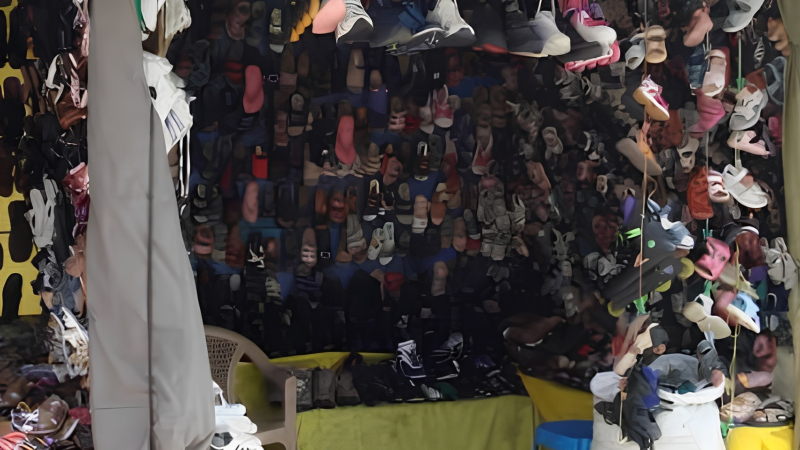
Since 16 October 2026, Islamabad’s H-9 and G-6 weekly bazaars have been shut. The Metropolitan Corporation’s Directorate of Municipal Administration ordered the closure until “100pc foolproof measures” are taken and the CDA’s Capital Emergency Services grants fire-prevention clearance. The notification gave no reopening date. In early November the corporation also permanently closed the G-10 weekly bazaar and the women’s bazaar, saying both fall within the right of way of the proposed 11th Avenue.
In a matter of weeks, three of the capital’s weekly markets have gone dark. The people who work and shop in them were not asked.
Who Loses Their Income?
H-9, popularly known as the Itwar or Sunday Bazaar, has around 2,750 stalls and normally runs on Tuesdays, Fridays and Sundays. G-10 supported about 1,000 kiosks, temporary shops, carts and pushcarts. These are not chain stores. They are people who pay rent for a stall, stock it with their own money and earn on the days the market is open. When the market shuts, the income stops that same day.
Traders told reporters the closure had brought their businesses to a standstill. Hundreds staged a sit-in outside the H-9 bazaar on 18 October, and on 20 October stallholders briefly blocked Srinagar Highway. One stallholder said poor people were being “pushed everywhere.” For many of the G-10 traders, reports say, the Sunday Bazaar was the family’s main source of income.
What Happens to the Shoppers?
Weekly bazaars exist because they are cheaper. Reports on the closure note that residents lose access to affordable household goods, fruits and vegetables. A family that buys its week’s vegetables at the bazaar will likely pay more for the same bag at a sector market or a supermarket, and for households watching every rupee, that is another bill.
Women lost a dedicated space too. The G-10 women’s bazaar, built for Rs70.8 million with 98 stalls, was razed days after the closure order.
Is Fire Safety a Good Reason to Close the Bazaar?
Yes, and nobody should pretend otherwise. H-9 has a bad fire record. Dawn counts five fires since 2017, including a major one in June 2026 that began in Block C, which mostly houses shoe stalls, while the interior minister told the Senate that eight fire incidents had caused losses of roughly Rs600 million. Days before the closure, another fire broke out at H-9, reportedly during welding work as stallholders installed shutter gates.
But the real question is whether a blanket, open-ended shutdown is the right tool. Traders say they have installed 30 security cameras and fitted mesh shutter gates at around 500 stalls, with work continuing on the rest, and they are asking for inspections. A stallholder told The Nation that fires tend to break out on off days, when only administration staff are inside. And the committee that investigated the June fire recommended stronger emergency services and a strict ban on keeping goods in stalls at night. Those are fixes that can be inspected, enforced and phased in without taking away every stall’s income at once.
What About the Claim That Traders Start the Fires?
After every blaze, a claim circulates: that some vendors set fires themselves to get rid of stock that is not selling. I could not find any investigation, court finding or official statement that supports it. What the record does show is thinner and less comfortable. After the June 2026 fire, the district administration’s inquiry identified where the fire started, at stalls C-432 and C-433, but left the cause to a pending forensic investigation, and was criticised for not establishing who was responsible. A market president called the fire suspicious and “a planned act”, and another person quoted by Dawn said it could have been deliberate and should be investigated scientifically. Suspicion of arson, in other words, comes from several directions, including from traders themselves.
The insurance motive also sits badly with the evidence. After an earlier fire, the Islamabad Chamber of Commerce said the CDA had not arranged any insurance for the thousands of traders in the bazaar, and reports put the June losses at Rs100 million to Rs150 million. Burning your own stock is an expensive way to clear a shelf when nobody pays you back.
If any of this turns out to be true, the answer is a forensic report, named suspects and prosecutions. It is not an indefinite closure that punishes around 2,750 stalls for the possible act of a few. Until the findings are published, the claim is a rumour, and the stalls that did nothing wrong are the ones paying for it.
Have the Bazaars Reopened After Fires Before?
They have. After the December 2022 fire, which gutted at least 133 shops, the deputy commissioner said it would be business as usual that Friday. After the June 2026 fire, vendors were back trading among the ruins within weeks, and by 24 July reconstructed stalls had reopened. The precedent for reopening what is safe while rebuilding the rest already exists. This time, there is no end date.
What Happens to the G-10 Vendors?
G-10 is a different case. The closure is permanent, and it is not about fire but about a road. The corporation says the proposed 11th Avenue, whose Rs24.5 billion project was approved at a CDA development working party in September, runs through the site. When Dawn reported the closure, the corporation had not announced an alternative site. Reports say the bazaar had been closed about two weeks earlier over security concerns, with traders assured it would reopen, and that goods were left inside the shops when they were demolished.
What Should Happen Next?
Fire safety and keeping the bazaars open are not opposites. A fair plan would publish an inspection schedule with dates for H-9 and G-6, reopen the blocks that pass, and keep inspecting the rest. For G-10, it would name a relocation site and compensate vendors for lost stock before anything else is bulldozed. And it would talk to the traders’ unions, not just notify them.
A market can burn down in an hour. A livelihood that is shut down does not make headlines. It just quietly disappears.
Sources
Closure of H-9 and G-6 (October 2026)
- Islamabad’s H-9, G-6 weekly bazaars closed over fire safety (Dawn, 16 Oct 2026)
- H-9, G-6 markets face temporary closure (The Express Tribune)
- Islamabad Sunday bazaar shut, traders stage protest (Minute Mirror, 18 Oct 2026)
- Islamabad traders protest closure of H-9 Sunday Bazaar (24NewsHD, 18 Oct 2026)
- Islamabad’s H-9 Sunday Bazaar traders protest closure, demand reopening (Hum English, 18 Oct 2026)
- H-9 Bazaar stays shut after fires; traders briefly block Srinagar Highway (The Nation, 21 Oct 2026)
- Fire at H-9 weekly bazaar during welding work; markets to remain closed (ProPakistani)
G-10 bazaar and women’s bazaar (November 2026)
- Metropolitan Corporation Islamabad closes G-10 weekly, ladies bazaars permanently (Dawn, 5 Nov 2026)
- Rs70.8m women’s bazaar razed without accountability for flawed planning (The Nation, 6 Nov 2026)
- CDA demolishes Islamabad’s G-10 Sunday Bazaar overnight, traders lose goods worth millions (SundayPlus, Nov 2026)
Fire history and past reopenings
- Islamabad’s H-9 Bazaar fire probe body wants emergency services strengthened (Dawn)
- Fire destroys shops in H-9 weekly bazaar (Dawn, 8 Dec 2022)
- Vendors resume trade amid the burnt ruins of the H-9 weekly bazaar (APP, 5 Jul 2026)
- Reconstructed stalls reopen at the H-9 weekly bazaar (APP, 24 Jul 2026)
Arson claims and the June 2026 inquiry
- Fire report sparks fresh criticism (The Express Tribune, 2026)
- Recurring fires expose safety gaps at H-9 Weekly Bazaar in Islamabad (Dawn, June 2026)
- Islamabad H-9 Weekly Sasta Bazaar fire destroys 330 stalls (Islamabad 51, 24 Jun 2026)
- Massive fire ravages Islamabad’s H-9 Bazaar, over 376 stalls gutted (Pakistan Today, 24 Jun 2026)
- Islamabad H-9 bazaar fire burns 500 stalls; inquiry committee formed (Samaa)
- ICCI urges govt to compensate victims of weekly bazar (The News)