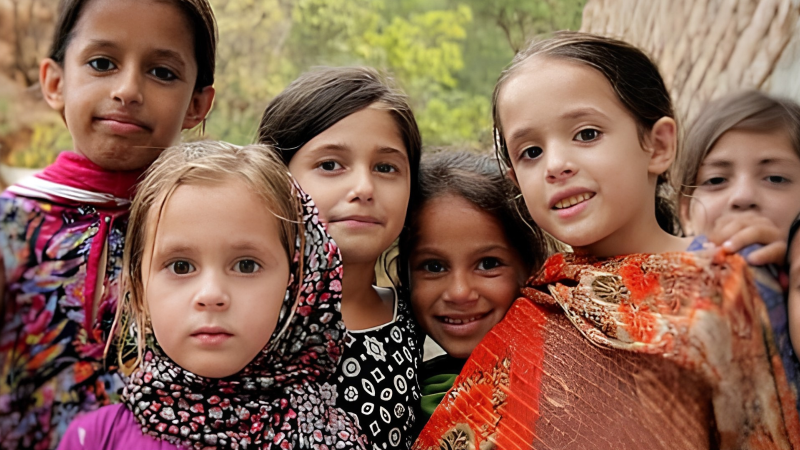
Pakistan has 241.5 million people and an intercensal growth rate of 2.55 percent. Every few years the same conversation returns: why do people have so many children? The usual answers are ignorance, religion, or irresponsibility. Religion and culture do matter, as we’ll see, but those answers skip over the economics underneath them. For many families, a child is not only a person to love. In an economy with no safety net, a child is also an asset. This is why population control in Pakistan keeps stalling: it asks poor families to give up their only investment, without offering a replacement.
How a Child Becomes Capital
No parent sits down and prices their baby. But the system does the pricing for them.
- Old-age insurance. Pakistan has no pension that most people can count on. As researchers note in a study of son preference in Pakistan, when insurance markets and safety nets are missing, sons become a major economic asset: they take over family businesses and cover their parents’ old-age needs. More children means more chances that one of them will be able to provide.
- Labour. A child who can work in the fields, a workshop, or someone’s home brings in income and frees an adult to earn. This is part of why a quarter of primary-school-aged children are out of school.
- A hedge against loss. When children are malnourished and healthcare is out of reach, parents have more of them to make sure some survive. About 40 percent of Pakistani children are stunted.
- A ticket out. Families send a son abroad or into a job and depend on the remittances. A daughter, in the same logic, becomes a cost to be married off.
None of this is cold calculation by bad parents. It is the rational response to a country where the state does not take care of you when you are old, sick, or broke.
Poverty Is Rising, Not Falling
The conditions that make children valuable are getting worse. The World Bank reports that the national poverty rate rose from 22 percent in 2018–19 to 29 percent in 2024–25, with about 70 million Pakistanis now living in poverty. Weak job creation and high inflation have eroded real incomes. And the human capital that might change a family’s odds is thin: roughly 75 percent of children who do attend primary school cannot read and understand a simple story by the end of it.
If school does not lead to a job, and a job does not pay enough to support parents, then investing in one well-educated child is a bad bet. Having several children is the hedge.
Why Awareness Campaigns Don’t Move the Needle
Pakistan has run family planning programmes since the 1960s. Awareness is not the problem: 96 percent of married women know at least one modern contraceptive method. Yet contraceptive use among married women has only recently moved from 34 to 38 percent, and the total fertility rate has slowly fallen from 4.0 to 3.6 births per woman.
The same study shows where change is happening. Urban areas have a fertility rate of 3.0, against 4.1 in rural areas, and contraceptive use of 44 percent against 34 percent. Education emerges as a key factor. And decisions about family planning are often made or dominated by male family members, which limits women’s autonomy.
The pattern is consistent. Fertility falls where children cost more than they earn, and where women have schooling and a say. It stays high where children are the only insurance a family has.
The Rs 30 Pill and the Religion Question
Price alone is not the barrier. Emergency contraceptive pills sell for tens of rupees a pack, with one major listing at around Rs 30, so for most families the pill’s cost is not what stands in the way. What does is autonomy, stigma, and belief. And one belief is widely repeated: that Muslims are meant to keep reproducing.
The belief has real roots. As a Guttmacher primer on Islam and family planning notes, Islam clearly values procreation within marriage and prizes fertility. That text has been used to argue that contraception is not permitted, and an organised religious party in Pakistan has officially opposed family planning as “un-Islamic,” with couples commonly citing religion as their reason for not using contraception.
But it is not a settled religious ruling. Most Islamic jurists consider family planning permissible. A study in Khyber Pakhtunkhwa notes that most scholars accept reversible methods such as condoms, injectables, pills and IUDs, while rejecting irreversible sterilisation. Pakistani scholars have developed a consensus that family planning is permissible, but governments have been cautious about involving religious leaders, while Bangladesh, Iran, Indonesia, Egypt and Tunisia won scholars’ endorsement much earlier, which helped their programmes.
The two forces reinforce each other. When a family has no pension and no safety net, the belief that children are a blessing and that God provides gives moral cover to what is also an economic necessity. Religion rarely forces the decision on its own, but it makes the economic logic feel like faith.
Patriarchy: Who Gets to Decide
Even where women know about contraception and can reach a clinic, they often can’t make the call. A case-control study of poor urban women with physical access to family planning services found that husbands’ opposition was the strongest factor in whether a woman intended to use contraception, ahead of any other family member. A more recent survey found that only 2.9 percent of husbands openly opposed contraceptives, yet quiet disapproval, passive resistance and gendered expectations can be enough to stop a woman, and only about half of respondents had autonomy over reproductive decisions.
Awareness is also uneven. Most married women know a modern method, but only 15 percent of young girls knew about family planning before marriage. For a girl who marries young, family planning may arrive after the first child, if at all.
Then there are sons. In a Population Council study in Punjab, 97 percent of respondents who wanted another child wanted a boy. Women can face pressure to keep having children until a son is born, which limits their choices. Studies measure opposition and son preference rather than masculinity directly, but it is a reasonable reading that a large family also works as proof of a man’s status and success as a provider, and that his wife’s fertility is treated as his to decide.
This is not the same as saying men hate family planning. Most Pakistanis approve of it in principle, and Population Council research suggests many men are changing their attitudes and are eager to be involved. The problem is that family planning has been aimed almost entirely at women, while the decision often sits with the husband.
What Would Actually Change the Math
- A social safety net. A reliable pension and basic health cover reduce the need to treat children as insurance.
- Schools and jobs that pay off. Parents will invest in fewer children only if each child’s education leads somewhere.
- Girls’ education and women’s say. Both are linked with lower fertility and with greater use of contraception.
- Child health. When fewer children die or are stunted, parents don’t need “spares.”
- Services that actually reach people. About 17 percent of married women have an unmet need for family planning. They want to delay or stop childbearing and aren’t using contraception.
- Religious leaders on board. Where scholars publicly back family planning, programmes work better. Pakistan has the scholarly consensus but has been slow to use it.
- Bringing husbands in. Counselling, outreach and campaigns that include men, not only women, since the decision often rests with them.
The Other Side of the Argument
Not everyone agrees poverty has to be solved first. That 17 percent of women with unmet need suggests that many families would have fewer children right now if services reached them and husbands agreed. Countries such as Bangladesh are often cited as proof that fertility can fall before wealth arrives, through female education and door-to-door family planning. On this view, waiting for poverty to end is an excuse for not building the services that exist.
The two positions are less opposed than they sound. Services and women’s autonomy matter, but they work best where the underlying incentives are not pushing the other way.
The Bottom Line
When a country has no pension, weak schools, and little work, children become the family’s only savings account. You cannot tell a poor family to close that account while offering nothing in return. Population stabilises when children stop being capital, and that happens when the state makes them safe to raise rather than necessary to have.
References
UNFPA Pakistan: Family Planning
The News: Pakistan’s fertility rate declining gradually, study
World Bank: Pakistan country overview
World Bank: Pakistan Poverty, Equity and Resilience Assessment
NIUSSP: Son preference and birth spacing in Pakistan
Marham: ECP tablet price in Pakistan
Guttmacher: Islam, Women and Family Planning
PRB: Islam and Family Planning
Family planning, Islam and sin in Khyber Pakhtunkhwa (ScienceDirect)
Global Health: Science and Practice: Islam and family planning in Pakistan
Family members’ opposition and women’s intention to use contraception in Pakistan (PMC)
Contraceptive use intention among women in Pakistan (PLOS ONE)
Barriers to contraceptive use among Pakistani couples (Population Council)
Health education and contraceptive use among university students in Pakistan (Scientific Reports)