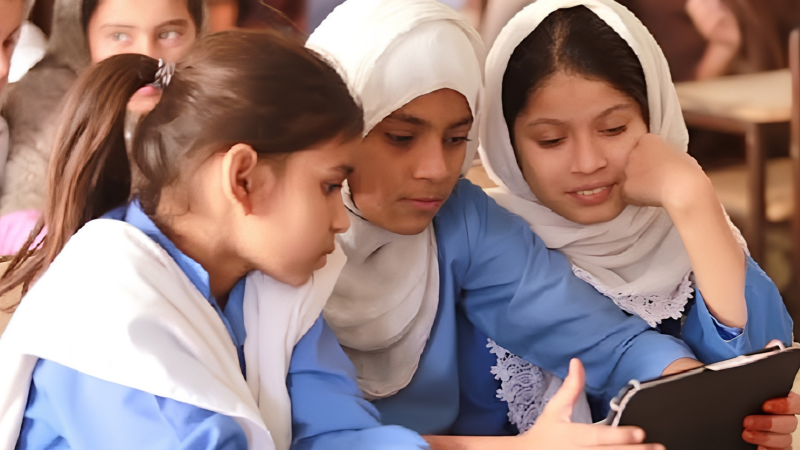
Of the 55,834 students who appeared in the latest Rawalpindi board exams for the 11th class, 30,280 passed and nearly 45 percent failed. In the 9th class it was worse: Rawalpindi had Punjab’s lowest pass rate at 37.56 percent, and across Punjab more than half of candidates failed.
Online, people are blaming TikTok, AI and the amount of time children spend on their phones. But if an entire generation is struggling at school, the problem is probably bigger than one app.
So what changed?
The Phone Problem
Children today are growing up with phones and apps specifically designed to keep them engaged for as long as possible. Short-form video platforms constantly offer new content, notifications pull users back in, and recommendation algorithms learn what keeps people watching.
This doesn’t require a conspiracy. The business model is public: the longer people stay on an app, the more opportunities there are to show them content and advertisements.
There is growing concern that this constant stimulation is also affecting attention. Children who are used to switching between dozens of short videos can find it harder to sit through a long lesson, read a chapter or concentrate on one difficult problem.
Phones aren’t necessarily the reason students are failing. But they may be making an already weak education system even harder to navigate.
1. School Closures and Constant Disruption
Today’s 9th and 11th graders were in primary or early middle school when COVID closed classrooms in 2020 and 2021. Then came floods, strikes, political unrest and repeated school closures.
Even after COVID, students have continued to lose classroom time. In Pakistan, the academic calendar has repeatedly been interrupted by everything from extreme weather to political events. November, for example, can bring additional days off because of protests, political activity or security concerns rather than an actual school holiday.
The problem isn’t one holiday. It is the accumulation of lost instructional days over several years.
ASER’s 2023 report found that Class 5 Urdu story reading had dropped from 55 percent to 50 percent, while COVID was identified as a major cause of children dropping out after Class 5.
A child can miss a few weeks of school and catch up. But when disruption keeps happening year after year, those missing weeks become missing foundations.
2. Weak Foundations
This may be the biggest problem of all.
A student who reaches 9th or 11th class without being able to comfortably read, write or perform basic mathematics is already fighting an uphill battle. Board exams don’t suddenly create those gaps; they expose them.
In 2023, only 26 percent of Punjab’s Grade 3 children could read an Urdu story. In ASER’s 2025 survey, only 7 percent of Class 3 children nationally could, and by Class 5 only about half could read a Class 2-level text.
That means a child can technically progress from grade to grade while falling further and further behind academically.
By the time that student reaches secondary school, memorising enough material to pass an exam becomes much harder. If the underlying reading and comprehension skills aren’t there, every new subject becomes more difficult.
The board results may therefore be less a sudden collapse in intelligence and more a delayed bill for years of weak foundational education.
3. Teachers Who Aren’t Being Paid — and Teachers Who Are Burning Out
Teachers are expected to produce better students while working in a system that often fails to support them.
About 20,000 teachers in Punjab’s PEIMA schools went unpaid for three months this year. Low-tier private-school teachers can earn as little as Rs 10,000 to 15,000 a month, often without meaningful benefits or job security.
Teacher satisfaction matters because teaching is not just about showing up and delivering a textbook.
A teacher who is underpaid, overworked, worried about rent and constantly dealing with administrative pressure is unlikely to have the same energy and motivation as someone who feels respected and secure in their profession.
And when experienced teachers leave for better-paying jobs, schools lose institutional knowledge. When inexperienced teachers replace them, students can end up paying the price.
You cannot demand excellent educational outcomes from teachers while treating teaching as a low-value job.
4. Poverty and Dropouts
Education is supposed to be the route out of poverty. But for many families, it is increasingly difficult to see the payoff.
About 31 percent of children drop out after Class 5, while 29 percent of Pakistanis now live below the poverty line.
For a poor family, keeping a child in school means giving up the income or labour that child could contribute at home. And if years of schooling do not appear to translate into a decent job, the incentive to stay becomes even weaker.
This creates a vicious cycle.
Families pull children out because they need money. Children receive less education, which limits their future employment opportunities. Then the next generation grows up in the same financial conditions.
Even students who remain enrolled may be working, caring for siblings, travelling long distances or studying in homes where there is little space or time for schoolwork.
When a country has widespread poverty, education cannot be separated from employment. Parents need to believe that keeping a child in school will actually lead somewhere.
5. Increased Screen Time
In a study of 310 children aged 7 to 10 in Islamabad schools, median screen time was four hours a day, and higher screen time was associated with lower grades, less interest in class and weaker learning.
Among university students in Lahore, average daily screen time exceeded eight hours while average sleep was under five.
These are observational studies, so they show an association rather than proving that phones directly cause poor grades. But the broader pattern is difficult to ignore.
Students are spending more time with screens while spending less time reading, sleeping and concentrating.
Elsewhere, US data show that the share of 13-year-olds who read for fun almost every day fell from 27 to 14 percent between 2012 and 2023.
The question isn’t whether phones are evil. It’s whether children are getting enough uninterrupted time to develop the ability to concentrate.
The Bottom Line
The Rawalpindi results shouldn’t simply be dismissed as students becoming “stupid” or lazy.
There has been a perfect storm of educational disruption: children lost years of classroom time during COVID, schools continue to face interruptions, foundational learning is weak, teachers are underpaid and dissatisfied, poverty pushes children out of school, and smartphones compete aggressively for the attention students need to learn.
Phones are part of the problem, but they are not the whole problem.
If we want better board results, the answer isn’t simply telling children to put their phones away before an exam. It means rebuilding the foundations much earlier, keeping schools open and functioning consistently, paying teachers properly, improving their working conditions and making education valuable enough that poor families can afford to keep their children in school.
The board results are telling us something. The question is whether we are willing to listen.