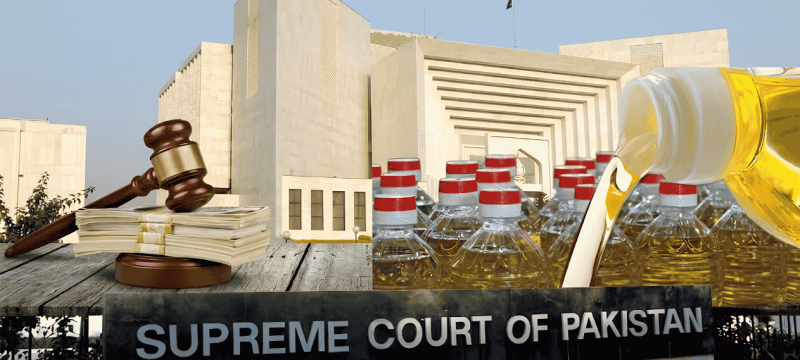
The Supreme Court has upheld a price-fixing violation against the ghee and cooking oil manufacturers’ association. However, it reduced the financial penalty to Rs30 million.
The court ruled that the Pakistan Vanaspati Manufacturers Association (PVMA) violated competition law. The association had coordinated prices among competing ghee and cooking oil manufacturers.
A two-member bench heard the case. Justice Jamal Khan Mandokhail and Justice Salahuddin Panhwar were part of the bench.
The judges upheld the main findings of the Competition Commission of Pakistan (CCP). They also supported the Competition Appellate Tribunal’s decision on the violation.
However, the Supreme Court reduced the penalty from Rs50 million to Rs30 million. The court directed PVMA to deposit the revised fine.
The dispute dates back to discussions held between 2007 and 2009. The federal government had engaged PVMA to discuss rising ghee and cooking oil prices.
PVMA participated in those discussions. The association later communicated the agreed prices to its member companies.
The CCP found that PVMA had effectively negotiated prices for competing manufacturers. It concluded that the practice breached competition law.
The commission cited Section 4(1), read with Section 4(2)(a), of the Competition Act, 2010. It initially imposed a Rs50 million penalty on the association.
The Competition Appellate Tribunal later upheld the commission’s penalty. PVMA subsequently challenged the decision before the Supreme Court.
In its judgment, the court stressed the importance of independent pricing decisions. Rival companies must decide their prices based on their own commercial interests.
Businesses must also consider market conditions when setting product prices. Trade associations cannot establish common prices for competing companies.
The judges warned that collective pricing can weaken market competition. Such practices can remove the pressure on companies to compete.
The Supreme Court also rejected the argument that lower agreed prices are automatically lawful. The court said the process used to set prices is also important.
Even an arrangement aimed at reducing consumer prices can breach competition rules. This applies when competing businesses jointly determine prices.
According to the judgment, healthy competition can encourage businesses to offer better prices. Consumers can benefit when companies compete independently in the market.
The court further rejected public benefit as a reason to bypass competition laws. Businesses must follow the Competition Act even when claiming consumer protection.
The case therefore provides an important clarification about collective pricing practices. Trade associations cannot use government discussions to justify common pricing among competitors.
There was No Relief from the Supreme Court on the core violation. PVMA remains responsible for breaching competition law.
However, the association received partial financial relief through the reduced penalty. The fine was cut by Rs20 million from the original amount.
The Supreme Court’s decision reinforces the need for independent pricing. It also highlights the importance of competition in protecting consumers.
For PVMA, there was No Relief on the finding that its conduct violated competition law. The association must now pay the revised Rs30 million penalty.
The ruling also sends a broader message to industry associations. Coordinated pricing among competing businesses can attract penalties under competition rules.
Ultimately, the court maintained the CCP’s central finding while reducing the financial burden. The decision provides No Relief from the underlying price-fixing violation.
In other news read more about: Supreme Court Rules Collective Ghee and Cooking Oil Pricing Illegal