

Growing up in the digital age in a relatively comfortable home in Islamabad, I used to feel stifled in my home and culture. I was bored, envious of the people I saw online who did what they wanted, where they wanted, dressed in what they wanted, with whom they wanted. Want is a strong emotion. To yearn is an itch, dissatisfaction ebbing throughout your body, a weight that holds you down.
I am not sure what I wanted, just that I was dissatisfied with what I had. All grown up, I realized I wanted this ownership over my choices. I thought my country could not not provide this ownership,the ideas themselves were fragmented and ambiguous.
I ended up a photographer of the imperfect. I enjoyed the innocent randomness of my area. The quiet quirks of screened windows and puddles and flowered trees. The colourful paint in a small market, the signage, the casualness of imperfection of things others might consider “pind” or low class. Slowly yet suddenly I fell in love with my homeland.
In my early 20s I had a group of friends so out of touch in a bizarrely extreme kind of way of which the obviousness of I am now grateful for. They operated in a way that you simply cannot in Pakistan, and with the rejection they faced by society, they turned to substances in a vicious cycle. It was an ugly low-budget season of the popular show Euphoria. I thankfully separated.
I had another friend group afterwards. They were more traditional. But this hate of Pakistan is present in both the conservative and liberal people I was friends with.
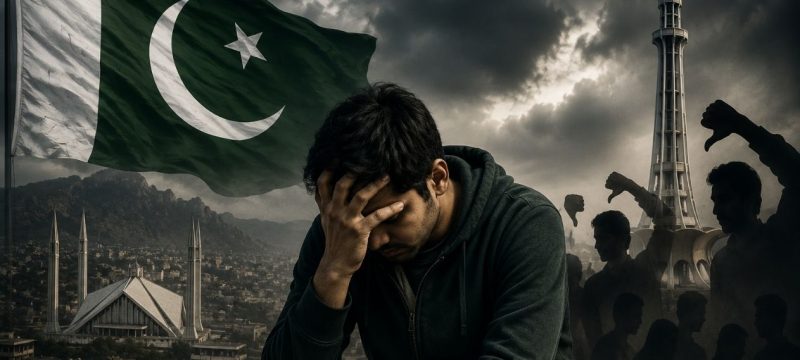
Oikophobia is a mindset where you hate your own country but romanticize others. Once in a conversation with artists, somebody was talking about littering in Pakistan and how normal it is. But when he littered in Canada, his niece got angry and told him not to dirty her Canada. Her Canada.
Canada was hers. But why doesn’t Pakistan belong to us? Do we belong to Pakistan? In this essay I want to explore Pakistani’s tendency to hate Pakistan and why it is.
I love Pakistan in a weird kind of way that you love a person, a parent, a provider. A land that feeds me, agriculture long before borders and laws. A land that clothes me, in beautiful, pure fabrics. My home, my safe place, the four walls of my room. I am a privileged girl.
That’s the thing, Oikophobia is the result of privilege, when your country and culture is the reason for your comfort.
Oikophobia is born in the minds of the upper class, the educated and scholarly, and like trends it trickles down slowly down the class ladder.
For example, Sialkot is the industrial city of Pakistan, factories upon factories of sportsgear, and we’ll scrunch up our nose at Sialkot but drop cash over the Nike or Adidas label of the tags our own people attach on the seams. We need that label, both for the comfort of our own oikophobia and the bigger issue of the functioning and value of our own industries.
I see so much Japanese idealization in people my age. Is Gen-Z liking Japan like Millennials liking the US? In the case of Japan, it surely is driven by progress. They hide their 18 hour work days with Hello Kitty and maid cafes.
But they own it, they have ownership over their kawaii culture and their teengirl porn industry. They bring bank over their innovation, a culture that prides themselves on their ideas, while hiding their culture of overwork. They know how to entice.
The same with the K-pop industry. Infantilized idols hiding eating disorders and extreme overwork, increasing their own countries value,
I’m trying to say, they overwork and I suppose so do we. I would say what separates us is oikophobia. We only like our own culture when the upper class alters it to look less “pind”.
I used to look down upon people who want foreign jobs, but seeing how hard it was for even my foreign educated peers to get jobs, I understand the plight. But I ask myself about the nature of oikophobia. Is it a simple romanticization or is it a plant sprouted to brain drain? Is it a digitally insidious new kind of colonization? Is our oikophobia again being manufactured, just like it was before 1947? With the century’s worth of colonization, is oikophobia in our genes, dormant but easily roused?
Just like the people who go abroad to provide for their family, the Nike label ensures our own people get fed (albeit extremely unfairly). Pakistan IS a rough place to live in. It’s dirty and expensive, it mistreats, it starves. But goddamnit I love it, I can fix it. I’m so enamoured by it. It’s mine. I mentioned in the beginning that I used to be consumed by want. But wanting a positive experience is itself a negative experience. Accepting the negative is a
positive experience. I keep talking about ownership, of love and possession. I believe you cannot shame anyone for being good. You can’t hate yourself for healthy progress. As a creative I learned the hard way that a scarcity mindset, a hateful mindset towards yourself does not yield a good painting. But whereas my scarcity mindset exists in my mind, while I panic over my life in an air conditioned room, people of my country have tin roofs. How much is this scarcity mindset foreign created, through brain drain, lack of jobs and bad economy?
According to Pakistan Institute of Development Economics “Brain drain could be defined as the migration of highly skilled human resources (Docquier et al., 2009) from one country to another or often the migration of highly skilled people from lower-income countries to high-income countries is termed as “brain drain” (World Bank report, 2023). Talent from less developed countries is drawn to developed nations due to their higher salaries, access to cutting-edge technology, better living standards, and more stable political environments.
The migration of high-skilled workers is a global phenomenon. However, most of the migration is from developing to developed countries. For high-income member countries of the Organization for Economic Cooperation and Development (OECD) it stands at 4 percent of the highly skilled population, formiddle-income countries this value is slightly over 10 percent and for low-income countries figures are 20 percent (Artuc et al.,2015; World Bank Report, 2023). Docquier (2014), through his landmark study, revealed the same findings that a low percentage of skilled people migrate from developed countries whereas in developing countries this percentage is very high.
However it also says “Pakistan, too being a developing country, stands third in South Asia (after India and Bangladesh) and sixth in the world in human capital migration (Farooq and Ahmad, 2017). Brain drain is the growing concern for developing countries like Pakistan, as these countries invest heavily in education and training of their young professionals. However, when these individuals migrate, significant resources are lost, and the recipient states benefit directly from these migrations as they haven’t paid any cost for it. Any nation’s intellectuals are among its most expensive assets due to their training, which involves both time and material costs, but more significantly, lost opportunities.”
This is good study because it asks. What investment in education and what opportunities? With the constant roadblocking due political instability and the VIP movement, the first and only action is the closure of educational institutes. People see “barri gaari” thundering along without consequences, their hearts filled with desire for a comfortable lifestyle and they know they’re not going to get it in Pakistan. They know because our media is mainly political content, social awareness content and saas bahu domestic issues. And if you’ve noticed these are the topics that dominate our conversations. I’m not saying that our culture doesn’t have its problematic qualities, but I believe that oikophobia is the reason we are not moving forward with solutions.
An example of this is how badly the feminist movement failed in Pakistan, and how even religious reform doesn’t work here either. We saw issues with the gender disparity and those issues are very real. Women here do have less access to education and opportunities here. But our oikophobia leads us to try to solve Pakistani problems with western solutions. We did not mould this idea of gender reform keeping in mind our own country’s culture and when the movement failed to entice the masses we rely on ragebait to keep the movement alive. But did we ever offer solutions that work for the women of our country? The oikophobia of the out of touch upper class trampled the future of feminism in Pakistan.
My liberal friends were permanently unhappy because all the solutions they tried to exercise were western in nature and it added to them having a rebel without a cause ideology. My conservative friends do not exercise these solutions but their problem is that they do not have solutions.
So you can understand why people who seek comfort in foreign media to escape their own lives’ very real problems, media of countries who take ownership of themselves, even with their own problems, and are allured by this possibility of a land that is not their own. Better is not in Pakistan, better will always be somewhere else.
I cannot talk about the economy, as an artist. I can only look at my own industry of creatives and realize how oikophobia litters it. Because Hollywood put America on the global idea of glamour, anime and Sanrio got Japan its spotlight. It was actually the AI “film” that a certain studio launched in theaters recently, relaunching a certain kid’s show from 1993 back when we weren’t extreme victims of oikophobia. The “director” bragged how all the work was done through AI, even voice acting. The media creates trends, after all. It reflects society.
It’s even worse than my disappointment when a certain handcrafted in Pakistan anime film launched in Pakistan, that boasted about being inspired by Studio Ghibli.
Despite its accolades touting about putting animation on the globe for Pakistan, I was very disappointed by the movie about how dishonest it was to itself and its own country. I could not at all connect with it. It was boring in the way it tried too hard to be something and that dishonestly made it hard to watch for me. Studio Ghibli owns its ideas, no matter how simple, it celebrates them with whimsy and passion. It knew what it was doing. My Neighbour Totoro is a simple movie plotwise, about childish innocence, but the joy it emanates brought tears to my eyes. In our version, Pakistan was just an unappetizing garnish on top of the whole movie. Perhaps it’s unfair to compare a country with a decade old animation industry and perhaps our Pakistani version did put us on the globe, but it’s like lauding a child who finished the first grade. We must look farther than catching up to the “developed”, we must not let oikophobia and a scarcity mindset cloud our creative endeavours where we laude and celebrate bare minimum progress. We must not stay in this small mindset of catching up. We must aim ourselves higher than this.
I don’t have solutions, but I believe a love for Pakistan, the lack of oikophobia can power us towards solutions that make our own country better. We cannot shame our country to progress.