


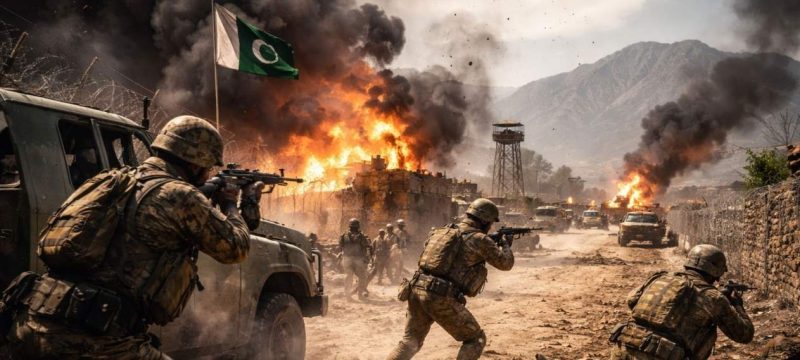
Tensions between Pakistan and Afghanistan have escalated after new military strikes and growing border clashes. The latest fighting marks a serious rise in hostilities between the two neighboring countries.
Officials in Islamabad and Kabul confirmed that Pakistan carried out overnight air strikes in several areas of Afghanistan. The strikes targeted Taliban military posts, headquarters, and ammunition depots near the border.
Pakistani officials said the operation came after an attack on Pakistani border forces. The recent fighting has raised fears of further escalation in the already tense region.
Pakistan’s Defence Minister Khawaja Asif described the situation as an “open war.” He said the country would respond strongly to threats coming from across the border.
The current tensions come after Pakistan launched earlier air strikes on militant targets inside Afghanistan last weekend. These operations were aimed at stopping cross-border attacks on Pakistani security forces.
Border clashes between the two countries have occurred several times in recent months. In October, heavy fighting killed dozens of soldiers on both sides.
That conflict ended after negotiations facilitated by Turkey, Qatar, and Saudi Arabia. A ceasefire was reached, but it remained fragile and short-lived.
Pakistan initially welcomed the return of the Afghan Taliban to power in 2021. However, relations between the two countries have since become strained.
Islamabad says leaders and fighters of the Tehreek-e-Taliban Pakistan (TTP) are based in Afghanistan. Pakistan claims these militants plan and launch attacks from Afghan territory.
Authorities also say that insurgents seeking independence for Pakistan’s Balochistan province sometimes use Afghanistan as a safe haven.
Kabul has rejected these accusations several times. Afghan Taliban officials insist they do not allow militants to use their territory for attacks against Pakistan.
The Afghan government has also accused Pakistan of harboring fighters linked to the Islamic State group. Islamabad strongly denies these claims.
Security analysts say militant attacks have increased since 2022. According to monitoring groups, attacks by the TTP and Baloch insurgents have risen each year.
The latest escalation followed a series of deadly attacks inside Pakistan. Security sources say militants linked to Afghanistan were behind several incidents since late 2024.
One recent attack in Bajaur district killed eleven security personnel and two civilians. Officials said the attacker was an Afghan national. The TTP later claimed responsibility for the assault.
The Tehreek-e-Taliban Pakistan was formed in 2007 by several militant groups. The organization has carried out attacks on markets, mosques, airports, and military bases.
The group also claimed the 2012 attack on schoolgirl Malala Yousafzai. She later received the Nobel Peace Prize.
Analysts warn that the ongoing fighting could intensify in the coming weeks. Pakistan may expand its military campaign, while Afghan forces could respond with cross-border raids.
There is a large difference in military strength between the two sides. Pakistan has more than 600,000 active personnel and advanced military equipment.
In other news read more about: After Rising Tensions, PM Shehbaz Visits GHQ With Tough Message on Security
The Taliban have around 172,000 fighters and limited air capability. Experts say the situation remains unpredictable as tensions continue along the border.