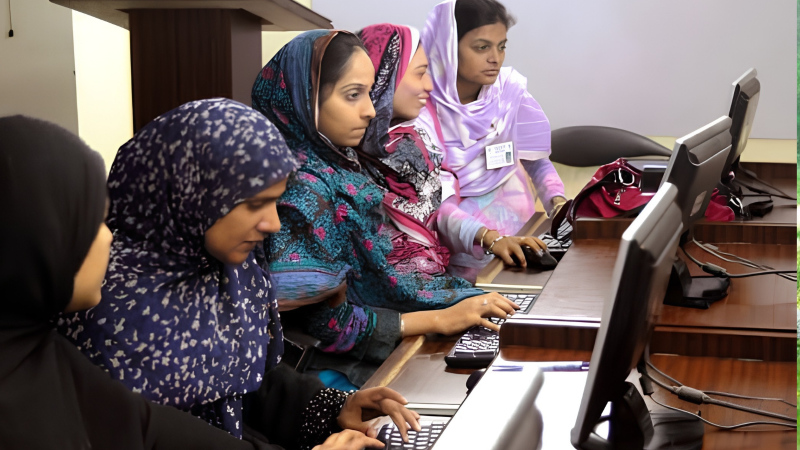
Pakistan has a women in tech paradox. Women are enrolling in technology degrees in large numbers and building careers as freelancers, yet very few reach executive positions. The same cultural expectations that push women away from corporate offices are driving them toward remote work, and the same norms build a hard ceiling above them.
Women Are Studying Tech
Pakistan reportedly has about 276,000 active students enrolled in Information and Communication Technology, and between 27 and 36 percent of them are women, which would put nearly 75,000 to 100,000 women in tech programmes. Women are also the biggest beneficiaries of the Prime Minister’s Laptop Scheme, accounting for 54 percent of participants as of April 2026, according to the Pakistan Economic Survey 2025-26.
Where Women in Tech Disappear
Professionally, women make up only about 14 percent of Pakistan’s IT workforce, according to the Pakistan Software Houses Association (P@SHA). A more recent P@SHA analysis puts the figure nearer 17 percent, while independent estimates stay around 14 percent. Local tracking also reportedly suggests that most of the more than 12,000 women who graduate from tech fields each year leave the sector within five years.
The drop-off is visible in the World Economic Forum’s 2026 data. Pakistan scores 44.9 percent gender parity for professional and technical workers but only 6.5 percent for legislators, senior officials and managers. An earlier P@SHA study found a similar mid-career bottleneck: 41 percent of women surveyed had between four and 15 years of experience, but only 13 percent reached general management, and women were about 13 percent of IT managers.
The Executive Positions Gap
The drop-off becomes even more pronounced in decision-making, executive and board-level roles. A P@SHA corporate ecosystem analysis reportedly estimates that only about 187 women have been formally identified with these profiles, and just 17 are widely recognized within formal executive pipelines. To reach healthy global benchmarks, P@SHA is said to estimate that Pakistan needs roughly 1,000 board-ready women in tech. Set against a female population of more than 117 million, 187 is a tiny number.
Women Leaders Do Exist
Women are shaping Pakistan’s digital economy, software ecosystem and tech policy as founders, executives and community leaders. Shaza Fatima Khawaja has been Minister of State for IT and Telecommunications since 2024. Jehan Ara, a veteran technology entrepreneur and former president of P@SHA, helped pave the way for the IT industry’s growth and for startup incubation through her work at Katalyst Labs and The Nest I/O. P@SHA is the trade association for Pakistan’s IT and IT-enabled services industry.
Where Women Are Thriving: Freelancing
The fastest growth is in the self-employed, remote digital economy. Research estimates that women make up 15 to 25 percent of Pakistan’s freelancers. Freelancing offers flexible shifts and a way to balance housework and family responsibilities in a country where office work is culturally challenging for many women.
The pay evidence is mixed. A Payoneer survey found Pakistani women freelancers earning $22 an hour against $20 for men, which would reverse the global pay gap. But that survey dates from 2020, and a later analysis of platform data found that women charged about 6.7 percent less than men per hour. The truth is probably somewhere between: women can earn well as freelancers, but not consistently more than men.
Why Culture Pushes Women Toward Freelancing
Working from home is often viewed more favorably by conservative families because it limits interaction with male coworkers and keeps women within the household. And because most childcare and domestic duties fall on women, a traditional 9-to-5 job is often unsustainable. Freelancing allows women to pause work during family hours and code or design late at night.
The Paradox
This is the paradox. The expectations that push women away from corporate offices are the ones pulling them toward freelancing, and those same expectations build a ceiling when it comes to climbing into management and leadership roles. Freelancing gives women an income and flexibility. It doesn’t give them seats on boards, access to promotion pipelines, or a route to executive positions. Until companies offer flexibility and a way back after breaks, Pakistan will keep training women for tech careers and then lose them before they can lead.
References
ProPakistani: PM Laptop Scheme Recorded 54% Female Participation
Business Recorder: Pakistan’s tech frontier needs more women pioneers
TechJuice: Pakistan Wants an AI Future. But Where Are the Women Building It?
Fuchsia Magazine: Pakistani Women in Tech & Innovation
The Borgen Project: The Boom of Freelancing in Pakistan
South Asia Investor: Pakistan Gig Economy, Women Freelancers
ITC Working Paper: The Global Gig Economy, Pakistan’s Opportunity