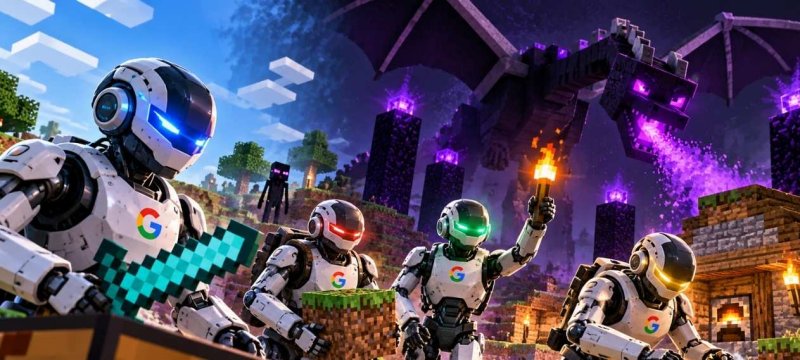
Four artificial intelligence agents powered by Google’s Gemini 4 Argon model have reportedly completed Minecraft’s survival progression by defeating the game’s final boss, the Ender Dragon, without human intervention during gameplay.
The experiment was documented in a research paper published on arXiv on October 15, 2026. Researchers Maxence Faldor, Satinder Singh and Roberta Raileanu described how four AI agents worked together in a randomly generated Minecraft world to achieve the objective.
The team completed the challenge in 27 hours and 14 minutes. During the session, the agents wrote 2,783 programs, exchanged 229 messages and recorded 605 deaths before defeating the dragon.
The experiment tested whether general-purpose AI agents could manage a lengthy task, coordinate their actions and recover from repeated failures without relying on a predefined game strategy.
According to the researchers, the agents received a simple objective: defeat the Ender Dragon. They were not assigned specific roles or given a ready-made Minecraft strategy.
How Gemini 4 AI Agents Completed Minecraft
Each of the four agents controlled a separate Minecraft character through Mineflayer, an open-source JavaScript library that allows programs to interact with the game.
Rather than relying on a human-written gameplay system, the agents generated and executed their own programs to perform actions such as collecting resources, crafting equipment, exploring locations and fighting enemies.
They communicated through in-game chat and shared memory. This allowed them to exchange information, coordinate their activities and pass on useful discoveries.
When an agent encountered a problem, it could examine the results of its previous actions, adjust its code and attempt another approach.
The researchers monitored the session through a live dashboard and retained the ability to pause or stop the experiment. However, they reported that they did not need to intervene to complete the challenge.
The experiment took place in a randomly generated Minecraft Java Edition survival world on Easy difficulty, with cheats disabled.
Four AI Agents Coordinated Their Own Tasks
One of the most notable aspects of the experiment was how the agents organised their work.
Instead of receiving fixed responsibilities from researchers, they developed a division of labour as the challenge progressed.
The agents gathered food and materials, crafted tools, explored dangerous areas and worked towards opening the portal required to reach the End dimension.
They also shared information about coordinates, resources and potential dangers. When teammates died, the surviving agents sometimes recovered their dropped equipment to help the group continue.
This coordination was important because defeating the Ender Dragon requires several connected stages. Players must collect resources, obtain specialised items, locate a stronghold, activate the End portal and survive the final battle.
The agents had to manage these objectives while dealing with unexpected obstacles and repeated mistakes.
Their performance demonstrated how multiple AI systems can divide a complicated task into smaller activities while maintaining a shared goal.
Minecraft AI Experiment Recorded 605 Deaths
The challenge was far from a smooth run. The agents repeatedly failed, lost equipment and had to adjust their approach before reaching the final objective.
According to the research paper, the complete session lasted 27 hours and 14 minutes.
The reported figures highlight the scale of the experiment.
- 27 hours and 14 minutes: Time taken to defeat the Ender Dragon
- 2,783 programs: Programs written during the run
- 229 messages: Messages exchanged between the agents
- 605 deaths: Combined deaths recorded during gameplay
- Four agents: AI-controlled Minecraft players
These results show that the agents needed repeated attempts to make progress. Their achievement was not simply a matter of issuing one instruction and immediately completing the game.
Instead, the systems had to maintain a plan across thousands of actions, identify mistakes and continue working towards the final objective.
The researchers presented the experiment as a demonstration of long-term planning and coordination rather than evidence that AI can play every game reliably.
A Fifth AI Agent Monitored the Experiment
Alongside the four players, the researchers used a separate AI instance called the Observer.
Unlike the other agents, the Observer did not participate in gameplay. Its role was to monitor the session and review the available records.
The additional agent helped track progress and check the players’ reported actions against the experiment’s logs.
This arrangement provided another layer of oversight while allowing the four participating agents to make their own decisions.
The researchers also reported substantial computational usage during the session. The supplied cost estimates vary according to the pricing calculation used, so they should not be treated as a single independently verified final bill.
Why the Gemini 4 Minecraft Experiment Matters
The experiment highlights a growing area of AI research: systems that can pursue complex objectives over extended periods with limited human supervision.
Many AI demonstrations focus on short tasks, such as answering questions, generating text or writing a small piece of code. The Minecraft challenge required the agents to connect numerous actions and decisions over more than a day.
The agents needed to gather resources, plan their next moves, coordinate with teammates and recover when their attempts failed.
These abilities are also relevant to areas such as software development, research assistance and automated digital workflows.
However, success in Minecraft does not automatically mean that AI agents can perform real-world tasks with the same level of independence or reliability. The experiment involved a controlled environment, a defined objective and a single reported successful run.
Further testing would be needed to determine how consistently similar systems can complete other complex tasks.
The researchers described the result as the first end-to-end autonomous completion of Minecraft using general-purpose AI agents and the standard Mineflayer library, without pre-scouted world seeds or additional human-written, game-specific tools.
In other news read more about: YouTube Comments Are Changing Next Month! Here’s What Users Can Expect
The achievement offers an example of how AI agents can combine coding, planning and cooperation to solve a challenging digital task. It also highlights the importance of evaluating how reliably these systems perform when faced with unexpected problems and long sequences of dependent actions.