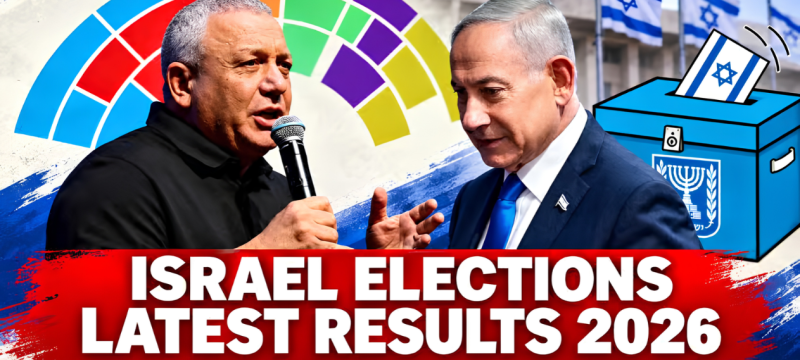
Israel is facing another period of political uncertainty after the Israel Election 2026 failed to produce a clear parliamentary majority. Prime Minister Benjamin Netanyahu now faces challenges in securing enough support to form a government.
Provisional results suggest that Netanyahu’s right-wing and religious alliance could win 53 seats in the 120-member Knesset. This leaves the alliance eight seats short of the 61 required for a parliamentary majority.
The opposition bloc, led by former Israeli military chief Gadi Eisenkot, is projected to secure 48 seats. Meanwhile, Arab political parties could win a combined 19 seats, potentially giving them greater influence over coalition negotiations.
With more than 98 percent of ballots reportedly counted, the overall parliamentary balance is becoming clearer. However, individual party seat allocations may change before the results receive official certification.
Israel Election 2026: Latest Seat Projections
The provisional figures show that neither major bloc can independently secure a parliamentary majority.
Netanyahu’s alliance remains ahead in the projected seat count. However, it needs additional support to establish a government.
The opposition could potentially reach a majority with backing from Arab political parties. However, political differences and restrictions on coalition cooperation could complicate such an arrangement.
| Political alliance | Projected seats | Parliamentary position |
|---|---|---|
| Netanyahu-led alliance | 53 | Eight seats short |
| Eisenkot-led opposition | 48 | Thirteen seats short |
| Arab political parties | 19 | Potentially influential |
| Total | 120 | 61 seats required |
Netanyahu’s Likud party remains the largest individual political force, with projections indicating approximately 26 to 27 seats.
However, several of his political allies appear to have lost parliamentary strength. Parties associated with far-right leaders Itamar Ben-Gvir and Bezalel Smotrich are projected to win seven and six seats, respectively.
Their combined representation could fall to 13 seats, compared with 20 in the previous parliament. This decline may make it more difficult for Netanyahu to rebuild his governing alliance.
Party-Wise Results Show a Divided Parliament
The projected results indicate a fragmented political landscape across Israel.
Gadi Eisenkot’s Yashar party is expected to win 21 seats, placing it behind Likud. The joint list associated with Naftali Bennett and Yair Lapid is projected to secure 12 seats.
Other opposition parties include The Democrats, led by Yair Golan, and Yisrael Beiteinu, led by Avigdor Liberman. They are projected to win eight and seven seats, respectively.
The provisional party-wise seat distribution is as follows:
| Political party | Leader | Projected seats |
|---|---|---|
| Likud | Benjamin Netanyahu | 26–27 |
| Yashar | Gadi Eisenkot | 21 |
| B’Yachad (Together) | Naftali Bennett and Yair Lapid | 12 |
| Joint List | Arab political alliance | 12 |
| The Democrats | Yair Golan | 8 |
| Otzma Yehudit | Itamar Ben-Gvir | 7 |
| United Torah Judaism | Yaakov Asher | 7 |
| Yisrael Beiteinu | Avigdor Liberman | 7 |
| Ra’am | Mansour Abbas | 7 |
| Shas | Aryeh Deri | 6–7 |
| Religious Zionism–Zehut | Bezalel Smotrich and Moshe Feiglin | 6 |
Arab Parties Could Influence Coalition Talks
One significant development in the Israel Election 2026 is the projected increase in parliamentary representation for Arab political parties.
The Joint List is expected to secure 12 seats, while Mansour Abbas’s Ra’am party could win seven. Together, the parties may hold 19 seats in the Knesset.
This representation could give Arab lawmakers greater influence during negotiations over the next government. However, their participation in a governing coalition remains uncertain.
Several Jewish-led parties have expressed reluctance to depend on Arab parties for parliamentary support. Netanyahu’s alliance has also opposed such arrangements, creating further obstacles to coalition building.
High Voter Turnout Marks the Election
Former Israeli army chief Gadi Eisenkot has emerged as a central figure in the opposition. His party’s projected performance places it ahead of several established political groups.
His wider opposition bloc includes parties associated with Bennett, Lapid, Golan and Liberman. Their combined strength could shape discussions about possible government arrangements.
The election also recorded reported voter turnout of approximately 77.7 percent. Arab citizens of Israel participated in large numbers, contributing to the projected gains for Arab-led parties.
The final outcome will depend on official results and negotiations among political groups. Until a coalition secures sufficient parliamentary support, Israel’s next government remains uncertain.
In other news read more about: World Leaders Reacts to US Election 2024 Victory