


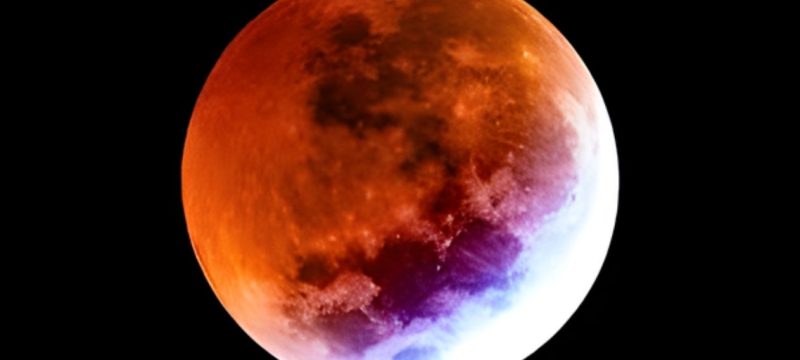
Skywatchers around the world are preparing for a rare celestial event as a total lunar eclipse creates a stunning Blood Moon in early March 2026. The phenomenon will occur when the full “Worm Moon” passes through Earth’s shadow.
According to astronomers, the eclipse will be visible overnight between March 2 and March 3, 2026. During this event, the Moon will gradually darken before turning a deep reddish color, commonly known as a Blood Moon.
A Blood Moon occurs during a total lunar eclipse. This happens when Earth moves directly between the Sun and the Moon. As a result, the Moon passes through Earth’s shadow.
The red color seen during a Blood Moon is caused by a scientific process called Rayleigh scattering. Earth’s atmosphere filters out blue light from the Sun while allowing red wavelengths to reach the Moon.
These red wavelengths bend around the planet and illuminate the Moon’s surface. This effect gives the Moon a dark copper or reddish appearance during the eclipse.
The March full moon is traditionally known as the “Worm Moon.” The name comes from seasonal changes that occur at the end of winter. As the ground begins to soften, earthworms start to emerge in many regions.
Astronomers say the total lunar eclipse will last about 58 minutes. This is the period when the Moon will be fully inside Earth’s shadow and appear as a Blood Moon in the sky.
The most dramatic views of the eclipse will be seen in North America, the Pacific region, Australia, and parts of East Asia. Observers in these areas will be able to watch the event clearly.
People living in the western United States will see the entire eclipse from beginning to end. However, viewers on the East Coast will only catch the early phase of the Blood Moon before sunrise.
Unfortunately, skywatchers in Europe and Africa will not be able to see the eclipse clearly. The timing of the event will place the Moon below the horizon in those regions.
According to space experts, the eclipse will begin with the penumbral phase around 3:33 a.m. EST in the United States. The partial eclipse will start at about 4:50 a.m. EST.
The most dramatic stage of the Blood Moon will appear between 6:04 a.m. and 7:02 a.m. EST. The Moon is expected to reach its deepest red color around 6:33 a.m. EST.
Unlike a solar eclipse, a Blood Moon is safe to watch with the naked eye. However, using binoculars or a telescope can provide a clearer and more detailed view of the lunar surface.
In other news read more about: Localized Dust Storms Accelerated Mars Water Loss, Study Shows
Astronomy experts encourage people to step outside and watch the rare event. The Blood Moon eclipse is expected to offer a memorable sight for those in regions where the sky remains clear.