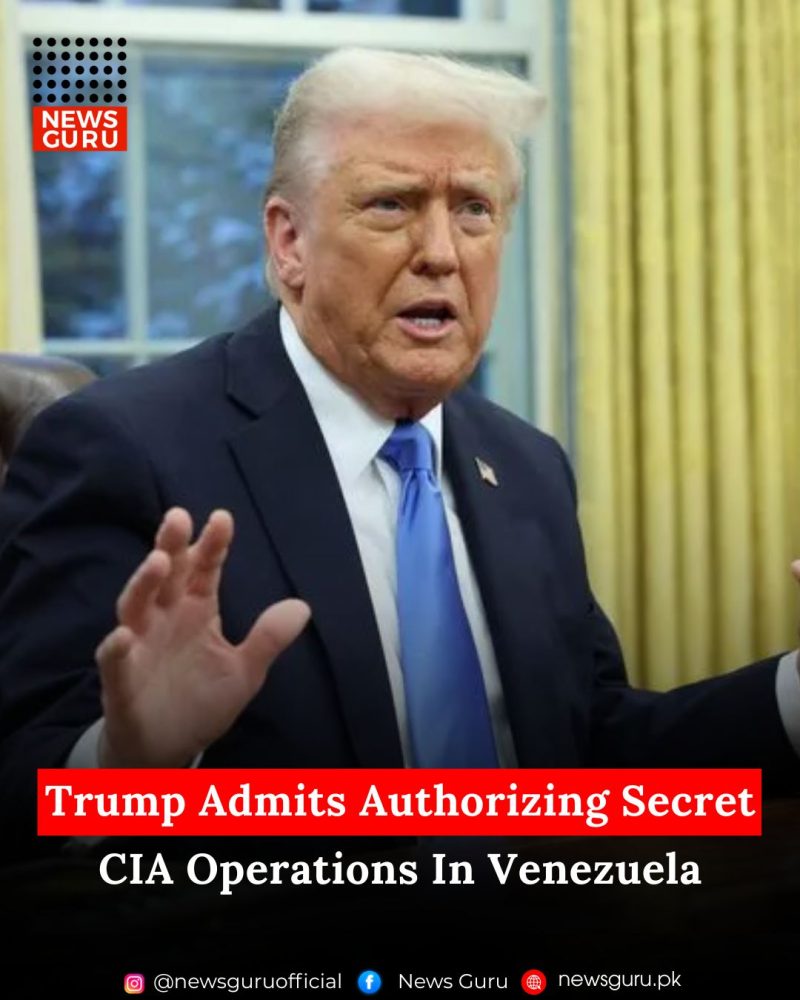
In a move that significantly heightens tensions between Washington and Caracas, U.S. President Donald Trump confirmed on Wednesday that he has authorized the Central Intelligence Agency (CIA) to conduct covert operations inside Venezuela, signaling one of the most aggressive steps yet in his administration’s campaign to remove President Nicolás Maduro from power.
The authorization, first revealed by The New York Times and later confirmed by Trump himself, reportedly grants the CIA wide-ranging operational authority — including the power to carry out lethal missions, gather intelligence, and support regional operations across the Caribbean basin.
According to U.S. officials cited in the report, the directive is part of a broader White House strategy aimed at undermining the Maduro regime, which Washington accuses of presiding over a “criminal narco-terrorist state.”
Trump’s Rationale: Migration and Drug Trafficking
Speaking to reporters in the Oval Office, President Trump said his decision stemmed from two major concerns:
- The alleged migration of Venezuelan prisoners into the United States.
- The country’s purported involvement in drug trafficking operations targeting U.S. borders.
“I authorized for two reasons really,” Trump said. “Number one, they have emptied their prisons into the United States of America — they came in through the border. And the other thing is drugs.”
However, the President offered no concrete evidence to substantiate claims that Venezuela had released inmates or psychiatric patients into the U.S., or that the country is a primary source of narcotics entering the American market.
Trump also asserted that the U.S. has “the sea very well under control” regarding drug interception and will now shift focus toward overland smuggling routes.
“We are looking at land now,” Trump said. “Because we’ve got the sea very well under control.”
The White House declined to elaborate on the specific scope of the CIA’s newly granted powers or what actions may already have been undertaken.
A Return to Cold War-Style Covert Strategy
If confirmed in full, the move marks one of the most substantial expansions of CIA operational freedom in Latin America since the Cold War era. Historically, the CIA’s footprint in the region has ranged from intelligence gathering to direct involvement in paramilitary and political operations, including the overthrow of governments in Chile (1973) and Guatemala (1954).
In the late 20th century, the agency played a key role in dismantling South America’s major cocaine cartels, particularly in Colombia and Bolivia. More recently, reports have suggested ongoing CIA collaboration with Mexican authorities to target drug traffickers along the U.S.–Mexico border.
Venezuela Responds: “Violation of International Law”
The Maduro government responded swiftly and sharply to the President’s statements.
In a statement issued by Foreign Minister Yvan Gil and posted on his official Telegram channel, Caracas condemned Trump’s remarks as a “flagrant violation of international law” and accused Washington of orchestrating a “regime-change operation” disguised as anti-drug enforcement.
“Our Permanent Mission to the UN will raise this complaint with the Security Council and the Secretary-General tomorrow,” Gil said, “demanding accountability from the United States government.”
Venezuela further accused Washington of seeking to seize the country’s vast oil resources under the guise of a counter-narcotics campaign.
Escalating Military Presence in the Caribbean
The CIA authorization follows a months-long U.S. military buildup in the southern Caribbean, including the deployment of naval and air assets and the execution of five strikes on vessels that the Trump administration claims were “narco-trafficking boats.”
While the Pentagon has provided no public evidence to substantiate these claims, administration officials argue that the operations are part of a “non-international armed conflict” against drug cartels — a legal interpretation recently communicated to Congress.
Trump’s critics, however, view the moves as a potential prelude to direct U.S. intervention in Venezuela.
Senator Jeanne Shaheen, the top Democrat on the Senate Foreign Relations Committee, expressed concern on Wednesday that the administration may be steering the U.S. toward a new military conflict without congressional approval.
“The American people deserve to know if the administration is leading the U.S. into another conflict,” Shaheen said. “Are we putting service members at risk or pursuing a regime-change operation?”
Trump’s Expanding Doctrine of “Unconventional Warfare”
The CIA directive reflects a broader pattern in Trump’s second term: an increasing reliance on covert or semi-legal military strategies to confront transnational threats.
From deploying active-duty troops in Los Angeles to conducting counterterrorism strikes on suspected drug traffickers, the administration has blurred the line between law enforcement and wartime operations, often bypassing traditional checks from Congress or the intelligence community.
Trump has also accused Venezuela — without clear evidence — of being a key transit hub for fentanyl, though U.S. records consistently identify Mexico as the primary source of the drug entering the country.
Asked whether the CIA now has the authority to target or assassinate Maduro, Trump declined to give a direct answer, instead responding cryptically:
“I think Venezuela is feeling heat.”
International and Domestic Fallout
The announcement is likely to draw sharp criticism from Russia, China, and Iran, all of which maintain close ties with Caracas. Venezuelan opposition leader and 2025 Nobel Peace Prize laureate María Corina Machado — currently in hiding — has publicly welcomed U.S. pressure on Maduro, describing it as necessary to “cut off the regime’s criminal networks.”
Still, the revelation could complicate Washington’s diplomatic standing at the United Nations and among Latin American allies, many of whom have expressed unease about Trump’s unilateral interventionism in the region.
With U.S.–Venezuela relations already at their lowest point in decades, the CIA’s new mandate represents a potential turning point — one that could reshape the geopolitical landscape of Latin America for years to come.
In other news also read about María Corina Machado’s Next Mission; Stopping Maduro’s “War” on Venezuela