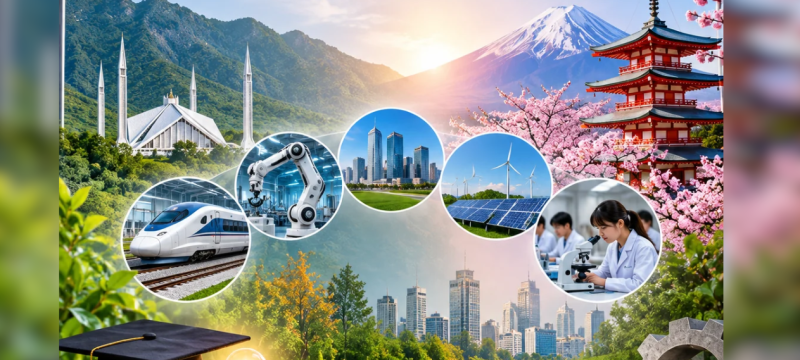
Every nation has a story. Some countries rise from difficult circumstances and build a future that once seemed impossible. Japan is one such example. After facing widespread destruction during the Second World War, Japan gradually rebuilt its economy, strengthened its industries, invested in education, and became known for its technological development. Pakistan, too, has the potential to create a better future, but meaningful progress requires a change in our priorities, institutions, and national mindset.
The question is not whether Pakistan can change. The real question is whether we are ready to make the changes necessary for progress.
Learning from Japan
Japan’s development offers several important lessons. Education, technical skills, industrial development, and a culture of responsibility have played important roles in its progress. Japanese society is also widely recognised for its emphasis on punctuality, cleanliness, and respect for public spaces.
These qualities did not develop through slogans alone. They were strengthened through social expectations, education, institutions, and everyday habits.
Pakistan can learn from these experiences without blindly copying Japanese society. Every country has its own history, culture, and challenges. What matters is understanding which lessons can work in Pakistan.
Education Must Become Our First Priority
No country can build a strong future while leaving its children behind. Education should not be limited to obtaining degrees or passing examinations. It must teach students how to think, solve problems, communicate effectively, and develop practical skills.
Pakistan needs better schools, trained teachers, modern laboratories, technical education, and greater opportunities for girls and boys in every region. Students should also learn about science, technology, entrepreneurship, and responsible citizenship.
Japan’s experience demonstrates the importance of developing skills that contribute to society and the economy. Pakistan must ensure that education prepares young people not only for jobs but also for the responsibilities of citizenship.
From Unemployment to Innovation
Pakistan has a young population with considerable potential. However, potential alone cannot create prosperity. Young people need opportunities to turn their ideas into businesses, products, services, and inventions.
The country should support small businesses, modern agriculture, information technology, renewable energy, manufacturing, and vocational training. Farmers need access to improved technology and water-management methods. Small business owners need a supportive environment in which they can grow. Young entrepreneurs need access to skills, finance, and fair opportunities.
Japan developed strong industrial capabilities over decades. Pakistan can pursue its own path by investing in productive industries, improving the quality of local products, and encouraging research and innovation.
Discipline, Law, and Public Responsibility
Development is not only the responsibility of governments. Citizens also shape the condition of their country through their daily behaviour.
Throwing rubbish into the streets, damaging public property, ignoring traffic rules, and using personal connections to avoid fair procedures all weaken public trust. A society cannot demand an orderly system while refusing to respect its rules.
At the same time, responsibility must begin with institutions. Laws should be applied fairly, public services should be reliable, and government offices should serve citizens without unnecessary delays. Accountability must apply to everyone, regardless of wealth, influence, or position.
Discipline should never mean blind obedience. It should mean respecting the law, fulfilling responsibilities, and demanding justice through lawful and peaceful means.
A Government That Serves the People
For Pakistan to progress, public institutions must become more effective, transparent, and accountable. Governments need to focus on education, healthcare, electricity, water, transport, justice, and economic opportunity.
Policies should continue when they benefit the country, rather than being abandoned simply because political leadership changes. Public money should be spent responsibly, and citizens should be able to understand how decisions are made.
Japan’s experience also reminds us that economic development takes long-term planning, capable institutions, investment, and cooperation between the public and private sectors. There is no single policy that can solve every problem, and Pakistan must develop solutions suited to its own circumstances.
Change Begins with Us
We often expect a new government, a new leader, or a new policy to transform the country overnight. But national change is a long process. It requires governments to perform their duties, institutions to improve, businesses to create opportunities, and citizens to participate responsibly.
A student who studies honestly, a teacher who performs their duty, a shopkeeper who treats customers fairly, an officer who refuses corruption, and a citizen who respects public property all contribute to national progress.
These actions may seem small, but their collective impact can be significant.
Conclusion
Pakistan does not need to become Japan. It needs to learn from the experiences of countries that have invested in education, technology, strong institutions, and public responsibility while building a future that reflects Pakistan’s own identity and needs.
We have the people, the ideas, and the resources to pursue meaningful progress. What we need is a sustained commitment to turning potential into results.
The future of Pakistan will not be decided by speeches alone. It will be shaped by the quality of our schools, the fairness of our institutions, the strength of our economy, and the choices we make every day.
A developed Pakistan is not merely a dream for the next generation. It is a responsibility that begins with the present generation.