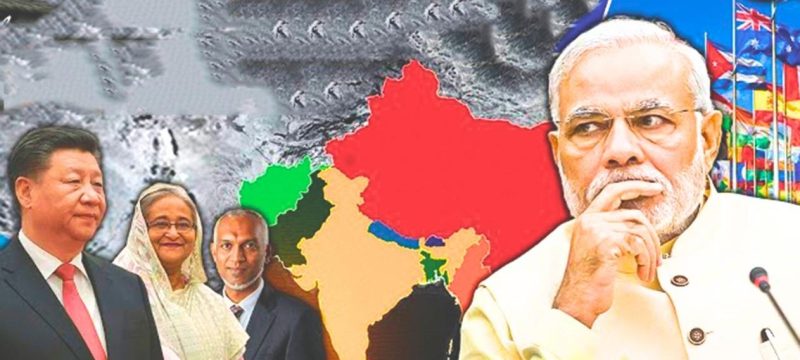
India’s aspiration to become a great power with global influence is no secret. Notwithstanding the structural inconsistencies, India’s demographic configuration, geographical positioning, and economic outlook are marketed as enabling the potential for ascent as a major player. Yet, underneath the carefully choreographed construct of “rising India” lies a fundamental and often overlooked contradiction: India is increasingly isolated in its immediate neighborhood.
Considering its geographic centrality in South Asia, India could have acted as a geo-economic anchor in the region. Yet India’s relations with almost all of its neighbors are marked by either distrust or hostility. The estrangement is not the consequence of happenstance, but is the cumulative product of a flawed regional strategy that long prioritized dominance and hegemony over mutually beneficial partnerships.
Since its inception, India approached its neighborhood through the prism of strategic dominance. The ambition was formalized under the Indira Doctrine, which designated South Asia as India’s exclusive sphere of influence and vowed to resist any external intervention. Though often rationalized as the manifestation of India’s quest for regional stability, the doctrine rather unequivocally articulated India’s desire for regional hegemony. By implication, the doctrine denied other South Asian states strategic autonomy and relegated them to extensions of India’s security perimeter.
Although the Indira doctrine was never codified as a formal policy, New Delhi’s posturing and actions vis-à-vis its neighbors demonstrate that the doctrine’s logic continues to shape India’s regional policy. India does not treat its neighbors as sovereign equals, but as ancillaries, which must align their domestic systems and external policies with New Delhi’s preferences. Such outlandish expectations come into direct conflict with the post-colonial sensitivities of smaller South Asian states, for whom sovereignty is not just a function of international law, but also a hard-won political achievement. The resulting tensions have created immense alienation in smaller South Asian states.
Nepal is the most vivid illustration of India’s hegemonic posture backfiring. New Delhi’s desire to shape the events in Kathmandu and the employment of coercive tactics have created strong resentment. For instance, notwithstanding the official denials, the 2015 blockade was interpreted as coercion by India to influence constitutional changes in Kathmandu. The blockade underscored Nepal’s structural reliance on India and cemented the belief that New Delhi remains willing to weaponize the structural reliance to impinge on Nepal’s sovereignty. In response, Nepal scrambled to diversify its options and deepened economic and political engagements with China.
Sri Lanka is another example of India’s regional dominance ambitions gone awry. India’s involvement in Sri Lanka during the civil war, particularly the military deployment in 1987-1990, was perceived as a breach of Sri Lanka’s sovereignty and generated strong resentment and backlash. Sri Lanka chose to diversify its options by strengthening relations with other countries, most notably China. Beijing’s burgeoning economic footprint in Sri Lanka is catalyzed by Colombo’s desire for alternatives. To put it alternatively, China capitalized on the opportunity created by years of botched Indian meddling in Sri Lanka.
Bangladesh, until recently, was cited as an example of India’s successful neighborhood policy. However, former PM Sheikh Hasina’s pro-India leanings and the domestic excesses created strong anti-India sentiment in Bangladesh. This manifested in the form of a mass uprising, culminating in the ouster of the Hasina regime in August 2024. Since then, India-Bangladesh relations have soared, with the extradition of Sheikh Hasina being the most contentious issue. New Delhi is perceived to be attempting to install a pro-India regime in Dhaka, much to the ire of the current dispensation. Lately, India has been accused of being behind the assassinations of youth leaders in Bangladesh — who played a prominent role in the overthrow of the Hasina regime — sparking another wave of anti-India protests.
India’s involvement in the Maldives in the form of military presence also caused a strong resentment in the Island nation. This manifested in the form of the “India out” campaign and translated into a wave of anti-India protests, which led to the electoral defeat of former President Ibrahim Solih. The current President, Mohamed Muizzu, won polls promising to evict the foreign troops and later secured the complete withdrawal of the Indian military personnel. Moreover, President Muizzu is also expanding ties with China, which is another example of smaller South Asian nations diversifying their options away from India.
India’s relationship with Pakistan, marked by enduring hostility, also underscores the limitations of India’s hegemonic ambitions. India’s insistence on dictating the terms of the bilateral relationship and refusal to have meaningful engagements with Pakistan based on sovereign equality have fortified a zero-sum regional order in South Asia, hindering any movement towards establishing regional cooperative frameworks. Hence, it is not surprising that South Asia has evolved to feature among the least economically integrated regions in the world. India’s desire for dominance has yielded a regional paralysis in South Asia.
The above instances underscore a consistent pattern wherein India’s desire for regional dominance has alienated its smaller neighbors. India often finds solace in blaming China for the regional setbacks. However, this explanation obscures the fact that China’s expanding footprint in South Asia is not just the result of Beijing’s economic might, but is also a consequence of regional countries’ desire to hedge against Indian hegemony. To put it alternatively, China did not create the South Asian nations’ alienation vis-à-vis India, though it did capitalize on that.
India’s growing isolation in its neighborhood is in stark contrast to its approach of cultivating economic and political ties with countries in other parts of the world. India champions itself as the voice of the Global South and seeks a major role in the emerging multi-polar world order. Yet its desire for regional dominance has isolated it in the immediate neighborhood and has created a deeply fractured South Asia.