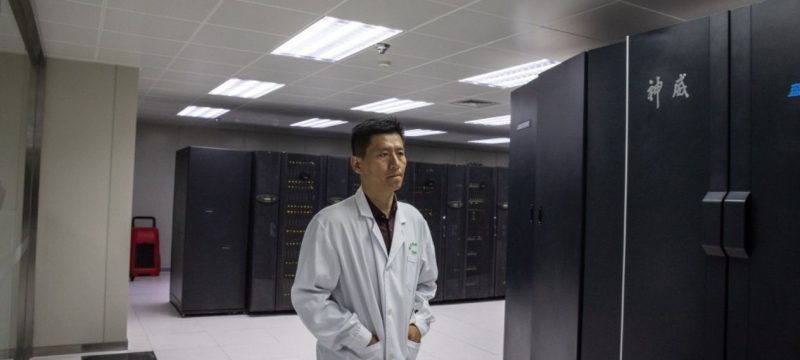
China has once again become home to the world’s fastest supercomputer after reclaiming the top position for the first time since 2017.
The new system, named LineShine, was installed at the National Supercomputer Centre in Shenzhen. It achieved a performance of 2.198 exaflops, placing it at the top of the latest TOP500 supercomputer rankings.
LineShine surpassed the previous leader, El Capitan, located at the Lawrence Livermore National Laboratory in the United States. El Capitan recorded a performance of 1.809 exaflops.
The achievement marks a major milestone in computing technology. LineShine is the first system on the TOP500 list to cross two exaflops of sustained double-precision performance using only central processing units (CPUs).
The supercomputer reached nearly 80 percent of its theoretical peak capability, which stands at 2.736 exaflops. TOP500 organiser Dr. Jack Dongarra described the system as an impressive development.
Unlike many modern high-performance systems, LineShine does not depend on graphics processing units (GPUs) for acceleration. Instead, it uses a CPU-focused design developed with custom technology.
The machine is powered by custom 304-core processors. It contains around 13.79 million cores operating at a speed of 1.55GHz. A specially designed network connects the processors and allows efficient data movement.
This approach helped China develop a powerful supercomputer despite challenges related to access to advanced foreign technologies.
LineShine consumes about 42.2 megawatts of electricity. It delivers an energy efficiency rating of 52.07 gigaflops per watt. Although El Capitan remains more efficient at 60.94 gigaflops per watt, LineShine leads in overall computing performance.
The latest TOP500 ranking includes five supercomputers that have crossed the one-exaflop mark. China has one system on the list, while the United States has three. Germany also has one entry.
El Capitan now holds the second position, followed by Frontier at Oak Ridge National Laboratory. Aurora from Argonne National Laboratory ranks fourth, while Germany’s JUPITER Booster completes the top five.
The ranking shows that different technologies are being used in the race for advanced computing. Systems now combine CPUs, GPUs, accelerated processing units, and custom hardware.
China has traditionally kept many details about its supercomputing projects private. However, LineShine was reportedly submitted for testing because it was developed without public funding.
In other news read more about iPhone 18 to Bring the Biggest Camera Upgrade in History
Developers have not revealed the company behind the processors or the manufacturing technology used. Despite limited technical information, the system has secured a leading position in global supercomputing.