The Role Teachers Actually Play
October 5th marks World Teacher’s Day, to honor teachers and recognize their vital role in moulding society and education.
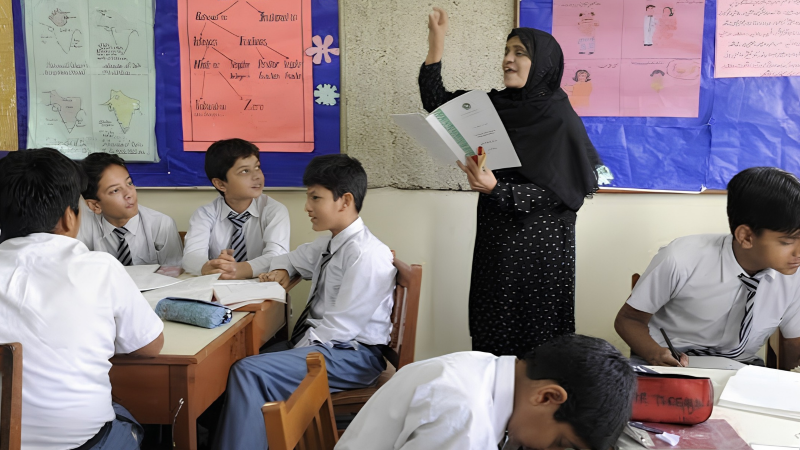
In Pakistan, the role of a teacher extends far beyond academic instruction; they frequently act as critical anchors for student development. While schools focus on literacy, the most profound impact occurs through individual mentorship. Exceptional educators possess a unique capacity to recognize individual potential in crowded classrooms, offering guidance and security during formative years. For many young people navigating complex environments, the timely intervention of a dedicated teacher provides the clarity needed to navigate major turning points. By offering steady mentorship, these professionals do more than deliver a syllabus — they actively alter student trajectories. Ultimately, the true measure of an educator’s influence is found in these quiet interventions, where a teacher’s insight serves as a lifeline that reshapes a student’s future.
The Disconnect Between Expectation and Reality
A truly dedicated teacher does not simply deliver a syllabus; they act as a profound psychological and emotional anchor, possessing the rare capacity to recognize a struggling student and step in to alter their life trajectory. For many young people navigating personal crises, a teacher’s timely guidance is a literal lifeline. However, a critical disconnect exists between this noble expectation and reality. Today, the transformative potential of classroom mentorship is being systematically stifled. Before a teacher can look past a crowded row of desks to rescue a vulnerable student, they must first survive an exhausting institutional environment that leaves them depleted, overwhelmed, and disconnected from the very purpose of their calling.
Economic Instability
Chief among these concerns is economic instability. Salaries for entry-level and contract teachers have failed to keep pace with inflation, and administrative delays frequently result in months of deferred compensation. These structural strains — particularly severe salary delays and bureaucratic blockages — predominantly affect government sector teachers. Programs like the College Teacher Interns (CTIs) and School Teacher Interns (STIs) hired by provincial governments frequently experience months of unpaid work while waiting for policy renewals or budget sign-offs.
“Over 20,000 public school educators under semi-autonomous authorities like the Punjab Education Initiatives Management Authority (PEIMA) regularly go up to three months without basic compensation due to delayed official subsidies.”
This isn’t a one-off. Per Dawn, around 20,000 teachers across roughly 4,300 PEIMA-run schools went unpaid for January through March 2026, affecting nearly 600,000 students. The same pattern repeated months later: TechJuice reported PEIMA schools facing another two-month payment delay for July and August, again affecting the same 20,000 teachers and 600,000 students.
The BPS Inflation Gap: Even for permanent public teachers locked into the Basic Pay Scale (BPS) system, statutory salary revisions and ad-hoc allowances routinely get stuck in administrative cycles, leaving their monthly income struggling to match national inflation rates.
The Private School Trap
Teachers in low-tier private schools suffer from chronically depressed, flat-rate wages. Their financial reality is grim. Unlike elite, high-end private school chains, these low-tier schools operate on very tight budgets and face distinct financial constraints.
This means salaries are kept exceptionally low — often sitting well below the government’s official legal minimum wage. Teachers in these schools frequently earn flat rates as low as Rs. 10,000 to Rs. 15,000 per month. Sindh’s own Education Minister has publicly acknowledged private teachers earning as little as Rs. 8,000 to 10,000 a month, against a government-mandated minimum of Rs. 25,000. They receive no built-in annual increments, no health insurance, no allowances for inflation, and no provident funds or pensions.
Teacher complaints published in The Express Tribune echo the same pattern nationwide: private school teachers paid a few thousand rupees a month for full-time work, often less than half the statutory minimum wage, despite the same schools charging high fees to students.
While public sector teachers face bureaucratic delays, they eventually receive scale promotions (BPS upgrades) and job security. In low-tier private schools, teachers have virtually no upward mobility or financial growth, regardless of how many years they dedicate to the institution.
What Gets Lost
An exceptional teacher possesses the rare capacity to act as a literal lifeline for a student, but the sheer weight of institutional misery increasingly stifles this potential. When a young person navigates a difficult personal or social crisis, a perceptive mentor can provide the stability and direction needed to alter their life trajectory. However, this deep, transformative mentorship requires immense emotional energy, presence of mind, and time — resources that are systematically drained by the current educational environment.
Instead of focusing on student well-being, teachers are consumed by exhaustive administrative upkeep, rigid paperwork, and endless regulatory compliance. When educators are forced to operate under chronic professional exhaustion, their role shifts from compassionate mentors to stressed administrators. It is impossible to look past a crowded row of desks and spot a struggling student when your entire day is consumed by performance metrics and box-checking. Ultimately, the greatest tragedy of a strained education system is not just falling academic standards, but the lost opportunities for quiet, life-saving interventions that exhausted teachers simply no longer have the capacity to give.
References
Dawn — 20,000 teachers unpaid, Jan–March 2026
TechJuice — Second payment delay, July–August 2026