


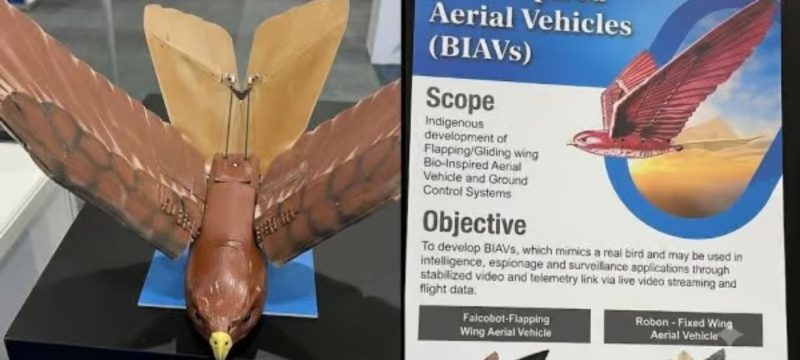
ISLAMABAD: Pakistan introduced an innovative Bird Spy Drone at the Indus RAS Expo, drawing significant attention from defence experts and visitors. The advanced unmanned aerial system is designed to resemble a real bird, allowing it to carry out surveillance missions while remaining difficult to detect.
The Bird Spy Drone is based on a Bio-Inspired Aerial Vehicle (BIAV). It closely imitates the appearance and flight patterns of a bird in the sky. This realistic design helps the drone blend naturally into its surroundings during intelligence and monitoring operations.
The drone quickly became one of the main attractions at the defence technology exhibition. Experts and attendees examined its unique features and discussed its potential role in future security and reconnaissance missions. Its bird-like appearance stood out among other unmanned systems displayed at the event.
Unlike conventional drones, the Bird Spy Drone is built with stealth in mind. Its design focuses on reducing visibility while improving operational efficiency. This makes it suitable for surveillance in sensitive locations where traditional drones may attract attention.
Officials and defence observers said the technology reflects the growing global interest in bio-inspired robotics. Many countries are investing in unmanned systems that copy nature to improve performance and reduce detection. Bird-inspired aircraft and insect-like robots are becoming increasingly important in modern defence research.
Experts believe bio-inspired aerial vehicles could shape the future of surveillance and defence operations. Their compact structure, realistic movement, and quieter flight create new opportunities for intelligence gathering. These features may allow security agencies to monitor areas more effectively without revealing the presence of the aircraft.
The development of the Bird Spy Drone also highlights advances in artificial intelligence, robotics, and lightweight materials. These technologies have made it possible to create aerial systems that are more efficient and capable than earlier designs. As these fields continue to evolve, bio-inspired drones are expected to become even more advanced.
Despite their advantages, experts noted that such drones still face several technical challenges. Flight endurance remains a key concern, as smaller platforms often have limited battery life. Mechanical complexity is another issue because the systems require sophisticated engineering to imitate natural bird movement.
Weather conditions can also affect the performance of bio-inspired drones. Strong winds and heavy rain may reduce their operational effectiveness. In addition, payload limitations mean they cannot carry as much equipment as larger unmanned aircraft.
Even with these challenges, analysts believe the technology has significant long-term potential. Continued improvements in robotics, artificial intelligence, and advanced materials could help overcome existing limitations. Future versions may offer longer flight times, greater reliability, and improved surveillance capabilities.
In other news read more about Punjab Launches First-Ever Drone Monitoring System For Early Flood Warning
The unveiling of the Bird Spy Drone at the Indus RAS Expo demonstrates Pakistan’s growing focus on advanced defence technologies. As research continues, bio-inspired aerial systems are expected to play an increasingly important role in next-generation surveillance, reconnaissance, and unmanned defence operations.