

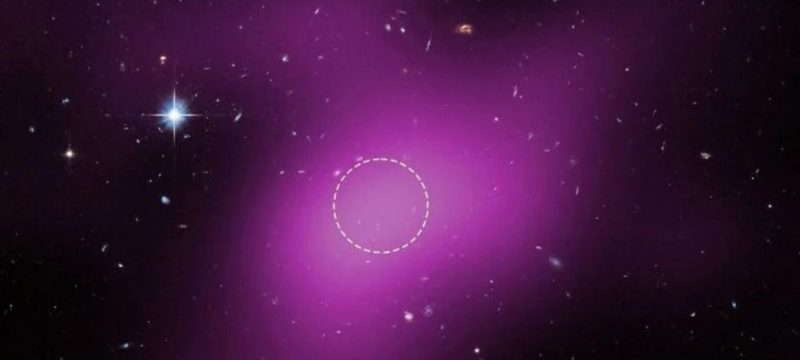
NASA has discovered a unique cosmic object named Cloud-9, marking the first confirmed “failed galaxy” in the universe. Unlike regular galaxies, Cloud-9 has no stars despite containing a large amount of hydrogen gas.
Located about 14 million light-years from Earth near the spiral galaxy Messier 94 (M94), Cloud-9 is classified as a Reionization-Limited H I Cloud (RELHIC). Scientists have long theorized the existence of such starless galaxies.
The discovery was made using ground-based radio telescopes, including the Very Large Array (VLA). However, it was the Hubble Space Telescope’s Advanced Camera for Surveys that confirmed the cloud is truly starless. This evidence proves Cloud-9 is a genuine failed galaxy.
Principal investigator Alejandro Benitez-Llambay from the University of Milano-Bicocca said, “This is a tale of a failed galaxy. Seeing no stars is exactly what proves the theory right.”
Cloud-9 spans roughly 4,900 light-years in diameter and contains about one million times the mass of the Sun in hydrogen gas. Its total mass, dominated by dark matter, is estimated at around five billion solar masses. This makes it massive enough to survive billions of years but not dense enough to form stars.
Researchers explained that RELHICs like Cloud-9 formed shortly after the Big Bang. Intense early-universe radiation prevented small dark matter halos from gathering enough gas to ignite star formation. Most such failed galaxies have likely vanished, making Cloud-9 an exceptional find.
Astronomers say the study of Cloud-9 can provide valuable insights into the early stages of galaxy formation and the role of dark matter in shaping cosmic structures. The discovery confirms long-standing theoretical predictions about starless galaxies in the universe.
In other news read more about: Scientists Find No Signs of Alien Technology on Interstellar Comet 3I/ATLAS
Cloud-9’s identification as the first failed galaxy opens new doors for understanding why some galactic structures never fully form stars, offering a rare glimpse into the universe’s earliest era.