

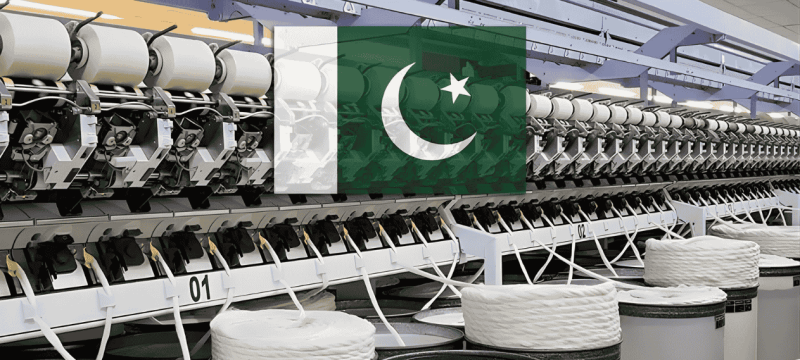
Pakistan’s cotton yarn exports to China recorded strong growth in 2025, surpassing $451 million. This reflects the maturity of bilateral textile trade under the China–Pakistan economic partnership.
Data from China’s General Administration of Customs (GACC) showed that uncombed single cotton yarn under HS code 52051100 generated $233.57 million in 2025. This marks an increase of $10.83 million, or 4.9 percent, compared to 2024.
Another category, uncombed single cotton yarn under HS code 52051200, contributed $212.56 million in exports, highlighting the diversity of Pakistan’s yarn shipments to China.
Chinese customs data confirmed that Vietnam remained the largest supplier of uncombed single cotton yarn under HS 52051100, exporting $341.99 million. Pakistan ranked second with $233.57 million, ahead of Malaysia and Bangladesh, which exported $17.28 million and $12.70 million, respectively.
Provincial import data show that Fujian Province was the top destination for Pakistani cotton yarn, importing $107.47 million worth. Guangdong followed at $72.06 million, and Beijing imported $18.15 million. Other key destinations included Zhejiang, Jiangsu, Anhui, Hunan, Shandong, and Xinjiang.
Trade was conducted through ordinary trade, bonded entrepot trade, processing with imported materials, and customs warehousing. These arrangements point to an increasingly sophisticated supply chain between Pakistan and China.
Sajjad Mazahir, Director of Marketing at Keywin Trading Ltd., told China Economic Net that Pakistan’s cotton yarn exports have shifted from short-term demand to stable, long-term supply relationships. He noted that Chinese buyers now rely on Pakistani yarn for consistent quality at competitive prices.
Despite challenges such as lower cotton output due to floods, higher energy costs, and global economic pressures, Pakistani spinners regained market share from mid-2025. Monthly cotton yarn exports averaging $35–40 million were seen as a “pleasant surprise” under difficult conditions.
Industry experts caution that while growth is positive, Pakistan’s textile exports remain concentrated in raw materials. Issues like inconsistent cotton supply, high energy costs, and limited adaptation to China’s digital procurement systems continue to limit value addition.
In other news read more about: Pakistan’s Textile Exports Rise 9.87% In July-August FY26