


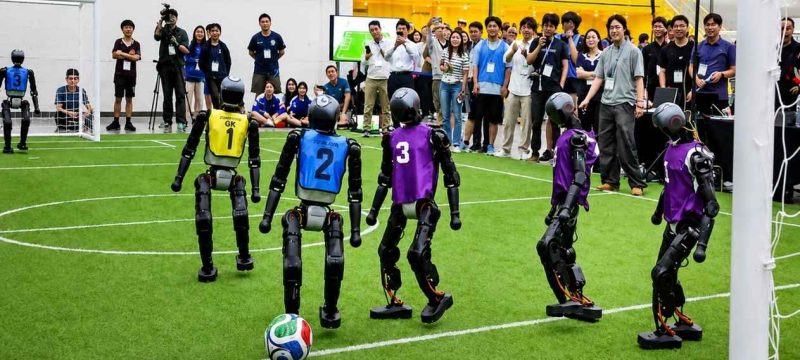
RoboCup 2026, often called the Football World Cup for robots, has officially started in Incheon, South Korea. The international event is being held at Songdo Convensia and has brought together thousands of robotics experts, engineers, researchers, and technology enthusiasts from around the world.
The five-day competition has attracted nearly 3,000 participants representing 45 countries. Teams are showcasing the latest developments in robotics, artificial intelligence (AI), and autonomous technology through a variety of contests, demonstrations, and exhibitions.
The biggest attraction at RoboCup is the robot football competition. In this event, humanoid robots play football matches without any direct human control. The robots rely entirely on artificial intelligence and onboard systems to make decisions during the game.
Photos and videos shared from the tournament show robots dribbling the ball, passing to teammates, and attempting to score goals. The machines move across the field on their own while responding to changing situations in real time.
Although the robots display impressive technical abilities, they are still far from matching human athletes. Some robots lose their balance and fall while running or kicking the ball. These moments highlight both the progress that has been made and the challenges that still remain in robotics development.
According to the organisers, RoboCup serves as a real-world testing ground for advanced robotic systems. It allows researchers to study how autonomous robots react under pressure and make decisions without receiving instructions from humans.
The competition also helps experts improve technologies related to machine learning, computer vision, and intelligent decision-making. These technologies have applications beyond sports and can be used in healthcare, manufacturing, disaster response, and other industries.
The RoboCup project first began in 1997 with an ambitious long-term vision. Its founders set a goal of developing a team of fully autonomous humanoid robots capable of defeating the human football world champions in a fair match.
Over nearly three decades, the event has grown into one of the world’s leading robotics competitions. Every year, universities, research institutes, and technology companies participate to test new ideas and demonstrate their latest innovations.
The competition has become an important platform for collaboration among scientists from different countries. Participants exchange knowledge and work together to solve complex engineering and artificial intelligence challenges.
Despite major advances, organisers admit that defeating the world’s best human football players remains a distant objective. Creating robots with human-like speed, balance, coordination, and decision-making continues to be a significant scientific challenge.
Even so, each edition of RoboCup represents another step toward that long-term goal. The event highlights how quickly robotics and AI are evolving and offers a glimpse into the future of autonomous machines.
In other news read more about: Cristiano Ronaldo May Retire After 2026 FIFA World Cup
As the competition continues in South Korea, visitors and participants are witnessing how technology is transforming the world of robotics. While robot football may still be developing, RoboCup continues to inspire innovation and demonstrates the growing capabilities of intelligent machines on the global stage.