


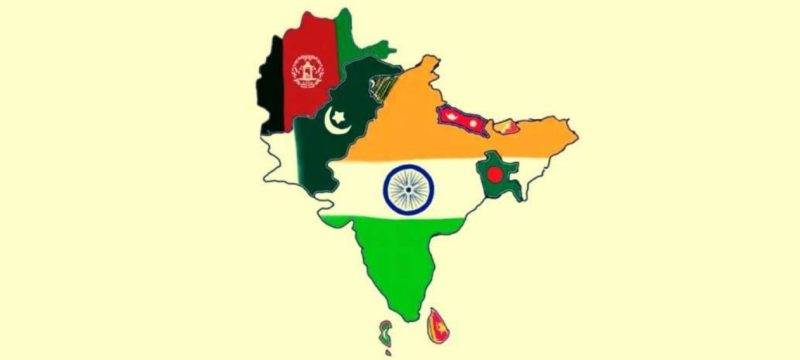
Economic integration within the regions is regarded as a prerequisite for the economic prosperity of nations. Several regions across the globe—most notably Europe and Southeast Asia—serve as the vivid examples of regional integration yielding common dividends in the form of prosperity and development. In South Asia, regional integration is invoked as an imperative for economic progress and political stability. However, despite decades of efforts to achieve regional integration mainly through institution building—most notably the South Asian Association for Regional Cooperation (SAARC)—South Asia remains the least economically integrated region in the world. Trade within the region remains well below its potential; the cross-border infrastructure in the region is inadequate and dilapidated; the institutional regimes in the region remain susceptible to political ebb and flow.
At the heart of fragmented South Asia lies India’s structural reality. Owing to its geographical size and centrality, India could have acted as the geo-economic pivot in South Asia. Instead, India’s geographic edge has produced a structural vulnerability: New Delhi offers the biggest impediment to regional integration in South Asia. Quite naturally, when regional integration is regarded as pivoting around a single actor, it becomes vulnerable to being dictated by the whims of the actor. This exponentially raises the probability of political considerations of the single actor translating into regional paralysis. The resulting situation mandates reimagining regional connectivity in South Asia sans India, i.e., by overcoming or circumventing the constraints offered by India’s structural edge.
In an era marked by intensifying geopolitical competition, climate-induced shocks, and supply-chain disruptions, the perception of overdependence on a single actor constitutes strategic vulnerability and creates risks of monopolization. Therefore, a sans India regional integration framework does not entail an exclusionary approach or fueling strategic antagonism in South Asia. Instead, it represents a pragmatic and practical approach aimed at diversification and redundancy of integration mechanisms and establishing regional integration frameworks that are not contingent on India’s political goodwill and physical infrastructure.
The widely championed model for regional integration in South Asia is governed by the hub-and-spoke logic, which designates India as the regional pivot interlinking other countries of the region. While the model makes geographical sense—thus offering economic enticements—India’s refusal to meaningfully engage with Pakistan to resolve outstanding disputes has led to enduring hostility between the two regional giants. The Pakistan-India hostility hinders overland connectivity in South Asia, thus underscoring the limits of the model. Furthermore, India’s long ambition to dictate the terms for other smaller countries in the region, i.e., regional dominance, has evoked strong regional backlash against New Delhi. This created incentives for the South Asian countries to diversify their economic and foreign policy options by expanding ties with extra-regional players—most notably China—further undercutting India’s regional position.
The fallout is palpable and quantifiable. Despite geographical contiguity and shorter distances, the transport costs in South Asia are significantly higher, which undercuts intra-regional trade. Moreover, despite the matching supply-demand profiles of the countries, there are hardly any regional value chains. This curtails South Asian nations’ ability to achieve economies of scale, which limits their manufacturing output and efficiency, besides hindering industrial advancement in the region. For all practical purposes, South Asia presents the quintessential illustration of economic geography being overridden by political geography.
Reimagining regional integration in South Asia sans India entails shifting away from the linear India-centric connectivity framework to a networked model focused on building interconnectedness between other countries in the region. To overcome the geographical constraints, the sans-India model emphasizes maritime routes for intra-regional trade and digital connectivity, instead of reliance on overland transit through a single state. On the value chain side, the model seeks equitable and specialty-driven allocation of manufacturing roles and aims to build redundancy in the regional trade and connectivity frameworks to ensure smooth functionality, even if the political environment turns adversarial.
To overcome the challenge emanating from the limited industrial and financial bandwidth of the South Asian countries, an extra-regional actor or actors can assume the role of the integration anchor. While the US, European nations, or even the Gulf states can act as regional anchors, the country well-positioned to undertake the role is China. Being a next-door neighbor to South Asia and already having deep trade linkages and investment footprint in the region, Beijing can facilitate building independent value chains within South Asia and can also link its own industrial network with the regional value chains, especially for low-end manufacturing.
Reimagining regional integration in South Asia sans India is a pragmatic approach to overcome structural vulnerabilities built into an overcentralized integration model and political fluctuations that have characterized the region for the past many decades. Under the new model, South Asia can move beyond the traditionally proposed regional economic integration framework—rendered dysfunctional by political vetoes and geographical chokepoints—and can shift towards a new economic order defined by networks, redundancy, and choice. For a region wherein developmental trends could be significantly reshaped by integration and fast mobility of goods, people, and data, the reimagining is an imperative for economic turnaround in the region.