


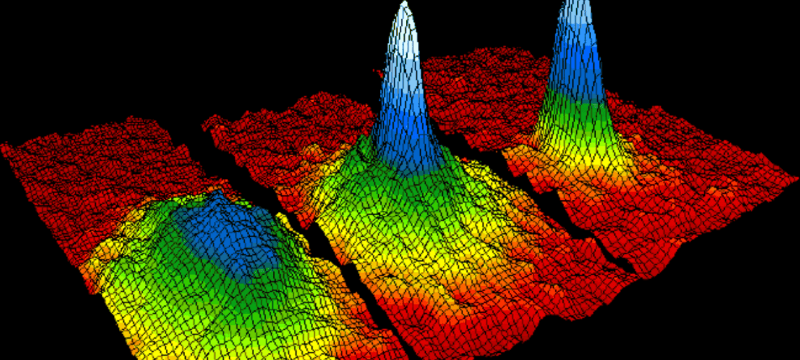
Researchers at Columbia University have announced a significant physics breakthrough, successfully creating a molecular Bose-Einstein condensate (BEC) for the first time. This milestone marks decades of effort to produce a condensate from molecules rather than individual atoms.
The team, led by physicist Sebastian Will, cooled sodium-cesium molecules to an extraordinary 5 nanoKelvin—just above absolute zero. At this temperature, the molecules stopped acting individually and merged into a single quantum state. The results were published in the journal Nature.
Creating a molecular BEC has been a long-standing challenge. Unlike atoms, molecules rotate and vibrate, and they tend to destroy each other upon collision. The Columbia team overcame this by using a method called “microwave shielding,” in collaboration with Tijs Karman from Radboud University. The microwaves created a barrier that kept molecules from colliding, allowing successful evaporative cooling.
The resulting condensate lasted about two seconds—long for such fragile systems—and consisted of roughly 200 molecules from an initial 30,000. Scientists highlight that sodium-cesium molecules are valuable because their polar nature allows long-range interactions, ideal for simulating complex materials.
“This physics breakthrough opens entirely new avenues for research,” Will said. “We can now explore fundamental quantum physics and simulate exotic materials in ways previously impossible.”
Jun Ye from JILA praised the study as “a marvelous achievement in quantum control technology.” The team plans to arrange the molecules into artificial crystals using lasers, a step that could provide further insights into the universe’s quantum behavior.
Experts believe this physics breakthrough may lead to new discoveries in quantum simulations, advanced materials, and fundamental physics research, cementing molecular BECs as a pivotal tool for the field.
In other news read more about: Scientists in Denmark Create Yogurt Using Ants