


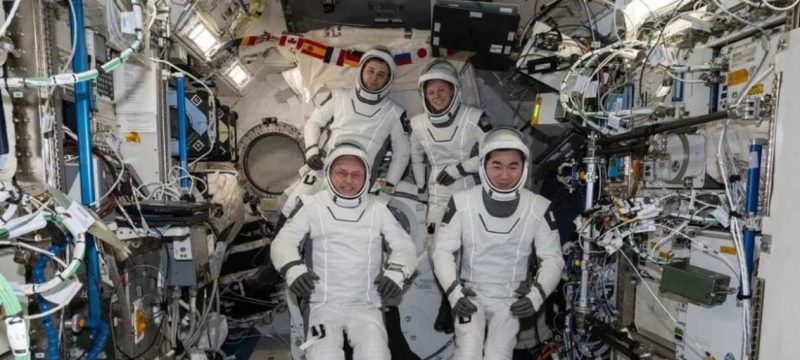
An ailing astronaut returned to Earth on Thursday, ending the space station mission over a month early in NASA’s first-ever medical evacuation. Three other crew members also returned safely.
SpaceX guided the capsule to a middle-of-the-night splashdown in the Pacific Ocean near San Diego. The descent occurred less than 11 hours after the astronauts left the International Space Station.
“It’s so good to be home,” said NASA astronaut Zena Cardman, who served as capsule commander during the return.
The mission, which began in August, concluded unexpectedly with only one American and two Russian astronauts remaining aboard the orbiting lab. Following the early return, NASA’s officials and SpaceX announced plans to move up the launch of a new crew of four, currently scheduled for mid-February.
Along with Cardman, NASA’s Mike Fincke returned to Earth, joined by Japan’s Kimiya Yui and Russia’s Oleg Platonov. Officials did not disclose the identity of the ailing astronaut due to medical privacy concerns.
While the astronaut remained stable in orbit, NASA’s priority was to ensure timely medical care and diagnostic testing on Earth. Authorities confirmed that the capsule re-entry and splashdown required no special modifications, and the recovery ship had its standard medical team on board.
This marks a historic moment for NASA’s operations, demonstrating the agency’s ability to perform a safe and efficient medical evacuation from space. The event also highlights the ongoing collaboration between NASA and SpaceX in managing emergencies aboard the International Space Station.
Officials noted that the new crew’s launch could be accelerated to maintain operations aboard the space station. Meanwhile, the astronauts will undergo thorough medical assessments to ensure full recovery and readiness for future missions.
In other news read more about: Meet Sabrina: The Next Einstein Who Turned Down Bezos, Google & Facebook to Unlock the Secrets of the Universe
The successful evacuation shows the agency’s commitment to astronaut safety while maintaining the continuity of NASA’s missions in space exploration.