

Celestial events have fascinated skygazers for centuries, and NASA has now offered a groundbreaking view with its PUNCH mission. The Polarimeter to Unify the Corona and Heliosphere (PUNCH) mission provided the first-ever continuous observation of solar eruptions in space.
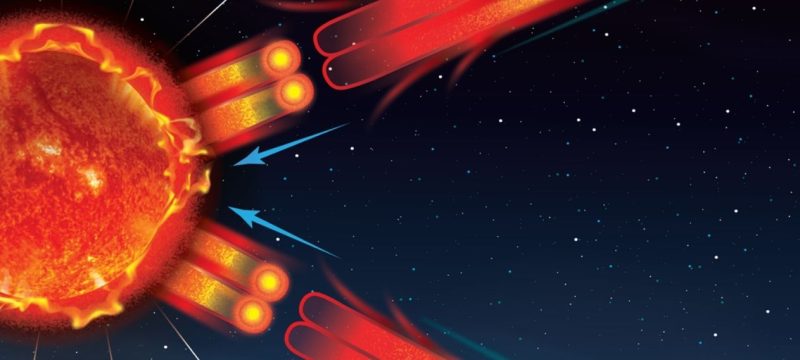
From October 21 to November 12, 2025, PUNCH tracked coronal mass ejections (CMEs), massive solar eruptions that travel from the Sun’s outer atmosphere into interplanetary space. These cloud-like features were captured in high detail, allowing scientists to study their movement and behavior for the first time over an extended period.
The mission used four small spacecraft to form wide-field mosaics of the Sun’s corona and solar wind. During this period, multiple CMEs were recorded, including a significant G4-class storm in mid-November. This storm produced visible auroras across several U.S. states, demonstrating the real-world impact of solar activity.
In addition to CMEs, NASA’s PUNCH mission captured images of celestial objects such as comet Lemmon, Venus, and Mercury. Scientists say this data is valuable for understanding space weather and its potential effects on Earth. Tracking CMEs can help predict disturbances to satellites, power grids, and human activities in space.
Craig DeForest, PUNCH principal investigator at Southwest Research Institute, highlighted the importance of the Level 3 images provided by NASA. He explained that these images allow scientists to track CMEs and estimate their impact on Earth in real-time.
The PUNCH mission continues to update its observations and works in collaboration with other NASA missions, including the Parker Solar Probe and Solar Orbiter. Together, these missions provide a comprehensive understanding of solar eruptions, improving forecasts of space weather and protecting Earth-based and orbital technology.
In other news read more about: Lightning Hits Burj Khalifa During Rare Green Sky Storm
NASA’s PUNCH mission marks a major milestone in solar observation, offering continuous and detailed views of the Sun’s activity, helping scientists better understand the dynamics of space weather and its effects on our planet.