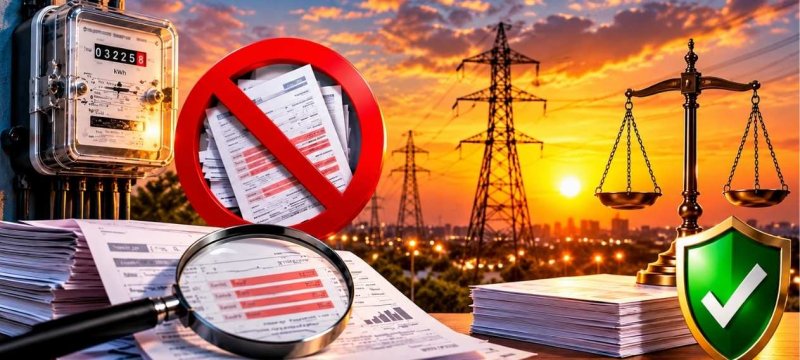
ISLAMABAD, Pakistan: The federal government has banned manual electricity detection bills across Pakistan, directing all power distribution companies (DISCOs) to generate these bills through a centralized online system to prevent arbitrary charges and protect consumers from excessive billing.
Federal Minister for Energy Sardar Awais Ahmad Khan Leghari issued the directive during a meeting with the boards of directors of electricity distribution companies on October 23, 2026. The Power Division said officials who violate the new instructions could face strict disciplinary action and major penalties.
The decision follows concerns about excessive and allegedly incorrect detection bills issued to electricity consumers. The government aims to improve transparency in the billing process while continuing its efforts to control electricity theft.
Under the new directive, all electricity detection bills must be processed through the centralized online portal developed by the Power Information Technology Company (PITC).
Field staff and sub-divisional officers (SDOs) will no longer be allowed to issue manual or discretionary detection bills. The Power Division has classified violations as serious misconduct that may result in disciplinary proceedings against the officials concerned.
Detection bills are issued in cases involving suspected electricity theft, unauthorized consumption or other irregularities identified under applicable procedures. The new system is intended to reduce unnecessary human intervention and limit the risk of unjustified charges.
Leghari emphasized that preventing power theft remains a government priority, but legitimate consumers must not face unfair financial penalties.
The Power Division has also announced plans to amend the Consumer Service Manual (CSM) to establish clearer timelines for meter replacement and billing adjustments.
Under the proposed changes, defective or burnt electricity meters would need to be replaced immediately or within a maximum of two billing cycles. Average billing during this period would be limited to two months.
The proposed framework also addresses meters that record electricity consumption faster or slower than the actual rate. In such cases, recovery or credit adjustments would be restricted to the preceding two billing cycles.
These measures aim to reduce disputes involving faulty meters and prevent consumers from receiving prolonged estimated bills or retrospective adjustments covering excessive periods.
The Power Division has outlined proposed limits on the period covered by detection billing in cases involving unauthorized electricity consumption.
Under the proposed framework, detection charges for general consumers would cover a maximum of three billing cycles. For registered consumers, the proposed limit would be six months, while charges for unregistered consumers could cover up to 12 months.
The purpose of these proposed limits is to restrict lengthy retrospective billing while allowing distribution companies to take action against unauthorized electricity use.
However, these limits form part of the planned amendments to the Consumer Service Manual. They should not be treated as fully implemented rules until the relevant amendments are formally adopted and notified.
The boards of directors of distribution companies have been directed to conduct detailed monthly reviews of detection bills.
Customer Services Committees will also examine the accuracy of bills, the transparency of calculations and whether the amounts being recovered are justified under the applicable rules.
Regular reviews are intended to identify irregular billing practices and strengthen accountability within Pakistan’s power distribution system.
The Power Division expects centralized processing and closer monitoring to reduce arbitrary decisions and improve consumer confidence in electricity billing.
The ban on manual detection bills is intended to provide greater protection to electricity consumers across Pakistan. By requiring detection bills to pass through a centralized online portal, the government aims to make the process more transparent and reduce discretionary decisions by field officials.
Consumers who receive unusually high detection charges should carefully review the bill details and use their electricity distribution company’s official complaint or review process to raise any objections.
The proposed changes concerning defective meters, average billing and retrospective adjustments could provide additional safeguards once the relevant amendments are formally implemented.
The federal government has reiterated that action against electricity theft will continue, but billing decisions must follow established procedures and consumers should not be subjected to unjustified charges.
In other news read more about: How To Check NADRA ID Card Status Without A Tracking Number
The latest directives mark another step in the government’s efforts to reform electricity billing, strengthen oversight of distribution companies and improve consumer protection in Pakistan.