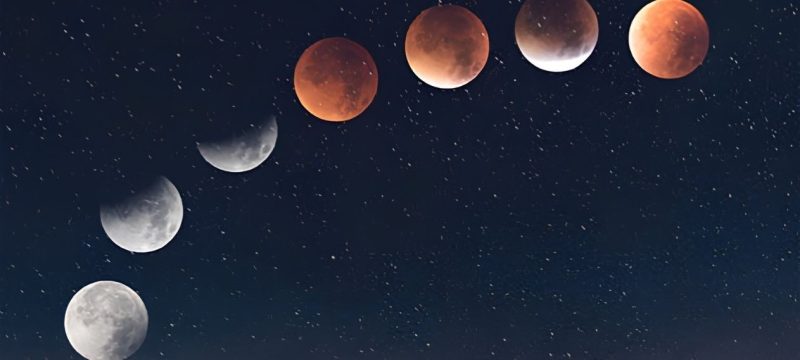
A rare celestial event will occur overnight on August 27-28, 2026. The event will be a partial lunar eclipse with an unusually deep shadow across the Moon.
The eclipse will happen when Earth moves between the Sun and the Moon. This alignment will cause Earth’s darkest shadow, known as the umbra, to cover most of the lunar disk.
Around 93.2% of the Moon’s diameter will enter the Earth’s umbral shadow. When measured by surface area, the coverage will reach about 96%.
This means the eclipse will look almost like a total lunar eclipse. Only a small section of the Moon will remain outside the darkest shadow.
The illuminated portion will appear as a narrow sliver near the Moon’s northern edge. This will create a striking view for observers in suitable locations.
The lunar eclipse will begin with its penumbral phase at 01:23 UTC on August 28. This corresponds to 9:23 PM EST on August 27.
The partial umbral phase will begin at 02:33 UTC. It will start at 10:33 PM EST on August 27.
The eclipse will reach its maximum at 04:12 UTC on August 28. This will mark the greatest extent of the Moon entering Earth’s umbral shadow.
The deepest part of the lunar eclipse will therefore occur during the early hours of August 28. Observers should check their local timing before planning to watch the event.
The umbral phase will end at 05:52 UTC on August 28. At this point, the Moon will completely leave the Earth’s darkest shadow.
The penumbral phase will continue afterward. It will finally end at 07:02 UTC on August 28.
Unlike a solar eclipse, a lunar eclipse is safe to watch with the naked eye. Viewers do not need special glasses or dark filters.
The event can be observed without eye protection because moonlight does not create the same danger as direct sunlight.
The August lunar eclipse is expected to attract attention because of its unusually deep partial coverage. Its appearance could make it resemble a nearly total eclipse.
The difference between diameter coverage and surface coverage is important. The 93.2% figure refers to the Moon’s diameter.
The higher 96% figure refers to the portion of the lunar surface within the umbral shadow. Only around 4% of the lunar disk will remain illuminated.
Skywatchers can look forward to a notable celestial event during the night of August 27-28. Clear skies will provide the best opportunity to observe the eclipse.
The exact visibility will depend on the observer’s location and local weather conditions. People should also check local sunrise and moonset times.
The event offers an interesting opportunity to observe Earth’s shadow moving across the Moon. It also demonstrates the precise alignment of the Sun, Earth, and Moon.
In other news read more about Lunar Eclipse to Light Up the Sky on March 3, 2026
With most of the lunar disk entering the umbra, the August 2026 lunar eclipse could provide a dramatic sight in the night sky.