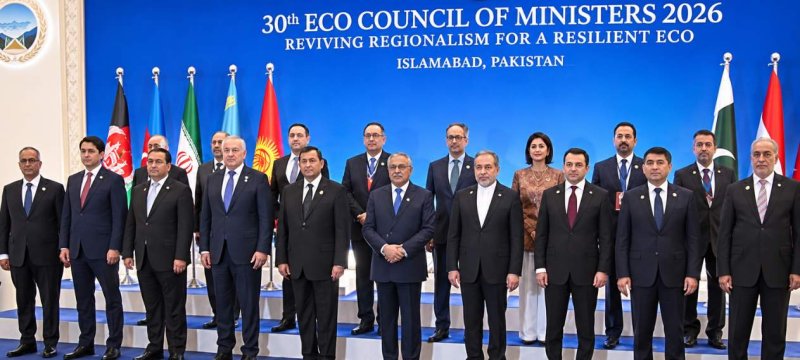
ISLAMABAD: Pakistan has hosted the 30th Economic Cooperation Organization (ECO) Council of Ministers meeting in Islamabad on November 15–16, 2026. The high-level gathering focuses on regional trade, investment, energy security and economic connectivity.
Foreign ministers, deputy foreign ministers and senior representatives from member countries are attending the meeting. The discussions aim to strengthen economic partnerships and improve cooperation across the region.
Pakistan has also assumed the organisation’s rotating chairmanship for 2026–27. The theme for its leadership period is “Reviving Regionalism for a Resilient ECO”.
Deputy Prime Minister and Foreign Minister Ishaq Dar is chairing the ministerial meeting. The gathering comes amid regional security challenges and disruptions affecting important energy routes.
Pakistan Takes Charge of ECO Chairmanship 2026–27
During the meeting, Ishaq Dar highlighted the importance of stronger regional cooperation. He called for better trade relations, improved transportation networks and greater economic integration.
He also outlined five priorities for Pakistan’s chairmanship.
These priorities include expanding trade and investment, improving regional connectivity and modernising the ECO Trade Agreement. Climate resilience and human development are also part of the agenda.
Dar said the region has significant economic potential. Its energy resources, agricultural capacity and geographical position could support long-term prosperity.
He also stressed the importance of involving private businesses. Better market access could create opportunities for small and medium-sized enterprises across member countries.
Iran Calls for Regional Energy Security Cooperation
Iranian Foreign Minister Abbas Araghchi also addressed the ministerial gathering.
He called for a regional mechanism to protect energy supplies and ensure uninterrupted fuel transportation. His remarks came amid tensions involving Iran, the United States and Israel.
Araghchi highlighted disruptions affecting important maritime routes. These include the Strait of Hormuz and Bab al-Mandab.
He said ECO members needed a reliable framework for regional energy cooperation. Such arrangements could help protect supplies and reduce external vulnerabilities.
The Iranian foreign minister also supported modernising regional trade arrangements. He said the organisation could become a stronger platform for joint economic initiatives.
Araghchi further stated that Iran had no inherent dispute with neighbouring countries. He stressed that their territories and facilities should not be used for attacks against other states.
Pakistan Focuses on Regional Trade and Connectivity
Improving transportation links is another major priority under Pakistan’s chairmanship.
Ishaq Dar highlighted the importance of connecting Central Asian economies with international markets. Pakistani ports could provide important trade routes for landlocked countries.
Karachi and Gwadar were among the key ports highlighted during the discussions.
However, better infrastructure alone cannot guarantee successful regional trade. Efficient customs procedures and improved border management are also necessary.
Pakistan plans to advance two important regional agreements. These include the ECO Trade Agreement (ECOTA) and Transit Transport Framework Agreement (TTFA).
The government also supports modernising the existing trade framework. A negotiating roadmap for ECOTA was approved by ECO trade ministers in November 2025.
The proposed Uzbekistan-Afghanistan-Pakistan railway project also remains important. It could strengthen transportation links between Central Asia and international markets.
Afghanistan’s Absence Raises Regional Security Questions
Afghanistan was not represented at the Islamabad ministerial meeting, according to the delegation list shared by Pakistan’s Foreign Office.
The country remains one of the ten ECO member states. Its geographical position makes it important for regional transportation and trade routes.
Ishaq Dar said Pakistan wanted a peaceful and prosperous Afghanistan. He also supported its integration into regional economic initiatives.
However, he stressed that Afghan authorities must address neighbouring countries’ legitimate security concerns. Action against terrorism remains important for improving regional cooperation.
A stable Afghanistan could support trade, investment and transportation between South Asia and Central Asia.
Senior Officials Finalise Islamabad Communiqué
Preparations for the ministerial meeting began with a Senior Officials Meeting on November 15.
Foreign Secretary Ambassador Asim Iftikhar Ahmad chaired the preparatory session in Islamabad. Representatives from member countries and regional institutions also participated.
Officials reviewed ongoing ECO programmes and institutional performance. They also discussed administrative and financial matters.
The meeting finalised the draft Islamabad Communiqué and ministerial agenda. These documents were presented for consideration during the Council of Ministers meeting.
The preparatory discussions also covered regional cooperation initiatives and institutional improvements.
Major Regional Delegations Attend ECO Summit
The ECO Summit has brought together senior representatives from across the organisation’s ten member states.
Prominent participants include Iranian Foreign Minister Abbas Araghchi and Tajikistan’s Foreign Minister Sirojiddin Muhriddin.
Turkmenistan’s Foreign Minister Rashid Meredov is also attending the meeting.
Several deputy foreign ministers are representing their respective countries. These include officials from Azerbaijan, Türkiye, Kazakhstan, Kyrgyzstan and Uzbekistan.
Representatives of other regional organisations are also participating. These include officials from the Organisation of Islamic Cooperation (OIC) and Shanghai Cooperation Organization (SCO).
ECO Secretary General Dr Asad M. Khan is also attending the ministerial gathering.
The organisation consists of Pakistan, Iran, Türkiye, Afghanistan, Azerbaijan, Kazakhstan, Kyrgyzstan, Tajikistan, Turkmenistan and Uzbekistan.
ECO Vision 2035 and Pakistan’s Next Steps
The discussions also focus on ECO Vision 2035. This long-term framework aims to strengthen economic integration across the region.
Its priorities include improved transportation networks, trade development, energy cooperation and investment partnerships.
Pakistan’s 2026–27 chairmanship provides an opportunity to advance these regional objectives. Islamabad aims to strengthen economic connections and promote sustainable development.
Pakistan has also reaffirmed its commitment to hosting the ECO Summit in 2027.
The next summit could provide another opportunity to review progress. Member countries will also have an opportunity to advance regional cooperation plans.
The Islamabad meeting comes at a challenging time for regional economies. Geopolitical tensions, energy disruptions and security concerns continue affecting economic activities.
The main challenge will be turning diplomatic commitments into practical results. Stronger trade arrangements, reliable transportation routes and energy cooperation will remain essential.
In other news read more about: PM Shehbaz Sharif and Asim Munir Ranked No. 1 in Muslim 500 List 2027
Successful implementation could create new economic opportunities across the ECO region.