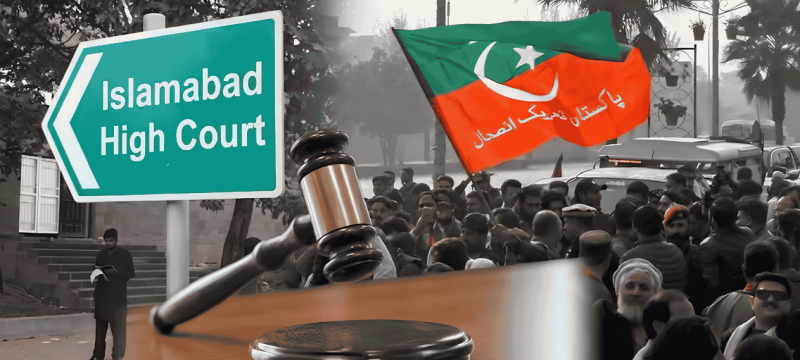
The Islamabad High Court (IHC) has ruled that political parties cannot block roads in the federal capital. The court also barred public office holders from shutting roads for political activities.
The ruling came on Monday as the court announced its reserved verdict. The case concerned protests and a long march organized by Pakistan Tehreek-e-Insaf (PTI).
A larger IHC bench delivered the decision. Chief Justice Sardar Muhammad Sarfraz Dogar headed the bench during the proceedings.
The court made it clear that no political party has the legal authority to block roads. Public office holders also cannot obstruct roads for political purposes.
The IHC stressed that public infrastructure must remain accessible to citizens. Roads cannot be closed simply to facilitate political gatherings or protests.
The court also issued directions to provincial governments. It ordered chief ministers to ensure that government machinery is not used for political protests.
According to the ruling, official resources must remain separate from political activities. Provincial administrations must prevent state machinery from being used by political parties.
The decision places responsibility on provincial chief ministers. They must ensure that government equipment and resources are not deployed during political demonstrations.
The court’s ruling addresses concerns surrounding the use of public resources during protests. It also highlights the importance of keeping public infrastructure available for general use.
The case was linked to PTI protests and a planned long march. The court examined the legal questions surrounding political demonstrations in Islamabad.
The verdict provides clear directions regarding road closures in the capital. Political groups cannot use their influence to block roads or restrict public movement.
The court also rejected any suggestion that public office holders can authorize such closures. Political status does not provide authority to obstruct public roads.
The ruling emphasizes the distinction between political activity and government functions. State resources must not be used to support political demonstrations.
The IHC’s decision also gives provincial governments a clear responsibility. Chief ministers must ensure their administrations remain neutral during political protests.
The word block is central to the court’s direction on public roads. The ruling seeks to prevent political activities from disrupting public access.
Road closures during major protests can affect commuters and essential services. The court has therefore emphasized the need to protect public infrastructure.
The decision does not prevent political parties from holding lawful protests. However, political activities must not involve unauthorized road closures.
The court disposed of the petition after announcing its reserved verdict. The ruling now provides directions for handling similar situations.
The IHC decision could also influence future political demonstrations in Islamabad. Political parties and public officials will need to follow the court’s instructions.
Provincial governments are expected to ensure compliance with the ruling. Chief ministers must prevent government machinery from becoming part of political protests.
The court has also reinforced the principle that public roads serve all citizens. No political group can claim exclusive control over these spaces.
The ruling comes amid continued political activity involving protests and demonstrations. It provides a legal framework for separating political gatherings from state resources.
The IHC has made its position clear through the latest verdict. No political party or public office holder can block roads in Islamabad for political activities.
The decision also directs authorities to keep government machinery away from such protests. The court’s ruling aims to protect public movement and maintain institutional neutrality.
In other news read more about:IHC Reserves Verdict On PTI September 27 Protest Case