

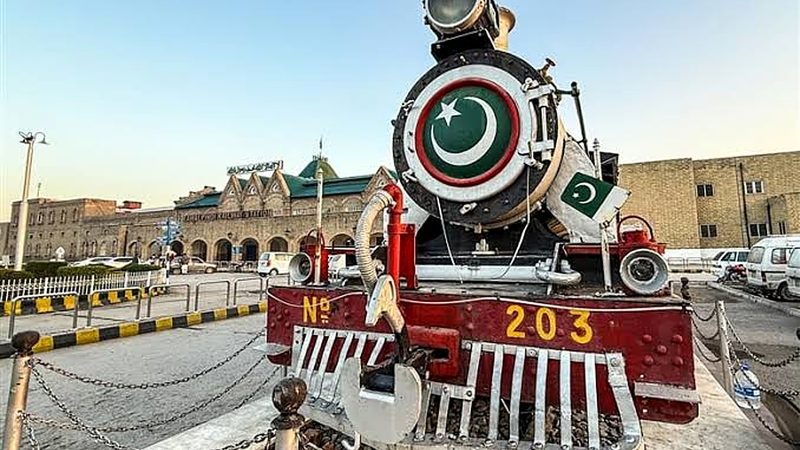
Pakistan Railways, once the backbone of the subcontinent’s transport network, is now one of the country’s most persistent financial drains. Despite sitting on hundreds of thousands of acres of land and receiving regular bailouts from the federal government, the organization has been unable to turn a sustainable profit in decades, and the country’s top court has at one point called it the “most corrupt” state institution in Pakistan.
A Network Built for a Different Country
Pakistan’s railway system predates Pakistan itself. Rail transport in the region began in 1855 under British rule, with early lines like the Scinde Railway linking Karachi to the interior. These scattered private lines were consolidated into the North-Western State Railway by 1905. When Pakistan gained independence in 1947, it inherited roughly 8,122 kilometers of track from this network — infrastructure designed to move colonial administrators, troops, and cash crops, not to serve a modern, growing economy.
That inherited network was renamed Pakistan Western Railway in 1961 and finally became Pakistan Railways in 1974. Industry analysts who have studied its trajectory describe it as following a classic industry life-cycle: growth through the 1950s and 60s, a peak around the mid-1970s, and a steady decline from the 1980s onward, driven by underinvestment, political interference, and competition from road freight operators such as the National Logistics Cell.
The claim that the network “hasn’t changed since partition” is an exaggeration, but not by much. Several branch lines have been abandoned outright — the Zhob Valley Railway closed in 1986, the Khyber Pass Railway and Nowshera–Dargai line are suspended, and narrow-gauge sections that once crisscrossed the country have mostly been dismantled or converted. Even Main Line 2, running 1,246 km from Kotri to Attock, opened in 1896 and still operates at speeds as low as 30 km/h in places, over a century later. Signaling on many sections remains manual or semaphore-based rather than computerized, and long stretches of usable track that once existed no longer do. The network has, in effect, shrunk and aged rather than modernized.
The Financial Collapse, in Numbers
According to the latest report from the Auditor General of Pakistan (AGP), Pakistan Railways posted a net loss of Rs61.19 billion in fiscal year 2024-25 — a jump of nearly Rs10 billion, or 19%, over the previous year. Revenue for the year stood at just Rs92.7 billion, while operating expenses climbed to nearly Rs153 billion, pushing the operating loss ratio to 65%. In plain terms, the railway spends roughly Rs1.65 for every Rs1 it earns.
The trend has been worsening steadily rather than suddenly:
- Between 2020-21 and 2024-25, operating expenses rose 60% while losses grew by 29%
- Cumulative losses between 2012 and 2023 alone reportedly touched Rs400 billion
- A large share of the annual budget — in one recent breakdown, roughly 68% of a Rs120 billion allocation — goes toward salaries and pensions, leaving comparatively little for track maintenance, signaling upgrades, or new rolling stock
This staffing burden isn’t automatically evidence of theft — Pakistan Railways remains a large, unionized public employer with a bloated organizational chart relative to the traffic it actually carries — but it does mean the money that should go toward keeping trains safe and on schedule is chronically squeezed before operations even begin.
Where Documented Corruption Comes In
Separate from routine mismanagement, official audits and investigations have repeatedly flagged specific financial irregularities:
- The AGP’s 2024-25 audit alone flagged Rs11.25 billion in irregularities, including Rs9.95 billion in unrecovered dues from government departments and private parties, and Rs612.81 million in rent and land-lease collections that were deposited into private bank accounts instead of the official Railway Revenue Account
- In December 2025, Railways Minister Hanif Abbasi referred fraud and illegal-land-occupation cases worth Rs40 billion to the National Accountability Bureau (NAB), pledging that “no officer involved in wrongdoing would be spared”
- In October 2025, a vigilance inquiry at the Mughalpura Workshops in Lahore uncovered over 200 fraudulent allotments of railway staff housing, arranged in exchange for roughly Rs100 million in bribes — officials had forged senior officers’ signatures on housing allotment letters and kept the paperwork off official records
- Earlier reporting described a scandal in which fake electricity bills worth more than Rs100 million were approved by railway officials without proper verification
- A so-called “diesel lobby” within the organization has been blamed by auditors for stalling electrification of the network — which would cut fuel costs significantly — while diesel expenditure alone runs to roughly Rs18 billion a year
- Over a five-year period, reporting has pointed to more than 1,100 cases of alleged corruption, theft, and illegal recruitment, with hundreds of employees facing internal inquiries
So while it would be an overstatement to say “all” of the Rs61 billion loss is pocketed by government servants — most of it reflects a structurally unprofitable operating model — there is a well-documented, recurring pattern of officials diverting revenue, fabricating records, and extracting bribes on top of that baseline dysfunction.
Sitting on a Fortune in Land
This is where the railway’s story gets more interesting than a simple tale of losses. Pakistan Railways owns an estimated 168,858 acres of land across the country — a colonial-era land bank, accumulated for rail yards, staff colonies, and rights-of-way, that could in theory be one of the organization’s greatest assets. Yet it generates only around Rs3.5 billion a year from this land — a trivial return relative to its potential commercial value in cities like Karachi, Lahore, and Rawalpindi.
Compounding the problem, land estimated to be worth Rs25 billion is under illegal occupation by encroachers, with recovery efforts repeatedly announced by railway officials but rarely followed through. The Rs40 billion in fraud and illegal-occupation cases referred to NAB in late 2025 centers substantially on this land — allegations of officials colluding with encroachers, issuing fraudulent leases, or simply failing to act against unauthorized use of railway property.
Proposals to commercially develop this land — through long-term leases, joint ventures with private developers, or sales of clearly surplus parcels — have circulated under multiple governments for years. They have repeatedly stalled amid legal disputes, allegations of underhanded dealing in how leases get awarded, and a general lack of institutional capacity to manage such a large real-estate portfolio transparently.
The Bigger Picture
Pakistan Railways’ troubles are less a single scandal than a slow-motion institutional decline, decades in the making. A network inherited from a colonial administration and never fully rebuilt for a modern economy; an overstaffed and underfunded organization whose wage bill crowds out maintenance spending; a shrinking share of the freight and passenger market, now dominated by road transport, which carries an estimated 93% of passengers and up to 96% of freight nationally; and, layered on top of all that, a well-documented and recurring pattern of financial irregularities, fabricated paperwork, and land-related corruption that courts and auditors have flagged for years.
The federal government continues to bail the railway out year after year rather than force the structural reforms — in fare policy, staffing levels, land monetization, and freight strategy — that repeated audits and even Supreme Court hearings have called for. Various modernization plans, including a long-discussed, China-backed main-line upgrade (ML-1), have been announced over the years, but progress has been slow, underfunded, and repeatedly delayed.
Sources: Auditor General of Pakistan FY2024-25 audit report; The Express Tribune; Pakistan Today; Dawn; Bloom Pakistan; HUM News; The Nation; Journal of Advanced Transportation (2018); Science and Industry Museum.