Child trafficking in Pakistan includes forced begging at roadsides and traffic signals and domestic servitude in private homes, including affluent and official households. The US State Department’s 2026 report says about one in four households employs a child in domestic work, and that prosecutions of domestic servitude remain insufficient compared with the scale of the problem.
What Does Child Trafficking Look Like in Pakistan?
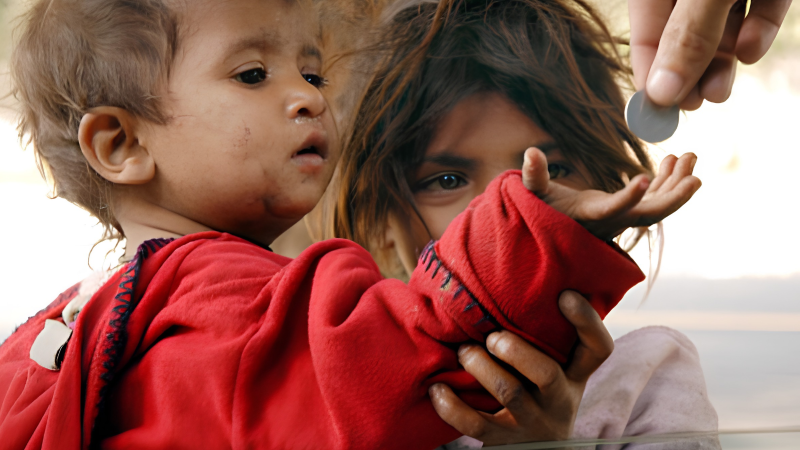
Two children, one city. One stands between lanes of traffic at a signal, tapping on car windows. The other opens the gate when you visit, carries the tea tray, and never sits down. Most of us notice the first child. Almost nobody notices the second.
When people hear “trafficking” they picture vans and borders. In Pakistan it is usually quieter than that. The US State Department’s 2026 Trafficking in Persons Report says traffickers buy, sell, rent and kidnap children for forced labour in begging, domestic work, small shops, agriculture and brick kilns, and for sex trafficking. It also estimates there are 8.5 million domestic workers in the country, including many children, and that about one in every four households employs a child in domestic work. That last number is worth sitting with.
Who Are the Children at Traffic Signals?
Not every child at a signal has been trafficked. Some are sent out by poor families, and the line between a family in desperate need and a handler running a business can be blurry. But the evidence that organised networks are involved is not thin. According to the US report, civil society groups say most children working on Pakistan’s streets are subjected to forced begging and are vulnerable to sexual exploitation.
The Punjab government says that this year it removed 5,327 beggars from Lahore’s traffic signals, including 505 children, with special squads aimed at professional handlers and organised rings. In Karachi, a three-year-old boy kidnapped from Shah Latif Town was spotted begging two months later when his uncle recognised him; police said a gang was involved. In Islamabad, police arrested handlers who had divided the city’s sectors and signals between them and sent children from slum areas to beg.
Why Doesn’t a Barefoot Child at 11 pm Break Our Hearts Anymore?
Think of the last time you saw a child at a signal late at night. Barefoot, maybe, on tarmac that still holds the day’s heat or already holds the night’s cold. What did you feel? For most of us it is a flicker, a hand moving toward the window button, and then the green light. That is not because we are heartless. We have simply seen it a thousand times. Familiarity does what cruelty never could: it turns a child into part of the road, somewhere between the speed breaker and the signal pole.
The hour matters more than we admit. A child standing in traffic at 11 pm is not in school and not in bed, and somebody decided that is where she should be. Police see the same thing. In July 2026, Lahore’s traffic police ran a “Midnight Beggars Operation” that arrested 109 people at signals, eight of them children. When police schedule raids around the late shift, it is hard to argue the sight is rare.
The same US report says forced labour in domestic servitude goes unreported because it is normalised within society, and the roadside version works the same way. If a barefoot child at midnight is scenery, nobody asks who sent her, who is waiting at the corner for the money, or where she sleeps tonight. We rarely fail these children because we decided not to help. We fail them because we stopped seeing them.
How Do Begging Networks Work?
A recent Pakistan Today analysis describes an entire ecosystem: recruiters who identify vulnerable families, handlers who move women and children between provinces, and others who train them in what makes passers-by hand over money. The same piece notes that Sindh’s own child protection research found domestic trafficking of children for begging is more common than cross-border trafficking.
The US State Department has also reported that begging ringmasters sometimes maim children to earn more, and force some to steal. Pakistan’s 2025 amendments to its trafficking law now include “organized beggary” in the definition of trafficking, which at least means the law has caught up with what everyone at the signal can see.
What Happens to Children in Wealthy Households?
This is the part that is easier to look away from. In many homes, a girl of ten or twelve working as a live-in helper is not seen as a crime. She is seen as a favour: she gets food, a roof and a monthly sum sent to her parents. The State Department’s 2025 report notes that experts say domestic servitude often goes unreported because it is normalised within society, and that child domestic work, at times involving forced labour, continues with impunity.
Earlier reports go further, describing employers forcing children as young as seven into domestic work, where they face severe physical abuse, including torture and sexual abuse, with several government officials among the suspected perpetrators.
Two cases made national headlines. In 2016, ten-year-old Tayyaba was recovered from the Islamabad home of a sessions judge after neighbours complained of torture, and a medical board later found marks of torture on her body. In 2023, a 14-year-old girl, Rizwana, was taken to hospital in Lahore after working for six months in the Islamabad home of a civil judge. Police reported more than 15 torture marks on her face and body. The judge’s wife was arrested; she has denied the allegations. The US State Department’s 2024 report says she was charged under the trafficking law for the forced labour of a 14-year-old girl in domestic servitude.
Why Do Powerful Employers So Rarely Face Consequences?
Tayyaba’s case shows how it usually goes. Within days of her rescue, her parents had reached a compromise with the judge and the child was handed back to them. It took the then Chief Justice taking suo motu notice of the compromise for a trial to go ahead. In 2018 the Islamabad High Court sentenced the couple to one year each, and then raised that to three years. In 2020 the Supreme Court set aside the longer sentence and restored the original one year. For a case the whole country watched, that is the best outcome on record.
The wider numbers are no better. According to the 2026 US report, Pakistan investigated 3,906 trafficking cases in 2025, prosecuted 2,175 suspects and convicted 307 traffickers, while investigations, prosecutions and convictions for bonded labour and domestic servitude remained insufficient compared to the scale of the problem. A family earning a few thousand rupees a month cannot easily take on an employer with a judge’s or an official’s connections. A 2020 amendment banned the employment of children as domestic workers after the death of an eight-year-old maid, but the State Department noted in 2024 that only Punjab had banned children from working in private homes.
Is There Evidence of Organised Elite Trafficking Networks?
Online, claims about elite trafficking rings travel faster than facts. The public record I could find supports something less lurid and in some ways more damning: children working as domestic servants in comfortable homes, including those of judges and officials, with abuse hidden by normalisation, family compromise and slow courts. An organised elite ring is a different claim. It needs court records or credible investigation behind it before anyone repeats it about a named person.
What Is Bacha Bazi, and Why Do We Look Away From It?
There is another group of children we rarely talk about, because the subject makes people change the channel: boys. Bacha bazi, literally “boy play,” is a form of sexual exploitation in which boys are forced to provide social and sexual entertainment for older men. The US Department of Labor’s report on Pakistan describes it as common within the country and notes that child labourers, particularly boys, are often sexually exploited in order to get or keep work or somewhere to sleep. Reporting in The Friday Times places the practice mainly in parts of Khyber Pakhtunkhwa, Punjab and Balochistan’s coal country.
A 2026 study in The Journal of Sex Research, based on interviews with 45 khwaja sira in Mingora, Swat, looked back at how poverty and insecurity push young boys into coerced relationships with older men, with vulnerability shaped by age, class, gender and power.
The problem has been on camera before. Pakistan’s Hidden Shame, a 2014 documentary shown on Channel 4 and filmed mainly in Peshawar, followed homeless boys as they described their experiences. The broadcaster’s own description cited an estimate that nine in ten street children in the city had been sexually abused, with much of the abuse of boys taking place at bus and truck terminals. That was twelve years ago, and those figures are the film’s estimates, not official data. The 2026 reporting above suggests the gap in attention has not closed.
Boys are easy to overlook. ECPAT’s 2022 report on Pakistan notes that where governments do collect data on child sexual exploitation, the samples are almost always limited to adolescent girls, so boys barely appear in the numbers. A system that does not count a child rarely protects him. If a child tells you an adult is hurting him, believe him, tell him it is not his fault, and call 1121.
What Can You Do If You See a Child in Danger?
Pakistan has a national child protection helpline, 1121, run by the provincial and Islamabad child protection agencies, and the police emergency number is 15. If you see a child begging at a signal, note the location and what you can safely observe and report it, rather than confronting a handler yourself. Lahore’s police chief has urged citizens not to give money to organised networks. And if a child under 15 works in your own house, the most useful thing you can do is send her home with a school place and a conversation with her parents, not a salary.
Why Is the Child Behind the Gate Harder to Save?
The child at the signal is visible, and visible children eventually get counted, rescued and photographed for press releases. The child behind the gate is hidden by a wall, a family name and a social habit of calling it help. Both are children somebody decided were cheaper than a wage. Until the second one counts as much as the first, the numbers will keep looking better than the reality.
The child at the signal, the boy working for his keep, the girl in the kitchen: we have walked past all three for so long that walking past now feels like the normal thing to do. That numbness is what keeps the whole system running. It needs no handler and costs nothing to maintain, and it asks nothing of the rest of us.
Sources
US State Department Trafficking in Persons Reports
- 2026 Trafficking in Persons Report: Pakistan: 8.5 million domestic workers; about one in four households employs a child; 3,906 cases, 2,175 prosecutions, 307 convictions in 2025.
- 2025 Trafficking in Persons Report: Pakistan: forced begging among street children; “organized beggary” added to the trafficking definition; domestic servitude normalised.
- 2024 Trafficking in Persons Report: Pakistan: civil judge’s wife charged under the trafficking law; only Punjab bans children in private homes.
- 2023 Trafficking in Persons Report: Pakistan: children as young as seven; ringmasters maiming children.
Roadside begging
- 5,327 Beggars Removed From Various Traffic Signals (APP via UrduPoint, 20 Sep 2026)
- Karachi child kidnapping racket for begging exposed (The Nation, 21 Jul 2025)
- Woman among 6 “patrons of beggars” held (The Express Tribune)
- Boom in the Begging Industry of Pakistan (Pakistan Today, 27 Sep 2026)
- Child begging rackets to face zero tolerance, warns CCPO (The Nation, 23 Jul 2026)
Domestic servitude cases
- Judge, wife sentenced to one year in prison over torture case of child maid (Gulf News)
- Tayyaba torture case: Judge, wife handed one year in prison (Dawn, 17 Apr 2018)
- Tayyaba torture case: Court increases sentence of judge, wife to three years (The Express Tribune, 11 Jun 2018)
- IHC increases sentence of judge, wife to three years (Geo News)
- Tayyaba torture case: Supreme Court sets aside increased sentence (Dawn, 2020)
- Minor housemaid Rizwana was poisoned, claims health minister (ARY News, 1 Aug 2023)
- Judge’s wife arrested after widespread anger in Pakistan over torture of minor maid (Arab News, 7 Aug 2023)
Helplines
Late-night roadside operation
Bacha bazi and the sexual exploitation of boys
- 2019 Findings on the Worst Forms of Child Labor: Pakistan (US Department of Labor): bacha bazi described as common within Pakistan; boys frequently sexually exploited to obtain or keep work.
- The Boys Nobody Sees: Bacha Bazi, Child Labour, And The Gender Blind Spots Of Child Protection (The Friday Times, 4 May 2026)
- “More Dangerous Than Cocaine”: Bacha Bazi in Khyber Pakhtunkhwa, Pakistan (The Journal of Sex Research, 2026)
- Global Boys Initiative: Pakistan Report (ECPAT, 2022)