The Turkish parliament has approved the Makkah Joint Defence Agreement with Pakistan and Saudi Arabia. The decision marks an important step towards stronger military cooperation among the three countries.
The agreement was approved by 279 votes against 119 during a General Assembly session. Deputy Parliament Speaker Celal Adan chaired the parliamentary proceedings. The Turkish parliament has 600 seats.
The ruling Justice and Development Party (AK Party) supported the agreement. Its parliamentary ally, the Nationalist Movement Party (MHP), also backed the move. The main opposition Republican People’s Party (CHP) supported the ratification as well.
The agreement provides a framework for expanding defence and security cooperation. Its key areas include military training, joint exercises and defence technology development. It also covers counterterrorism, intelligence sharing and logistical assistance.
The pact aims to strengthen cooperation between the armed forces of Pakistan, Saudi Arabia and Türkiye. It also encourages joint defence industry projects. These include technology transfers, research, weapons production and defence innovation.
How the Makkah Defence Agreement Was Signed
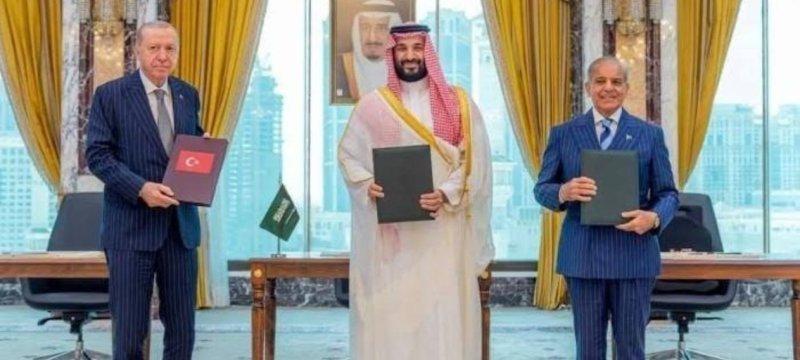
The agreement was signed in Makkah on August 7. Saudi Crown Prince Mohammed bin Salman, Turkish President Recep Tayyip Erdogan and Pakistan’s Prime Minister Shehbaz Sharif endorsed the arrangement.
The three leaders agreed to strengthen collective security and deepen military cooperation. They also pledged to support peace and stability across the region and beyond.
Under the agreement’s collective defence principle, an attack on one member is considered an attack on all. This provision establishes a shared security framework for the three countries. The agreement also encourages personnel exchanges and joint military training programmes. Regular exercises will help improve coordination between their armed forces.
Intelligence Sharing and Military Support
The pact includes provisions for closer intelligence cooperation. The three countries will share information through mutually agreed secure channels. These arrangements will follow confidentiality and information security requirements. The agreement also supports coordinated efforts against terrorism. Member countries will hold regular consultations on international security challenges.
They can take individual or collective measures based on shared security assessments. These actions will aim to protect their national interests. The framework also covers logistical assistance during peace, war and emergencies. Support may include weapons, ammunition, fuel and spare parts. Other military equipment can also be provided under agreed arrangements.
Türkiye May Consider Military Deployment to Saudi Arabia
The Turkish parliament’s approval could allow Türkiye to provide military support to Saudi Arabia. This comes amid attacks by Yemen’s Iran-aligned Houthi militia against the kingdom. However, the agreement does not automatically authorise Turkish troop deployment. A separate parliamentary approval will be required for any such move.
Foreign Affairs Committee Chairman Fuat Oktay described the alliance as entirely defensive. He said it was not designed to support attacks against other countries. Oktay also stressed that Türkiye would not enter an uncontrolled conflict. Any decision to send Turkish troops would require another parliamentary mandate.
Joint Defence Committee and Secretariat
The agreement establishes a Strategic Political and Defence Committee. It will oversee cooperation and coordinate activities among the three members.
The committee will include foreign ministers, defence ministers and chiefs of general staff. Meetings are generally planned twice each year. Leaders may reduce the schedule to one annual meeting when necessary. A permanent secretariat will operate in Saudi Arabia. Retired Pakistani General Nauman Mahmood has been selected as its first secretary-general. He will serve a three-year term.
The secretary-general position will rotate among the founding countries. Pakistan will provide the first officeholder under this arrangement. The agreement also allows other countries to join the partnership. Existing members must approve any new membership.
Regional Security and Future Implementation
The defence agreement comes amid increased diplomatic coordination between the three countries. Their ministers have already held meetings in Istanbul and Riyadh. High-level delegations also travelled to Tehran last month. They discussed regional security and efforts to prevent renewed fighting.
The agreement will become effective after all three countries complete domestic ratification procedures. The final ratification instrument must also be deposited with the committee’s secretariat. A member country may withdraw after 10 years. It must provide at least three months’ written notice through diplomatic channels.
In other news read more about Saudi Arabia to Hire Thousands More Pakistanis as Job Opportunities
Existing projects and ongoing activities will remain unaffected by withdrawal. Obligations concerning classified information will also continue. The Turkish parliament has completed its ratification process for the agreement. Pakistan and Saudi Arabia must also complete their respective procedures before it formally enters into force.