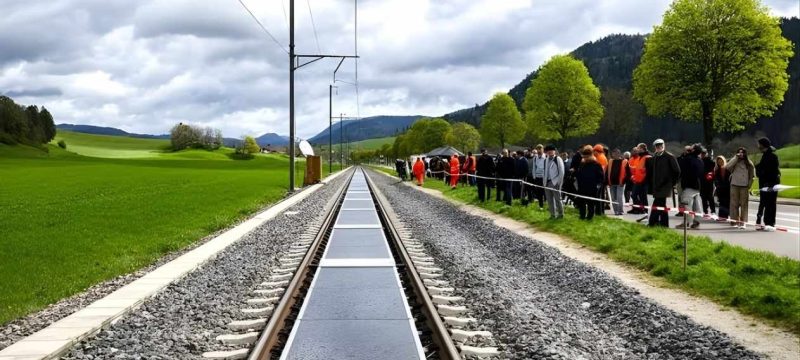
Solar Railways could soon become a common feature across Europe after a successful trial in Switzerland demonstrated the potential of generating clean energy from active railway tracks. The pilot project has delivered promising results, encouraging plans for larger installations in the coming years.
Swiss start-up Sun-Ways launched the world’s first removable solar power system on an active railway line in April 2025. The installation is located in Buttes, a village in Switzerland’s Val-de-Travers district.
The pilot project covers 100 meters of railway track and includes 48 specially designed photovoltaic panels. Together, the panels have a total capacity of 18 kilowatts peak (kWp). The system was originally approved as a three-year trial to evaluate its safety, efficiency, and long-term performance.
According to Sun-Ways, the project performed well during its first year. The company believes these positive results could support the installation of a permanent Solar Railways system along the railway line before the trial officially ends.
Currently, the electricity generated by the pilot project is supplied to the local power grid. However, the company is also developing technology that could send electricity directly to railway substations or train traction lines in future projects.
One of the key features of the system is its removable design. Railway operators can temporarily lift the solar panels whenever track inspections, repairs, or maintenance work are required. This allows railway operations to continue while keeping maintenance practical and efficient.
Switzerland has more than 5,300 kilometers of railway tracks that could potentially support this technology. Sun-Ways estimates that installing solar panels across the country’s railway network could generate around one terawatt-hour of electricity each year. This would account for nearly 2 percent of Switzerland’s annual electricity consumption.
The company also estimates that one kilometer of railway equipped with solar panels could produce about 200 megawatt-hours of electricity every year. Its specialized installation train can reportedly install up to 1,000 square meters of panels in a single day, making large-scale deployment more practical.
Unlike rooftop solar panels, railway panels must remain flat between the tracks. While angled panels usually produce more electricity, Sun-Ways estimates that the flat design reduces energy production by only around 10 percent.
Despite this limitation, the pilot installation generated approximately 16,000 kilowatt-hours of electricity during its first year. This amount is roughly equal to the yearly electricity consumption of an average fully electric home in the United Kingdom.
The project also addressed several safety concerns raised by railway experts. Sun-Ways designed stronger panels with anti-reflection filters to reduce glare for train drivers. Built-in sensors continuously monitor system performance, while cleaning brushes attached to trains help remove dirt from the panel surfaces.
According to the company, more than 11,000 trains passed over the installation during the first year without affecting its stability or safety. The system also required no special maintenance throughout the trial period.
Following the success of the Swiss project, Sun-Ways has signed a collaboration agreement with an Italian business partner to explore a pilot project in Italy. The company has also received government approval for another Solar Railways installation in South Korea.
In other news read more about Pakistan Railways Plans to Solarize Stations, Offices, and Workshops
In addition, discussions are underway with businesses in the Netherlands, China, India, and Singapore as Sun-Ways works to expand the technology internationally. The company believes Solar Railways can play an important role in increasing renewable energy production while making better use of existing railway infrastructure.