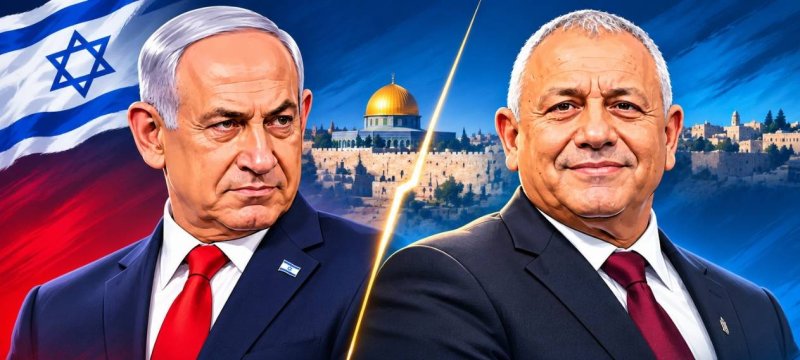
Former Israeli military chief Gadi Eisenkot has moved ahead of Prime Minister Benjamin Netanyahu in the race to form Israel’s next government after receiving support from 67 lawmakers.
The development has created fresh uncertainty for Netanyahu, who reportedly received recommendations from just 46 members of the Israeli parliament during consultations with President Isaac Herzog.
Israel’s Knesset consists of 120 members, meaning a candidate generally needs the backing of at least 61 lawmakers to establish a majority government.
Although Eisenkot currently has more parliamentary recommendations, his chances of becoming prime minister will depend on whether he can bring different political groups together.
The opposition remains divided over several important issues, particularly cooperation with Arab political parties.
President Isaac Herzog is expected to announce on Sunday, November 8, which candidate will receive the first opportunity to form a new government.
Support from Arab political groups has helped strengthen Eisenkot’s position. Ra’am, led by Mansour Abbas, and the Joint List have both reportedly recommended him for the premiership.
Together, these parties hold 19 seats in the Knesset. Their backing has played an important role in increasing Eisenkot’s parliamentary support.
Mansour Abbas leads Ra’am, which controls eight parliamentary seats. His party has previously participated in Israeli coalition politics and supported political arrangements involving different ideological groups.
Abbas has also advocated a two-state solution to the Israeli-Palestinian conflict and expressed support for US President Donald Trump’s Gaza peace initiative.
The Joint List, which holds another 11 seats, has also backed Eisenkot. Its leadership has highlighted dissatisfaction among Arab citizens over discrimination, crime and other domestic concerns.
However, the recommendation does not necessarily mean that these parties will become formal members of an Eisenkot-led government.
Meanwhile, Netanyahu is facing difficulties maintaining the support of his traditional right-wing and religious allies.
His political bloc reportedly secured 53 seats in the October 27, 2026 election. However, disagreements between coalition partners have complicated his efforts to secure another term.
United Torah Judaism, a longtime Netanyahu ally with seven parliamentary seats, reportedly declined to recommend either candidate.
The disagreement is linked to disputes over military service exemptions for ultra-Orthodox Israelis.
As a result, Netanyahu received recommendations from only 46 lawmakers, leaving him behind Eisenkot in the latest political consultations.
Despite this setback, Netanyahu’s Likud remains the largest individual party in the Knesset, with 27 seats.
Gadi Eisenkot previously served as chief of staff of the Israel Defense Forces (IDF) between 2015 and 2019. He spent several decades in military service before entering national politics.
He began his military career in the Golani Brigade and gradually advanced through senior command positions. In 1997, he became commander of the brigade before taking on other important military responsibilities.
His appointment as IDF chief of staff in 2015 marked a major milestone in his career.
After retiring from military service in 2019, Eisenkot entered politics and secured a seat in the Knesset.
His political profile increased following the Hamas-led attacks on Israel on October 7, 2023. He subsequently joined Netanyahu’s emergency war cabinet during the Gaza conflict.
However, disagreements over military strategy and the government’s handling of the conflict eventually led him to become a vocal critic of Netanyahu’s leadership.
Eisenkot currently leads Yashar, a centrist political party established in September 2025.
The party reportedly won 21 seats in the October 27, 2026 parliamentary election, making it the second-largest individual party after Likud.
The election produced a divided parliament, with Netanyahu’s traditional political bloc securing 53 seats and Eisenkot’s opposition bloc holding 48. Arab political parties won another 19 seats.
These results have made cooperation between different parliamentary groups particularly important for the formation of the next government.
Eisenkot’s political future now depends on his ability to secure a workable coalition. Although 67 lawmakers have recommended him, some supporting groups may hesitate to join a government involving Arab political parties.
Under Israel’s parliamentary system, the president selects a candidate to receive the mandate to form a government following consultations with political parties.
The selected candidate generally has 28 days to establish a coalition. The president may grant an additional 14 days if more time is required.
A proposed government must ultimately receive the confidence of at least 61 members of the Knesset.
President Isaac Herzog is expected to announce his decision on November 8, 2026. His announcement will determine who gets the first opportunity to negotiate a new governing arrangement.
Until a new administration takes office, Benjamin Netanyahu will continue serving as caretaker prime minister.
In other news read more about: Nuclear Attack Fears Rise As Iran Distributes 180,000 Anti-Radiation Tablets
Eisenkot currently holds a numerical advantage over Netanyahu, but securing recommendations is only one stage of the political process. The final outcome will depend on whether he can turn that support into a stable government.