


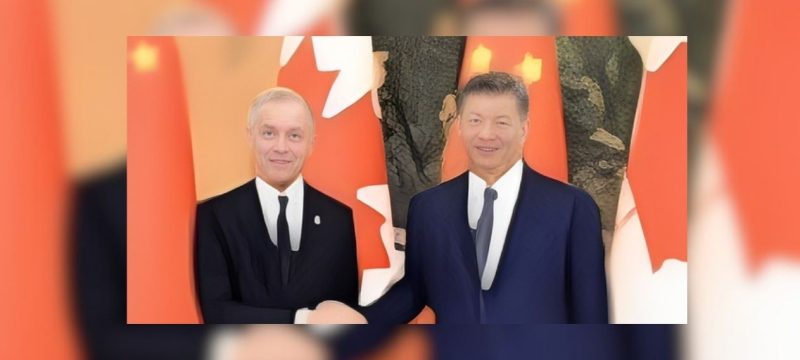
Canada and China have reached an initial trade agreement aimed at easing long-standing trade tensions.
The deal was announced during Prime Minister Mark Carney’s official visit to Beijing on Friday.
It marks the first visit by a Canadian prime minister to China since 2017.
The agreement focuses on electric vehicles and agricultural products.
It also signals a wider effort to rebuild economic trust between Canada and China.
China is Canada’s second-largest trading partner after the United States.
Under the new deal, Canada will reduce tariffs on Chinese electric vehicles.
Canada will allow up to 49,000 Chinese EVs to enter annually.
These vehicles will face a tariff of 6.1 percent.
This is a sharp drop from the 100 percent tariff imposed in 2024.
Prime Minister Carney said the quota will increase over time.
It could reach around 70,000 vehicles within five years.
He said Canada needs global cooperation to build a strong EV sector.
He stressed the importance of supply chains and innovation partnerships.
The move has drawn mixed reactions at home and abroad.
Some US officials criticized the decision for diverging from US policy.
However, President Donald Trump publicly supported the deal.
He said trade agreements with China are beneficial if achievable.
Ontario Premier Doug Ford strongly opposed the agreement.
He warned of risks to Canada’s domestic auto industry.
He said the deal lacks clear investment guarantees.
Agriculture is another key part of the agreement.
China had earlier imposed heavy tariffs on Canadian farm products.
These measures followed Canada’s earlier EV tariffs.
They affected canola oil, meal, and seed exports.
China’s imports from Canada fell sharply in 2025.
Under the new deal, China will cut canola seed tariffs by March 1.
The rate is expected to fall from 84 percent to about 15 percent.
Other products will also see relief.
Tariffs on canola meal, lobsters, crabs, and peas will be removed temporarily.
This relief is expected to last until at least the end of the year.
Canadian canola futures rose after the announcement.
Carney said the deal could unlock nearly $3 billion in export orders.
Chinese officials confirmed changes to anti-dumping measures.
They linked the changes to Canada’s lower EV tariffs.
The two countries also agreed to deepen cooperation.
They will restart high-level economic and financial talks.
They plan to expand ties in energy, agriculture, and green technology.
Carney said China offered visa-free travel for Canadians.
Details of the policy were not disclosed.
He also highlighted Canada’s energy plans.
Canada aims to double its power grid within 15 years.
He said Chinese investment could support offshore wind projects.
Canada plans to export 50 million tonnes of LNG annually by 2030.
All exports will be directed to Asian markets.
Analysts say Canada, China ties are becoming more predictable.
However, Canada is unlikely to shift away from the United States.
Experts note Canada’s deep security and economic links with Washington.
In other news read more about Canada Warns of Likely Election Interference by China and India on April 28
Still, the renewed engagement between Canada, China may influence global trade dynamics.
The agreement shows a pragmatic approach by Canada, China amid global uncertainty.
It also reflects how Canada, China relations are entering a more stable phase.