


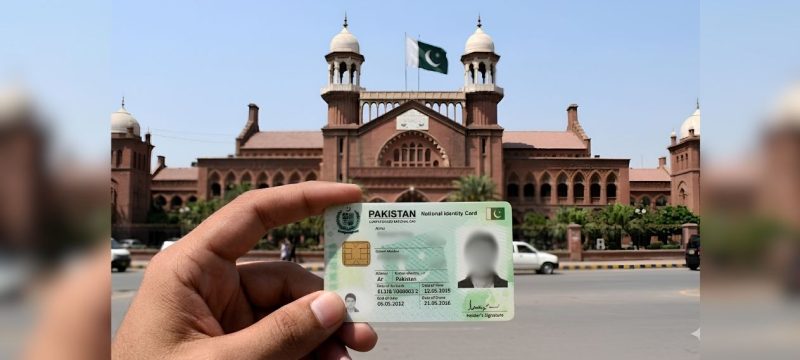
LAHORE – The Lahore High Court (LHC) has ruled that holding a CNIC does not automatically prove that a person is a Pakistani citizen. The court clarified that citizenship cases must be decided according to the Pakistan Citizenship Act and relevant laws governing national registration.
The ruling was issued by Justice Mohsin Akhtar Kayani while hearing a civil revision petition filed by the National Database and Registration Authority (NADRA). The authority had challenged earlier decisions of lower courts that had declared two individuals, including Khalid Khan, as Pakistani citizens.
In its judgment, the court stated that possession of a CNIC alone cannot be treated as final evidence of nationality. It said that citizenship disputes require proper examination under the legal framework related to citizenship and registration matters.
The court set aside the previous rulings and accepted NADRA’s petition. It observed that nationality questions cannot be settled solely through civil court proceedings. Instead, authorities must evaluate such claims under the applicable citizenship laws.
According to case details, NADRA had blocked the CNIC records of the respondents after classifying them as foreign nationals. The matter was then referred to a Joint Verification Committee. The committee included representatives from the Special Branch, Intelligence Bureau (IB), and Inter-Services Intelligence (ISI).
During the verification process, officials investigated the respondents’ nationality claims. However, the committee could not confirm that they were Pakistani citizens. The court noted that the respondents’ father failed to provide important information about his family background and history.
Justice Kayani observed that this lack of information created serious doubts regarding the family’s claim of Pakistani origin. The judgment also highlighted that many people entered Pakistan as refugees during and after the Afghan conflict. Some of them reportedly obtained national identity documents despite not being citizens.
The court further stated that the respondents were asked to provide reliable public records issued before 1979 to support their father’s citizenship status. However, no such documentary evidence was presented before the court.
After reviewing the case, the LHC found that the lower courts had overlooked important facts and records submitted by NADRA. The court concluded that the available evidence did not support the respondents’ nationality claims.
In other news read more about Punjab Allocates Rs560 Million for Social Media Campaigns to Promote Family Planning
As a result, the Lahore High Court overturned the earlier judgments and ruled in favour of NADRA. The decision reinforces that a CNIC is an important identification document, but it is not the sole proof of Pakistani citizenship. Citizenship matters must be determined through proper legal procedures and supporting evidence.