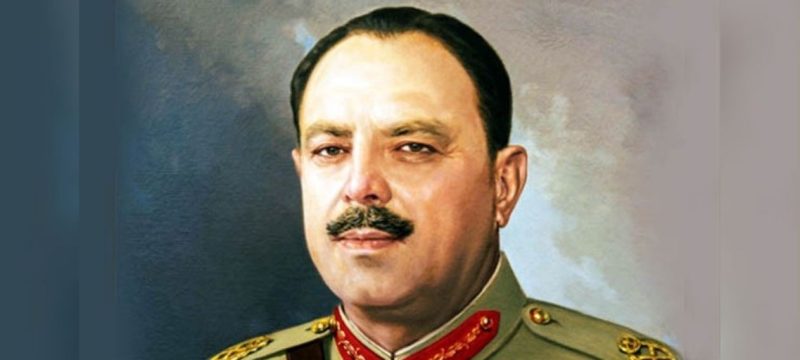
In October of 1954, Pakistan’s 1st native Commander-In-Chief, General Muhammad Ayub Khan, circulated a top-secret document titled ‘A Short Appreciation Of Present And Future Problems Of Pakistan’, in which he reasoned that the ultimate purpose of Pakistan must be to become a unified nation, and that this could only be achieved if such a Constitution was evolved that would suit the genius of the people.
He acknowledged that Pakistan consisted of a variety of ethnicities and that the Pakistani population was diverse. He appraised that East Pakistan should be given as much partnership as possible, that West Pakistan should be amalgamated into One Unit, that Provincial Ministries and Legislatures should be abolished, and that the Provinces should have maximum partnership as possible and that the Centre should deal only with inter-provincial affairs.
In October of 1958, President Iskander Mirza proclaimed Martial Law. He declared that although the Constitution that had been promulgated in March of 1956 was consecrated, it was also ‘unworkable’, full of ‘dangerous compromises’, and that Pakistan would ‘disintegrate’ without the removal of ‘inherent malaise’. He then appointed General Ayub as Chief Martial Law Administrator (CMLA) until ‘alternative arrangements’ were made.
In a letter written in September of 1959, CMLA Ayub outlined that Pakistan’s political institutions should recognize the people as a source of power and that the people should be assured reasonable freedoms. He argued that Islam was the ideological foundation of Pakistan, and that it, as an ideology, should be articulated to elaborate the relationship between the State and Nation and to state the fundamental rights of the individual.
In February of 1960, President Ayub appointed a Constitution Commission to draft a new Constitution and appointed Justice Muhammad Shahabuddin as its chairman. In a brief prepared on behalf of the Government for the Commission by Foreign Minister Manzur Qadir, he reasoned that Pakistan should have a unitary form of Government, a strong central Government, and a Presidential system, as the President wanted.
In April of 1961, the Constitution Commission presented its report. It used questionnaires as its method of inquiry; it had printed approximately 20,000 questionnaires and received approximately 6,000 replies. The Commission unanimously emphasized the representative form of Government and the unsuitability of Basic Democracies (which had already been promulgated by President Ayub in October of 1959, in The Basic Democracies Order) as an electorate. In March of 1962, he promulgated Pakistan’s 2nd Constitution.
The Constitutional Commission had been asked to submit proposals for the Constitution, taking into consideration the ‘genius of the people’, but President Ayub had already come to the conclusion that the people were ‘politically immature’ and had to be ‘saved against themselves’. The Ayub that had outlined in the winter of 1962 that the people be recognized as the source of power by Pakistan’s political institutions himself viewed the people, to whom he was answerable, as uneducated and inexperienced, and yet, as per Altaf Gauhar, Ayub’s Information Minister, he was simultaneously aware of the hardships of the masses.
And yet, a majority of the West Pakistanis that Ayub consulted had little belief in the democratic process, and he did not receive one letter from a commoner in East Pakistan about the future constitution, which showed how out-of-touch he was with them and how polarizing any future Constitution to them would be. The 3 Ministers in Ayub’s cabinet, that being the Law, Industries, and Commerce Minister, who expressed that the Commission was an exercise to establish a highly-centralized system of Government, were dropped after its promulgation.
Public reaction to the Constitution of 1962 was popularly seen as an intricate plan to perpetuate one-man rule. In his autobiography, ‘Friends Not Masters’, President Ayub wrote that the people must always be carried along, and that a first-class idea is only useful if it is put into practice, and that it is the people alone who can implement said ideas, for which they must be convinced of its validity, without which it is defeated.
In 1968 to 1969, a mass uprising forced President Ayub to resign. As per the provisions of the Constitution he himself had promulgated, he did not hand over power to the Speaker of the National Assembly, but encouraged Commander-In-Chief Agha Muhammad Yahya Khan to declare Martial Law. CMLA Yahya abrogated the Constitution of 1962, abolished Basic Democracies (which had been revitalized in 1964 despite the appeal made by the Commission), and also abolished One Unit.
President-Marshal Muhammad Ayub Khan died in 1974. With his resignation in 1969, he was forced to acknowledge the death not of a Constitution that he had merely happened to promulgate, but a rebuttal of his entire political thought. The so-called uneducated and inexperienced people had ironically verified Ayub’s idea that they were indeed the source of power, and that they wanted a Pakistan for all Pakistanis, as was articulated by the Constitution Of 1973, in the form of a Federal, Parliamentary, and Decentralized Pakistan.
(Friends Not Masters, by Muhmmad Ayub Khan)
(Pakistan’s First Military Ruler, by Altaf Gauhar)
(The Altaf Gauhar Papers, Documents Towards The Making Of The Constitution of 1962, by Altaf Gauhar)