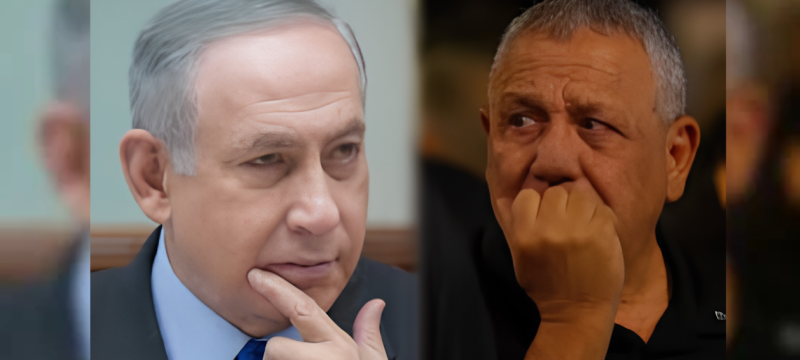
JERUSALEM: Israeli caretaker Prime Minister Benjamin Netanyahu has renewed his proposal for a national unity government with political rival Gadi Eisenkot.
However, Eisenkot rejected the proposal, accusing the outgoing prime minister of using political tactics to influence ongoing government formation talks.
The disagreement comes as Eisenkot continues negotiations to establish a new government following Israel’s recent elections.
Eisenkot was selected on Sunday to form a government after securing an opportunity to build parliamentary support.
Netanyahu Calls for National Unity Government
In a video statement on Saturday, Netanyahu said his recent meeting with Eisenkot strengthened his support for a unity government.
The two political leaders met on Thursday to discuss the possibility of cooperation.
The caretaker prime minister argued that political unity was necessary to protect Israel’s national security.
He also claimed that a united government could address security challenges involving Iran.
According to his proposal, the government would include political parties recognizing Israel as a Jewish state.
The outgoing leader warned against Eisenkot’s plan to establish a minority administration.
He argued that such an arrangement could create political uncertainty during a sensitive period.
Eisenkot Accuses Netanyahu of Political Tricks
Eisenkot responded shortly after the caretaker prime minister released his statement.
The former Israeli military chief accused his political opponent of refusing to accept the election results.
He also questioned the sincerity of the proposed unity government.
Eisenkot said negotiations were already underway when the caretaker prime minister publicly demanded further discussions.
He accused the outgoing leader of increasing political divisions while presenting himself as a supporter of national unity.
The former army chief maintained that political cooperation must involve genuine commitments rather than public statements.
Israeli Parliament Faces Government Formation Challenge
Israel’s parliament, known as the Knesset, has 120 members.
Eisenkot’s political bloc currently holds 48 seats, while the opposing bloc controls 46.
The remaining 26 seats belong to Arab and ultra-Orthodox political parties.
Under Eisenkot’s proposed arrangement, his supporters could approve a minority government if other lawmakers abstain.
This approach would allow the government to receive more votes in favour than against without securing 61 supporting votes.
Eisenkot has been given 28 days to establish a government.
An additional 14-day extension may also be granted if negotiations require more time.
However, political disagreements could make forming a stable coalition difficult.
Eisenkot Demands Separation From Far-Right Groups
Another major disagreement concerns the participation of far-right political figures in a future government.
Eisenkot has called for political parties to distance themselves from extremist elements.
He specifically raised concerns about supporters of far-right minister Itamar Ben Gvir.
The former military chief said such separation would be necessary for participation in a government under his leadership.
Meanwhile, Netanyahu has proposed a coalition involving Jewish political parties from the centre and right.
His proposal would exclude Arab political parties.
Eisenkot has criticized the outgoing prime minister’s campaign against Arab parties, describing it as discriminatory.
Despite these disagreements, Eisenkot has indicated openness to cooperation with members of Likud and Religious Zionism.
However, he said any partnership must demonstrate a genuine commitment to political unity.
Knesset Speaker Election Adds to Political Tensions
The upcoming election for the Knesset speaker has become another important issue in coalition negotiations.
The position is currently held by Amir Ohana, a close political ally of the caretaker prime minister.
Opposition parties have nominated Matan Kahana, a former Israeli military officer, as his replacement.
Kahana holds the fifth position on Eisenkot’s electoral list.
The speaker election is scheduled for Tuesday.
Eisenkot has urged Likud and its allies to support Kahana’s appointment if they genuinely seek political cooperation.
He argued that allowing the parliamentary process to proceed would demonstrate their commitment to democratic institutions.
The dispute over the speaker position could further influence negotiations between rival political groups.
For now, Netanyahu and Eisenkot remain divided over the structure and leadership of Israel’s next government.
In other news read more about Who Is Gadi Eisenkot? Could Arab Parties Help Him Replace Netanyahu?
The coming weeks will determine whether Eisenkot can secure enough parliamentary support to form a new administration.