Twenty-one years have passed since the devastating Earthquake struck Pakistan on October 8, 2005. The disaster remains one of the country’s most painful memories.
The magnitude 7.6 Earthquake struck at around 8:50 am near Muzaffarabad. The powerful tremors affected Azad Jammu and Kashmir and parts of Khyber Pakhtunkhwa.
The disaster also affected Indian-administered Kashmir. Tremors were also felt in Afghanistan, showing the wide reach of the powerful seismic event.
The destruction covered an area of nearly 30,000 square kilometres. Thousands of communities were affected across the mountainous region.
Official estimates placed Pakistan’s death toll between 73,000 and 87,350. Most widely cited figures put the number close to 86,000 or 87,000.
More than 100,000 people were also injured in the disaster. Between 2.8 million and 3.5 million people were left without homes.
Indian-administered Kashmir also reported between 1,300 and 1,360 deaths. The wider regional death toll therefore approached 100,000 in some estimates.
Some of the disaster’s most tragic images came from destroyed schools. Around 19,000 children and teachers were reportedly killed in collapsing school buildings.
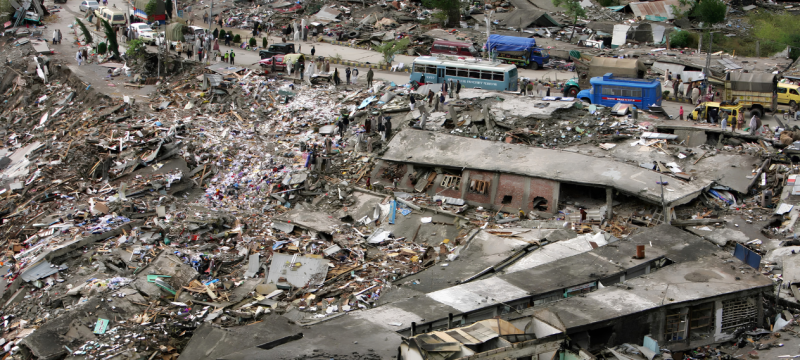
Entire communities were buried under concrete, rocks and earth. Massive landslides also blocked roads and buried settlements.
Destroyed bridges and mountain routes made rescue operations extremely difficult. Thousands of survivors were left waiting for emergency assistance in isolated areas.
Balakot suffered almost complete destruction during the disaster. Muzaffarabad also experienced catastrophic damage across the city.
Around 780,000 buildings were destroyed or severely damaged across affected areas. The damage included homes, schools, hospitals and other public infrastructure.
The first hours after the Earthquake became a desperate struggle for survival. Rescue teams raced against time to reach people trapped under collapsed structures.
The Pakistan Army quickly deployed troops, engineers and medical teams. Aviation units also joined the emergency response.
Military helicopters became crucial lifelines for isolated mountain communities. They evacuated injured people and transported essential relief supplies.
The supplies included food, tents, medicines and other emergency materials. Army engineers also cleared roads blocked by landslides.
Soldiers searched collapsed buildings and established relief camps for survivors. Reports later estimated that 40,000 to 50,000 military personnel were deployed.
The Army Medical Corps played an important role in the emergency response. Engineers and aviation units also supported relief operations across difficult terrain.
However, the rescue effort extended far beyond the military. The disaster triggered a major international humanitarian response.
The United Nations, NATO and several countries sent assistance. Medical teams, helicopters, engineers and emergency supplies reached affected areas.
NATO provided thousands of tonnes of relief supplies and engineering support. Local communities and charities also played a major role.
Civil society groups and NGOs often reached remote areas during the crisis. Their efforts highlighted the importance of community-led disaster response.
The disaster eventually led to one of Pakistan’s largest reconstruction programmes. The government established the Earthquake Reconstruction and Rehabilitation Authority.
The authority was tasked with managing the extensive recovery and rebuilding process. The World Bank and Asian Development Bank estimated needs at around $5.2 billion.
Schools, hospitals, roads and bridges were gradually rebuilt. Communities also began restoring homes and rebuilding their livelihoods.
However, reconstruction could not reverse the human loss. Thousands of families permanently lost loved ones and entire communities.
The disaster also changed Pakistan’s approach to emergency preparedness. It increased calls for stronger building standards and earthquake-resistant construction.
Authorities also placed greater focus on emergency planning and institutional coordination. The experience contributed to stronger national disaster-management structures.
The National Disaster Management Authority later became an important part of this effort. The tragedy also produced temporary humanitarian cooperation between India and Pakistan.
Several crossing points were opened to support relief efforts across the divided region. Various groups also participated in post-disaster assistance.
Today, affected communities continue to remember those who died on October 8. Memorial ceremonies and prayers are held to honour the victims.
The 2005 Earthquake remains more than a historical disaster figure. It represents a lasting national memory of loss, survival and recovery.
Its legacy continues through rebuilt communities and stronger disaster-preparedness efforts. For many families, however, the memories of that morning remain deeply personal.
In other news read more about: 19 Years After the 2005 Earthquake: Incomplete Recovery and Unhealed Wounds